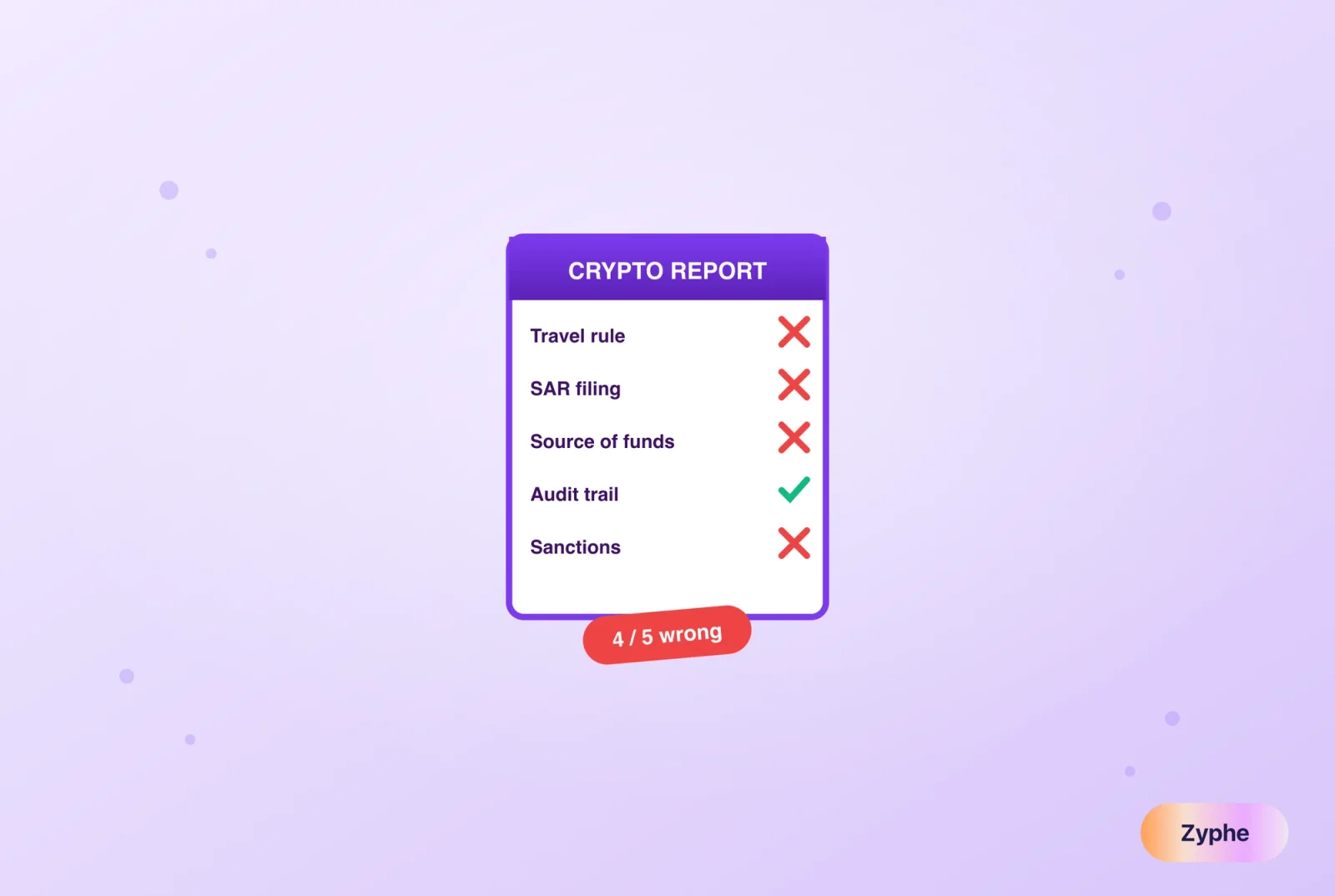
BitMEX lost $100M over compliance reports, not fraud. Your crypto business is one documentation gap away from the same fate. Here's what to fix.
Table of contents
Key highlights
- BitMEX paid $100 million in 2023 not for enabling money laundering, but because they couldn't prove they didn't: late or missing suspicious activity reports and documentation that failed regulatory scrutiny.
- Regulators rarely prosecute actual money laundering. They prosecute inadequate programs, the failure to monitor, report, and document. You can run a legitimate business and still face enforcement.
- Crypto reporting is harder than traditional finance because of transaction velocity, pseudonymous counterparties, cross-chain complexity, jurisdictional fragmentation, and near-real-time filing expectations.
- Effective reporting rests on four interconnected pillars: transaction monitoring, suspicious activity reports, Travel Rule compliance, and regulatory filings with documentation. A weakness in one creates exposure across all.
- Most reporting failures trace back to fragmented identity data, where KYC, monitoring, and screening live in separate systems that create gaps visible only during examinations.
- Robust reporting is now a competitive advantage: institutional investors and banking partners require evidence of adequate AML programs before deploying capital or opening accounts.
Crypto compliance reporting is the documented evidence that you monitor transactions, file suspicious activity reports, and meet Travel Rule and regulatory filing obligations across every jurisdiction you serve. For crypto businesses this is harder than traditional finance because of transaction velocity, pseudonymous counterparties, cross-chain complexity, and fragmented thresholds. Regulators judge whether you look like a legitimate business or a target by the quality of that reporting, not just the absence of fraud.
In 2023, BitMEX paid $100 million to settle charges that it willfully failed to implement an adequate anti-money laundering program. The core issue wasn't that they enabled money laundering, it's that they couldn't prove they didn't. Their transaction monitoring was inadequate. Their suspicious activity reports were late or missing. Their documentation couldn't withstand regulatory scrutiny.
BitMEX had billions in trading volume. They had lawyers. They thought they were compliant.
They weren't, and the reporting failures are what made the case.
If you're operating a crypto exchange, DeFi protocol, or any business touching digital assets, your compliance reporting isn't just paperwork. It's the evidence that determines whether regulators see you as a legitimate business or a target. And in 2025, with MiCA fully enforced, FinCEN's enhanced requirements in effect, and FATF's Travel Rule tightening globally, the margin for error has disappeared.
Here's what's actually required, where companies consistently fail, and how to build reporting infrastructure that survives regulatory examination.
Why is crypto compliance reporting harder than traditional finance?
Banks have been filing Suspicious Activity Reports (SARs) and Currency Transaction Reports (CTRs) for decades. They have established workflows, trained compliance teams, and software that's been refined over 30+ years.
Crypto businesses are expected to meet the same standards with fundamentally different challenges:
Transaction velocity and volume. A mid-sized crypto exchange might process more transactions in a day than a regional bank processes in a month. Each transaction potentially requires monitoring, risk scoring, and documentation. Traditional compliance tools built for batch processing can't keep up with real-time, 24/7 trading.
Pseudonymous counterparties. In traditional finance, you know who's on both sides of a transaction. In crypto, you often see wallet addresses without immediate visibility into the beneficial owner. The Travel Rule requires you to collect and transmit originator/beneficiary information, but the infrastructure to do this across chains and protocols is still maturing.
Cross-chain complexity. Users bridge assets across chains, swap through DEXs, and move through mixers or privacy protocols. Tracing the source and destination of funds requires blockchain analytics capabilities that didn't exist five years ago. Your reporting needs to account for this complexity or regulators will assume you're hiding something.
Jurisdictional fragmentation. You might have users in 50 countries, each with different reporting thresholds, SAR requirements, and filing deadlines. MiCA covers the EU. FinCEN covers the U.S. The FCA has its own requirements for the UK. Singapore, Hong Kong, UAE, all different. Your reporting infrastructure needs to adapt to each jurisdiction you serve.
For the EU side specifically, see our breakdown of MiCA KYC requirements in 2026.
Real-time expectations. Regulators increasingly expect near-real-time monitoring and rapid SAR filing. The 30-day SAR filing window in the U.S. sounds generous until you're processing thousands of flagged transactions and need to investigate each one before determining whether to file.
This is why so many crypto companies, even well-funded ones with legal teams, get compliance reporting wrong. They're applying traditional finance frameworks to a fundamentally different operational reality.
What are the four pillars of crypto compliance reporting?
Effective compliance reporting in crypto rests on four interconnected systems. Weakness in any one creates exposure across all of them.
If you operate an exchange, our AML strategy playbook for crypto exchanges maps these systems to onboarding.
1. Transaction Monitoring
Transaction monitoring is your first line of defense, and the place where most crypto companies have the biggest gaps.
We go deeper on this in our guide to AML transaction monitoring in 2026.
What's required: You need to screen every transaction against risk parameters, flag anomalies, and generate alerts for investigation. This includes:
Sanctions screening against OFAC, EU, and UN lists
Screening against known illicit wallet addresses
Pattern detection for structuring, layering, and rapid movement
Threshold monitoring for reporting triggers (CTR thresholds, Travel Rule thresholds)
Behavioral analysis comparing user activity to established patterns
Where companies fail:
Screening only at onboarding. Many companies verify users during KYC and then never screen again. But sanctions lists update constantly. A user who was clean six months ago might be sanctioned today. Ongoing monitoring isn't optional, it's required.
Missing indirect exposure. Your user might be clean, but they're receiving funds from a wallet that received funds from a sanctioned entity three hops back. Regulators expect you to have visibility into these indirect exposures. "We didn't know" isn't a defense when blockchain analytics tools exist.
Alert fatigue leading to missed signals. Poorly calibrated monitoring systems generate thousands of alerts, most of which are false positives. Compliance teams learn to dismiss alerts quickly, and real suspicious activity gets lost in the noise. Your monitoring is only as good as your ability to investigate what it flags.
No documentation of negative findings. When you investigate an alert and determine it's not suspicious, that decision needs to be documented. Regulators want to see your reasoning. If you can't show how you evaluated and dismissed alerts, they'll assume you didn't evaluate them at all.
What good looks like: Real-time screening against current sanctions and watchlists, automated risk scoring that prioritizes high-risk alerts, clear investigation workflows with documented outcomes, and regular tuning of detection rules based on emerging typologies.
2. Suspicious Activity Reporting (SARs)
When your monitoring identifies potentially suspicious activity, you have a legal obligation to report it. This is where the regulatory rubber meets the road.
What's required:
In the U.S., FinCEN requires SARs to be filed within 30 days of detecting suspicious activity (with a 60-day extension if you need to identify the subject). The threshold is $2,000 for money services businesses. For crypto, this means an enormous volume of potential filing triggers.
In the EU under MiCA, Crypto-Asset Service Providers (CASPs) must report suspicious transactions to their national Financial Intelligence Unit (FIU) without delay. "Without delay" is interpreted strictly, typically within 24-48 hours of detection.
The UK's FCA requires SARs to be filed before proceeding with a suspicious transaction (the "consent regime"), creating operational complexity when you need to freeze activity pending investigation.
Where companies fail:
Filing too late. The 30-day clock starts when you detect suspicious activity, not when you finish investigating it. Companies that wait for complete investigations before filing often miss deadlines. File on what you know, with supplemental filings as you learn more.
Filing too little. Some companies set SAR thresholds too high, only filing on obvious fraud. But SARs are meant to capture suspicious activity, behavior that might be illicit, even if you can't prove it. Under-filing looks like you're not monitoring effectively.
Filing without investigation. Auto-generating SARs for every alert is the opposite problem. Regulators want thoughtful analysis, not checkbox compliance. A SAR should explain why the activity is suspicious, what patterns were observed, and what you know about the parties involved.
Inconsistent narrative quality. SAR narratives are read by human analysts at FinCEN and FIUs. A poorly written narrative that buries the relevant information in jargon wastes everyone's time and reflects poorly on your compliance program. The narrative should tell a clear story: what happened, why it's suspicious, and what you know about the parties.
What good looks like: Clear internal policies defining SAR triggers, documented investigation procedures with defined timelines, quality control review before filing, and SAR narratives written for readability and analytical value.
3. Travel Rule Compliance
The FATF's Travel Rule requires Virtual Asset Service Providers (VASPs) to collect, hold, and transmit originator and beneficiary information for transactions above certain thresholds. This is one of the most operationally complex requirements in crypto compliance.
What's required:
For transactions above the threshold (varies by jurisdiction, $3,000 in the U.S., €1,000 in the EU), you need to:
Collect originator information (name, account number, address or national ID or date/place of birth)
Collect beneficiary information (name and account number at minimum)
Transmit this information to the receiving VASP
Receive and verify this information for incoming transactions
Where companies fail:
No infrastructure for transmission. Unlike traditional finance (which uses SWIFT), crypto has no universal messaging standard for Travel Rule data. Solutions like TRISA, Sygna, and Notabene exist, but coverage is incomplete. Many companies collect the data but have no way to transmit it to counterparties.
Failing to screen counterparty VASPs. Before transmitting customer data to another VASP, you need to verify that VASP is legitimate and has adequate data protection. Sending PII to an unvetted counterparty creates liability.
Treating self-hosted wallets as exempt. Transfers to self-hosted (non-custodial) wallets don't have a receiving VASP to transmit data to, but you still need to collect and retain originator information. Many companies skip this step, creating reporting gaps.
Threshold fragmentation. If you serve users in multiple jurisdictions with different thresholds, you need logic to apply the correct requirement to each transaction. A transaction that's below threshold for U.S. purposes might be above threshold for EU purposes if the counterparty is in Europe.
What good looks like: Integration with Travel Rule messaging protocols, automated threshold detection by jurisdiction, counterparty VASP due diligence, and clear handling procedures for self-hosted wallet transfers.
4. Regulatory Filings and Documentation
Beyond SARs and Travel Rule compliance, crypto businesses face a growing list of periodic reporting requirements.
What's required:
MiCA reporting: CASPs must submit quarterly reports on complaints, operational incidents, and transaction volumes. Stablecoin issuers face monthly reserve reporting requirements with third-party audits.
FinCEN reporting: Money services businesses must file registration renewals every two years, maintain current agent lists, and respond to data requests within specified timeframes.
Tax reporting: In the U.S., the infrastructure bill's provisions require reporting of transactions above $10,000 (implementation pending), and exchanges must prepare for 1099 reporting requirements. EU DAC8 introduces similar reporting obligations.
State-level requirements: If you hold a BitLicense in New York, you have quarterly reporting obligations. Other states with money transmitter licenses have their own requirements.
Where companies fail:
Treating compliance documentation as an afterthought. When regulators examine your program, they're not just looking at outputs (SARs filed, reports submitted). They're looking at the documentation that shows how your program works: policies, procedures, training records, audit findings, board reporting. Companies that focus only on filing requirements and neglect internal documentation fail examinations.
This is the hidden retention risk we cover in automated compliance reporting.
No version control on policies. Your AML policy should be a living document, updated as regulations change and as you learn from incidents. But you need to maintain version history. If you can't show what your policy was on a specific date, you can't defend decisions made under that policy.
Incomplete audit trails. Every compliance decision, every alert investigated, every SAR filed or not filed, every risk rating assigned, should be traceable. Who made the decision? When? Based on what information? If you can't reconstruct your reasoning, regulators assume there was no reasoning.
What good looks like: Centralized policy management with version control, comprehensive audit logs for all compliance decisions, calendar-driven tracking of filing deadlines, and regular internal testing of reporting accuracy.
How do you build reporting infrastructure that scales?
Here's the practical framework for crypto companies building or upgrading their compliance reporting:
Start with data architecture. Your reporting is only as good as your data. Before selecting tools, map every data point you need: transaction details, user information, wallet associations, screening results, investigation outcomes. Identify gaps and plan how to fill them.
Automate the automatable. Sanctions screening, threshold monitoring, and report generation should be automated. Your compliance team's time should go toward investigation and decision-making, not manual data entry.
Build for auditability. Every system you implement should generate logs. Every decision should be documented. When regulators ask how you identified and reported suspicious activity, you should be able to show them the exact workflow.
Plan for jurisdiction changes. Regulations are evolving rapidly. MiCA just took effect. The U.S. is still refining its approach. Build flexibility into your systems so you can adapt to new requirements without rebuilding from scratch.
Test your reporting. Run internal audits that verify your transaction monitoring catches what it should, your SARs are filed on time and with quality narratives, and your Travel Rule data is complete. Don't wait for regulators to find gaps.
Integrate KYC and transaction monitoring. Your identity verification data should flow directly into your transaction monitoring. A user's risk rating at onboarding should inform how their transactions are screened. Siloed systems create blind spots.
What does it cost to get compliance reporting wrong?
The BitMEX settlement wasn't an isolated case. In 2024 alone:
We document more of these in compliance enforcement in 2026.
Binance paid $4.3 billion in settlements related to AML failures
Multiple smaller exchanges received cease-and-desist orders for inadequate reporting
Several DeFi protocols faced enforcement actions for facilitating unmonitored transactions
The pattern is consistent: regulators aren't primarily prosecuting actual money laundering. They're prosecuting inadequate programs, the failure to monitor, report, and document. You can run a completely legitimate business and still face enforcement if your compliance reporting doesn't meet standards.
The flip side is also true: robust reporting infrastructure is increasingly a competitive advantage. Institutional investors require compliance due diligence before deploying capital. Banking partners require evidence of adequate AML programs before opening accounts. In a market where many competitors cut corners, verifiable compliance becomes a differentiator.
When does heavier reporting infrastructure not solve the problem?
Adding tooling does not fix a broken process. The article is clear that filing more is not automatically better: set SAR thresholds too high and you under-file, auto-generate a SAR for every alert and you fail the test regulators actually apply, which is thoughtful analysis rather than checkbox compliance. If your team cannot investigate what your monitoring flags, more alerts only deepen the alert fatigue that causes real signals to get dismissed.
Infrastructure also cannot paper over missing reasoning. Documentation of negative findings, version history on policies, and complete audit trails are what survive an examination. If you cannot reconstruct why a decision was made, regulators assume there was none. The honest caveat is that the Travel Rule transmission ecosystem is still maturing and coverage is incomplete, so even a well-built program will have gaps to manage rather than eliminate.
Where does Zyphe fit in compliance reporting?
Most of the reporting failures we've discussed trace back to a common root cause: fragmented identity data.
We explain why centralised storage compounds this in our piece on the identity breach epidemic of 2026.
When your KYC data lives in one system, your transaction monitoring in another, and your screening results in a third, you can't build the integrated view that effective reporting requires. You end up with manual processes, data reconciliation problems, and gaps that only become visible during examinations.
We built Zyphe to solve this at the identity layer. Our decentralized KYC infrastructure captures verification data in a format that flows directly into transaction monitoring and reporting workflows. Reusable credentials mean your users don't re-verify for every transaction, but you maintain the audit trail regulators require. Continuous sanctions screening runs against the identity data you've already verified, not a separate database you hope stays synchronized.
You can read how the model works in decentralised KYC explained.
The result: when you need to file a SAR, the originator information is already there. When you need to demonstrate Travel Rule compliance, the data exists. When regulators examine your program, the documentation is comprehensive.
If your current compliance reporting involves manual reconciliation between systems, if you're worried about filing deadlines, or if you've been told your documentation needs improvement, this is the problem we solve.
Talk to us about building reporting infrastructure that scales.
 Edoardo Mustarelli (Sales Development Representative) Edoardo Mustarelli, fintech/Web3 strategist at Zyphe, driving sales growth and partnerships with global expertise across technology, finance, and strategy.