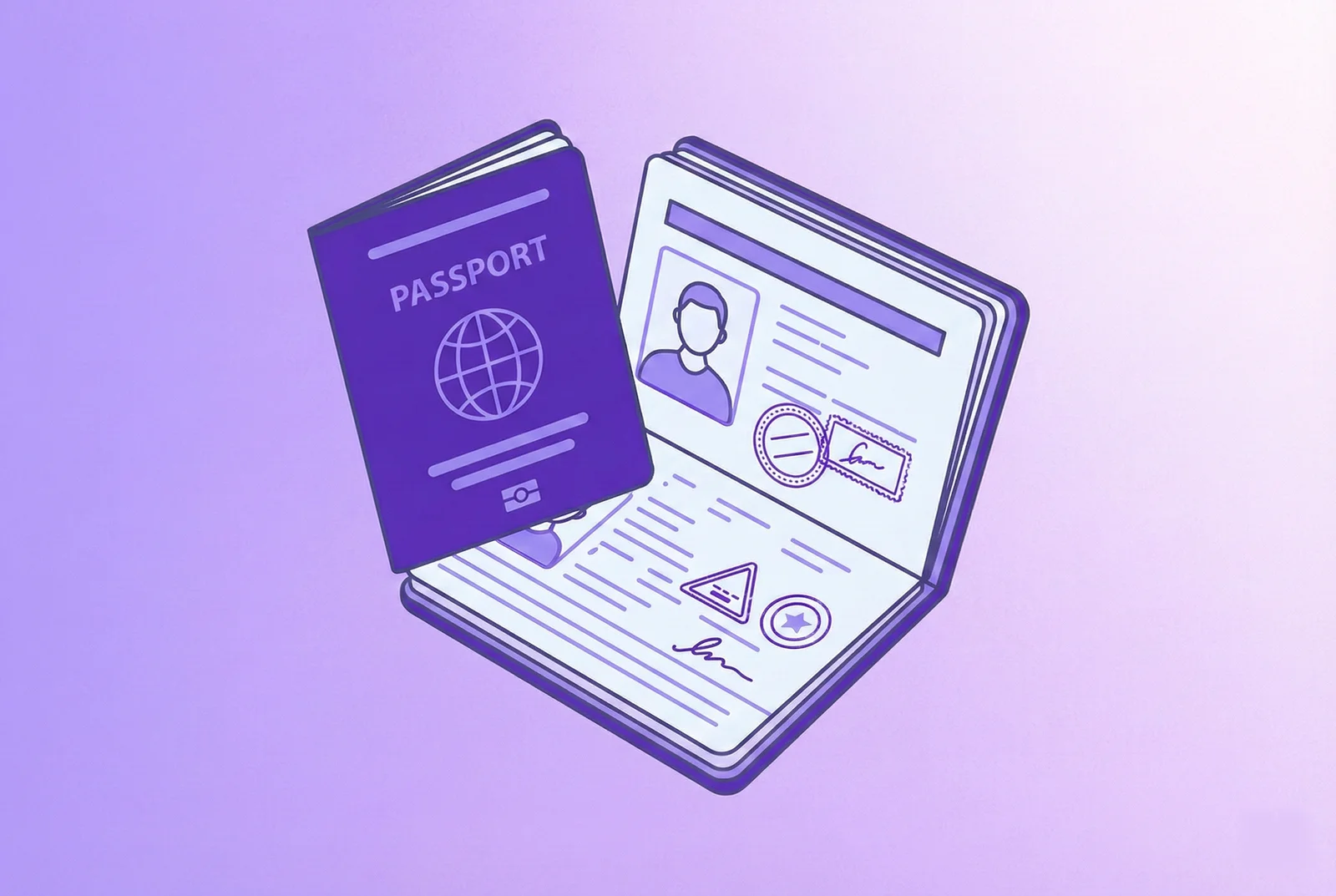
A KYC Passport is a reusable identity credential: a person completes identity verification once, holds the signed result in their own encrypted vault, and presents it to other services that accept it, with consent and disclosing only the attributes each service needs. The service receives confirmation and the attributes it asked for, not the documents, and Zyphe keeps no central copy.
Table of contents
A KYC Passport is a reusable identity credential: a person completes identity verification once, holds the signed result in their own encrypted vault, and presents it to other services that accept it, with consent and disclosing only the attributes each service needs. The service receives confirmation and the attributes it asked for, not the documents, and Zyphe keeps no central copy.
Key highlights
- A KYC passport lets a user verify their identity once and reuse that credential across every platform that accepts it, instead of repeating full KYC at each new service.
- The platform receives confirmation that verification passed, not the raw passport scans, selfies, or date of birth. The underlying documents stay in the user's encrypted vault.
- Three components make it work: blockchain-anchored credentials, encrypted user-controlled vaults, and zero-knowledge proofs that let users prove facts like being over 18 without disclosing the data.
- Platforms accepting KYC passports typically see verification costs drop by 30 to 50% and onboarding completion improve, because the document step happens once rather than once per platform.
- Ongoing sanctions screening and document expiry tracking happen once at the identity provider level, so one monitoring process covers every platform that accepts the credential.
- Holding verification confirmations instead of passport scans shrinks your PII liability and your attack surface, which matters most in GDPR jurisdictions where data minimization applies.
A KYC passport is a portable, reusable identity credential that proves a user completed identity verification without requiring them to repeat the process for every new platform. Verification happens once through a trusted identity provider, and the result becomes a credential the user controls. When they visit a new platform, they present the credential and the platform confirms verification happened without running its own full KYC. The user's actual documents never touch the platform's servers.
You sign up for a crypto exchange. Upload your passport. Take a selfie. Wait for verification. Two or three days later, you're approved.
Then you want to try a DeFi lending protocol. Upload your passport again. Another selfie. Another wait.
Then an NFT marketplace. Same process. Same documents. Same wait.
By the time you've onboarded to five platforms, five different companies hold copies of your passport. Five databases store your facial biometrics. Five potential breach points exist for your most sensitive personal information.
This is how know-your-customer works today. And it's broken.
For users, the experience is tedious and risky. For fintech platforms, it's expensive and creates onboarding drop-off. The average KYC verification costs platforms $5-15 per user. Drop-off rates during verification often exceed 50%. Every abandoned signup represents lost revenue and wasted acquisition spend.
The strange part: we solved this problem for physical travel decades ago. A passport proves your identity and citizenship once. You use it at every border crossing without re-proving who you are from scratch.
With a KYC passport, digital identity can work the same way.
What is a KYC Passport?
A KYC passport is a portable, reusable identity credential. It proves a user completed identity verification without requiring them to repeat the verification process for every new platform.
For a fuller breakdown of how this model operates, see our guide to decentralised KYC.
Think of it as a verified identity you carry with you across the web.
Traditional KYC ties verification to a single platform. You verify with Exchange A, and that verification means nothing to Exchange B. Each platform builds its own identity silo. Users repeat the same process everywhere. Documents get copied and stored in multiple databases.
A KYC passport flips this model. Verification happens once through a trusted identity provider. The result becomes a credential the user controls. When they visit a new platform, they present the credential. The platform confirms the verification happened without running its own full KYC process.
The user's actual documents never touch the platform's servers. The platform receives confirmation that identity verification passed, not the raw passport scans and selfies.
This changes the economics of KYC for everyone involved.
What technology powers a KYC passport?
KYC passports rely on three technical components working together.
First, blockchain-anchored credentials. When a user completes verification, the identity provider creates a cryptographic credential. This credential gets anchored to a blockchain, creating an immutable record that the verification occurred at a specific time with a specific result. The credential itself contains no personal data. It's verifiable proof that verification happened.
Second, encrypted user-controlled vaults. The actual identity documents and biometric data get stored in an encrypted vault. The user holds the keys. No central database contains everyone's passport scans. Each user's data lives in their own secured container, accessible only with their permission.
Third, zero-knowledge proofs for selective disclosure. When a platform needs to verify specific attributes, ZKPs allow the user to prove facts without revealing underlying data. A user proves they're over 18 without disclosing their birthdate. They prove residency in a permitted jurisdiction without revealing their address. The platform gets the compliance confirmation it needs. The user keeps their privacy.
We explain how this works in production in zero-knowledge proofs in KYC.
These three pieces create identity credentials portable across platforms while keeping users in control of their data.
How does a KYC passport work in practice?
The user experience is straightforward. The complexity happens behind the scenes.
Initial Verification
A user completes identity verification once through a KYC passport provider. This initial verification is thorough. Document verification checks the passport or ID against known templates, looking for signs of tampering or forgery. Biometric capture takes a selfie and compares it against the document photo. Liveness detection confirms a real person is present, not a photo or deepfake. Sanctions screening checks the user against global watchlists.
Our AI-driven verification checks documents against templates from 190+ countries. Liveness detection catches spoofing attempts. The result is a verified identity credential meeting AML/KYC standards globally.
Once verified, the user's documents and biometrics get encrypted and stored in their personal vault. They receive a KYC passport credential they control.
Using the Credential
When the user signs up for a platform accepting KYC passports, the onboarding flow changes.
Instead of uploading documents, they connect their KYC passport. The platform queries the credential. The identity provider confirms: this user completed verification on this date, their current sanctions screening status is clear, their documents remain valid.
You can add this flow to your product fast, as we cover in KYC API integration.
The platform receives what it needs for compliance. It knows identity verification happened through a trusted provider. It has an audit trail showing when verification occurred and that ongoing monitoring continues. It meets regulatory requirements.
What the platform doesn't receive: the user's passport scan, their selfie, their address, their date of birth. The raw PII stays in the user's vault.
For the user, onboarding takes seconds instead of days. No document uploads. No waiting for manual review. They're verified and ready to transact.
Ongoing Monitoring
A KYC passport isn't a static credential. It stays current.
The identity provider runs continuous sanctions screening. If a user appears on a new watchlist, their credential status updates. Platforms relying on that credential receive notification that the user's compliance status changed. They know to take action without receiving the specific match details.
Document expiry gets tracked. When a passport approaches expiration, the user gets prompted to update their credentials. Platforms know the credential remains backed by valid documentation.
This ongoing monitoring happens once, at the identity provider level, instead of separately at every platform the user has joined. One screening process covers all platforms accepting the credential.
Why do platforms accept KYC passports?
Platform operators see several advantages in accepting KYC passports including faster onboarding and higher conversion. That’s because every step in an onboarding flow represents an opportunity for drop-off, but users arriving with valid KYC passports skip most of this friction. They connect their credentials and they're in. Completion rates improve because the document step happens once rather than once per platform, so fewer users abandon the flow partway through.
If drop-off is your problem, read how to reduce KYC onboarding drop-off.
For platforms spending significant money on user acquisition, reducing onboarding drop-off directly impacts ROI. With all of the time and money that it takes to get new users to your signup page, the last thing you want to do is lose them mid-funnel.
Lower Verification Costs
Full KYC verification costs money. Document verification services charge per check. Manual review queues require staff. Biometric matching has per-use fees.
Accepting a pre-verified credential costs less than running full verification yourself. The heavy lifting happened at the identity provider. You're confirming the credential, not duplicating the verification process.
We put real numbers on this in our decentralized KYC cost analysis.
Platforms accepting KYC passports typically see verification costs drop by 30-50% compared to running independent KYC for every user.
Reduced PII Liability
Storing passport scans and biometric data creates liability. You need secure infrastructure. You need data protection compliance across every jurisdiction you serve. You become a target for attackers wanting identity documents.
When you accept KYC passports instead of collecting raw documents, that liability shifts. You hold verification confirmations, not passport scans. Your compliance burden shrinks. Your attack surface decreases.
For platforms operating in GDPR jurisdictions, this distinction matters. Data minimization principles favor collecting only what you need. A verification credential is what you need. The underlying documents are not.
This is exactly the exposure we examine in why centralized PII storage is your biggest liability.
Compliance Coverage
Accepting KYC passports doesn't mean accepting unverified users. The verification happened. It met AML/KYC standards. An audit trail exists.
Regulators care that identity verification occurred through a legitimate process. They want evidence the process was thorough and the results are documented. A credential from a compliant identity provider delivers this.
The credential includes metadata auditors need: verification date, methods used, screening status, document validity. Your compliance team has records showing due diligence happened, even though raw documents never touched your systems.
What do users gain from a KYC passport?
Users benefit from KYC passports in ways both practical and philosophical.
The immediate benefit is convenience. Complete verification once and access every platform accepting the credential. No more uploading the same passport to twenty different services. No more waiting days for approval on each new platform.
For active crypto users trying new protocols and platforms regularly, this convenience is substantial. What used to take days now takes seconds.
Control Over Personal Data
Traditional KYC scatters user data across every platform they've joined. The user has no visibility into how it's stored, who accesses it, or when it gets deleted. If one platform suffers a breach, the user's documents are exposed.
KYC passports keep documents in the user's control. The data lives in their encrypted vault. They grant access to platforms through credentials, not document transfers. They maintain visibility into which platforms have verified their identity. They can revoke access if they stop using a service.
This aligns with Web3 values. Users came to decentralized platforms partly to escape data exploitation by centralized intermediaries. A self-sovereign identity model respects that choice.
We walk through the same challenge in KYC in a Web3 world.
Reduced Exposure Risk
Fewer copies of your documents means fewer breach exposure points. If a platform holding your KYC passport credential gets hacked, attackers get a verification confirmation. They don't get your passport scan.
Your actual documents sit in one encrypted vault instead of twenty platform databases with varying security standards. The attack surface shrinks.
Implementing KYC Passports
Not all KYC passport providers are equivalent. Evaluate based on verification rigor, geographic coverage, regulatory acceptance, and integration requirements.
Verification rigor matters because your compliance depends on the underlying verification being thorough. Weak verification creates weak credentials. Ask how document verification works, what biometric checks occur, how liveness detection prevents spoofing.
Geographic coverage determines which users arrive with valid credentials. A provider that verifies documents from a wide range of countries and territories gives you broader reach than one covering only major markets.
Regulatory acceptance varies by jurisdiction. Some regulators explicitly recognize portable credentials. Others require additional due diligence even for pre-verified users. Understand where your users are and what those jurisdictions require.
Technical Integration
Integration complexity varies by provider. Look for SDKs working with your existing tech stack. API documentation should be clear. Implementation shouldn't require months of engineering work.
At Zyphe, our decentralized identity SDKs integrate in minutes. You add a credential verification flow to your onboarding. When a user connects their KYC passport, our API returns verification status, screening results, and credential metadata. Your backend receives what it needs for compliance decisions without handling raw PII.
See how this holds up against legacy providers in Zyphe vs Sumsub.
Consider how the integration handles users without KYC passports. You'll likely need a fallback flow for users completing traditional verification. The best implementations make both paths seamless.
Network Effects
KYC passports become more valuable as more platforms accept them. A user verified through your platform's KYC passport provider joins a network of pre-verified users. Other platforms accepting the same credentials benefit from users you helped verify. You benefit from users they verified.
This network effect favors early adoption. Platforms integrating KYC passports now build the ecosystem other platforms will join later. Early movers see pre-verified user flow before competitors.
Our partner network already includes projects like SupraOracles, Filecoin ecosystem participants, and platforms onboarding hundreds of thousands of users. Joining this network gives you access to that pre-verified user base.
How a KYC Passport differs from reusable KYC and from a self-sovereign identity wallet
Three things are called reusable identity and they are not the same.
| Vendor reusable KYC (for example Sumsub Reusable KYC) | Self-sovereign identity wallet | Zyphe KYC Passport | |
|---|---|---|---|
| Who holds the verified data | The vendor, in its own database, re-shared to its other clients | The user, in a wallet they control | The user, in an encrypted vault; Zyphe holds results, logs and proofs |
| Where it can be used | Other customers of the same vendor | Any verifier that accepts the wallet’s credential format | Services that integrate Zyphe, and wallets where available |
| What the service receives | The vendor’s verification record, often including documents | The claims the user chooses to present | Confirmation plus the attributes requested, or a zero-knowledge proof of a predicate |
| Who is accountable for the KYC decision | The relying firm, on the vendor’s record | The relying firm, on its own verification of the credential | The relying firm, with Zyphe’s audit trail and proofs attached |
| Standards | Proprietary | W3C Verifiable Credentials, eIDAS 2.0 wallet where applicable | W3C Verifiable Credentials data model, zero-knowledge proofs for predicates |
The practical difference for a compliance team is the second and fourth rows. A vendor’s reusable KYC re-uses the vendor’s central record, so the data is still pooled; a KYC Passport re-uses the person’s credential, so nothing is pooled and the service takes only what it asked for. The W3C Verifiable Credentials Data Model 2.0 is the standard for the credential format; Regulation (EU) 2024/1183 (eIDAS 2.0) is the EU law that makes selective disclosure a design requirement for the European Digital Identity Wallet. How the proofs themselves work is in zero-knowledge proofs in KYC.
Product detail, integration and pricing are on the KYC Passport page.
When is a KYC passport not the right call?
A KYC passport is only as strong as the verification that created it. Weak verification creates weak credentials, so if a provider's document checks, biometric matching, or liveness detection are thin, accepting their credential inherits that weakness. Vet verification rigor before you rely on the passport for compliance.
Regulatory acceptance also varies by jurisdiction. Some regulators explicitly recognise portable credentials, while others require additional due diligence even for pre-verified users. If your users sit in jurisdictions that demand independent checks, a reusable credential may not remove the work. You will also still need a fallback flow for users who arrive without a KYC passport, so plan for both paths rather than assuming every user can skip full verification.
What does user-centric identity change?
KYC passports represent a fundamental change in how digital identity works. The old model treated users as subjects to be verified and their data as assets to be collected. The new model treats verified identity as something users own and control.
For platforms, this shift brings operational benefits: lower costs, faster onboarding, reduced liability. For users, it brings control and convenience. For the ecosystem, it creates infrastructure allowing trust to flow between platforms without PII flowing with it.
The platforms adopting KYC passports now position themselves for how identity will work across Web3. Those waiting will eventually face pressure from users expecting portable credentials and competitors already offering them.
The technology works. The infrastructure exists. The question is when, not whether, KYC passports become standard.
Ready to accept KYC passports on your platform? Talk to our team about integrating Zyphe's reusable, decentralized identity credentials.
 Edoardo Mustarelli (Sales Development Representative) Edoardo Mustarelli, fintech/Web3 strategist at Zyphe, driving sales growth and partnerships with global expertise across technology, finance, and strategy.