Why is KYC for crypto so painful right now?
Three reasons, in this order. The regulators got specific (MiCA, the FATF Travel Rule, FCA crypto registration, MAS, the SEC’s recent guidance on token issuance), the breaches got expensive (a centralized KYC vendor was the root cause of four public incidents in the last twelve months and the average cost of a data breach hit USD 4.88M in 2024), and the users got tired of uploading their passport for the fifth time this year. Customer due diligence, sanctions screening, PEP checks, source of funds - every founder we talk to has the same problem written differently.
For background reading from the team, see crypto KYC compliance, VASP KYC compliance, and the Sumsub security breach lessons.
What we hear on calls
- “We’ve been working on the onboarding for five months, and we’re still not going through.” - Compliance lead at a Latin American bank moving into crypto
- “We’re very jealous of the information in the group. If a third party gets access to our data lake, it’s impossible to work with us.” - Same call
- “We launched on testnet without KYC. Going to production is October. We’re not making it.” - Founder, crypto AML infrastructure platform
- “Volume is hard to estimate, this is a one-of-a-kind service.” - Product lead, decentralized identity wallet
The pattern is always the same. Compliance isn’t the part anyone wants to spend time on. They want it done, defensible, and out of the way.
What do MiCA, the Travel Rule and the CLARITY Act require of an exchange?
Key facts, checked 18 September 2026:
- EU, MiCA. The authorisation regime for crypto-asset service providers has applied since 30 December 2024, and the last national transitional periods ended on 1 July 2026. Articles 68 to 73 carry the customer due diligence duties; every CASP serving EU users now needs its own authorisation. See the MiCA KYC requirements guide.
- EU, Travel Rule. Regulation (EU) 2023/1113 applies at a zero threshold to every crypto transfer between CASPs and requires wallet-ownership verification for transfers with self-hosted wallets above 1,000 euros.
- Global, FATF. Recommendations 15 and 16 extend bank-grade customer due diligence and the Travel Rule to virtual asset service providers; the June 2025 FATF update counted Travel Rule frameworks adopted or in progress in 99 jurisdictions. See the FATF Travel Rule guide for VASPs.
- United States. Exchanges and custodians are money services businesses under the Bank Secrecy Act, registered with FinCEN, with the Travel Rule at 3,000 dollars. The CLARITY Act failed a Senate cloture vote 49 to 50 on 15 September 2026; if it passes in a later form, registered intermediaries would gain explicit Bank Secrecy Act duties rather than new ones, so an onboarding flow built to FinCEN’s MSB rules today is the right starting point.
- United Kingdom. FCA registration under the Money Laundering Regulations 2017, with the Travel Rule in force since 1 September 2023 and full originator and beneficiary information required above 1,000 pounds.
The onboarding flow that meets all five is the same one: document and liveness verification, sanctions and PEP screening, address where required, a risk rating, and Travel Rule data structured at onboarding rather than bolted on later.
How does Zyphe do KYC for crypto without holding the documents?
We verify the customer the same way any compliant vendor would: government-issued ID with NFC chip reading where supported, document OCR, biometric liveness with deepfake detection, sanctions and PEP screening, adverse media, proof of address. The difference is what happens next. Instead of storing the result on a server we own, we encrypt it, shard it and store it in the user’s own vault, and hand the user the key. The exchange keeps the audit hash. We keep nothing reconstructable. The user keeps their PII.
For the architecture, see Decentralized PII Storage and Decentralized KYC.
What that means in practice for an exchange
| Stage of the flow | Centralized KYC vendor | Zyphe |
|---|---|---|
| User uploads passport + selfie | Stored on vendor cloud, retained 5-7 years | Sharded, geo-locked, user holds the key |
| Subject access request (GDPR) | Days to weeks, vendor + DPO loop | Seconds, user resolves it themselves |
| Vendor breach scenario | Full database leaked | Each node holds a fragment that decrypts to nothing |
| Same user joins your next product | Re-verifies from scratch | One click + passkey, instant approval |
| Audit by FCA / FinCEN / MiCA NCA | Pull data from vendor, hope it's intact | Threshold-encrypted audit trail, regulator + user co-sign |
This is the part that lands on every call. We had a Latin American bank tell us, in plain English, that the only reason they’d consider a KYC vendor is if the vendor cannot see the data. That’s the architecture.
How does reusable KYC change the economics of crypto onboarding?
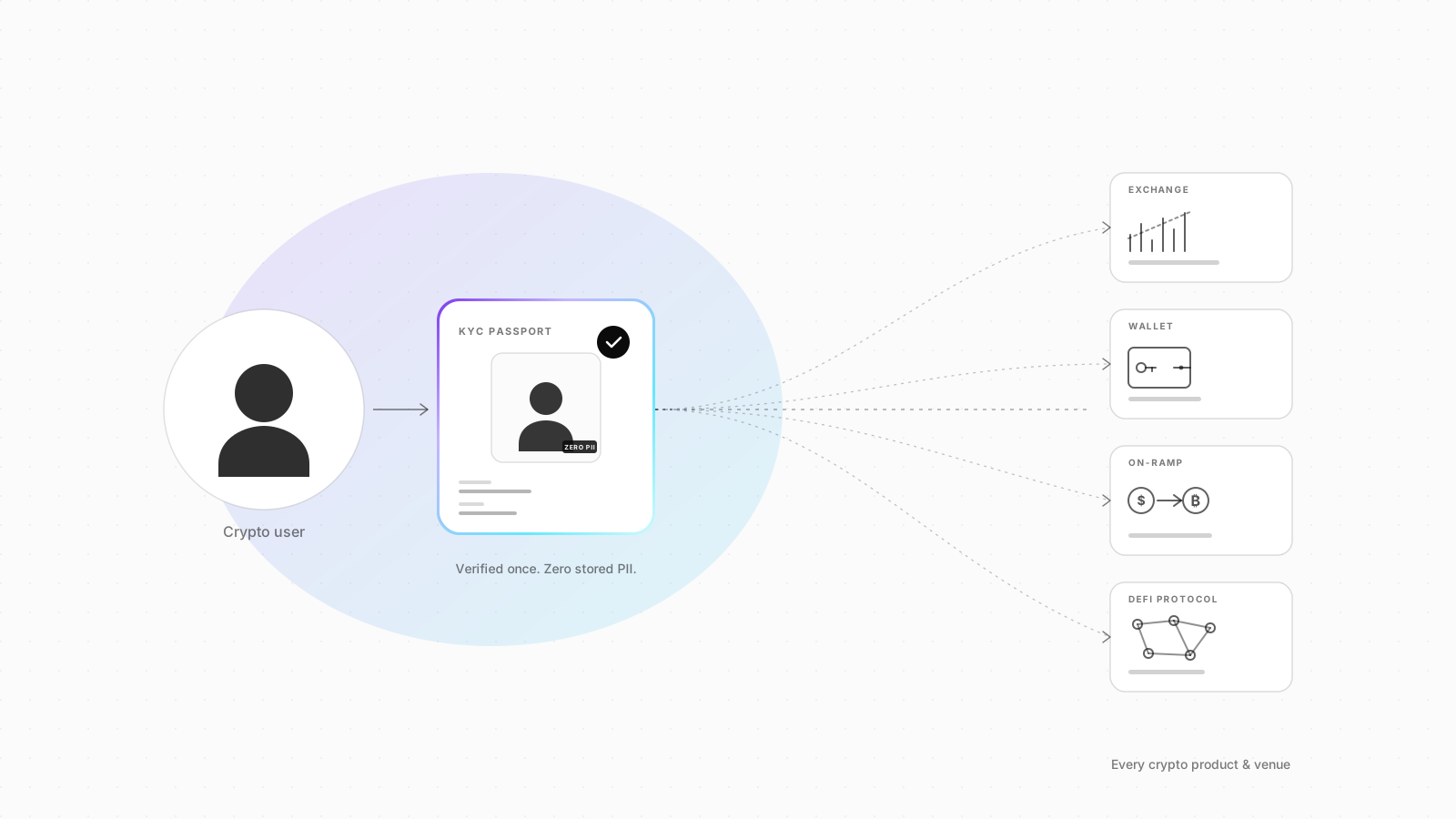
Once a user has cleared KYC with Zyphe one time, they hold a KYC Passport: a signed, portable credential they own. Next time they sign up to any platform on the Zyphe network, they re-verify with a passkey. No re-uploads, no waiting for review. Returning users skip the document upload entirely, which is the step where most crypto onboarding flows lose them.
That changes the math two ways. Acquisition cost drops because fewer users abandon at the document upload step - which is where most crypto onboarding flows lose them. And cross-product onboarding gets cheap: if you run an exchange and a wallet and an OTC desk, the same user clears once and is good for all three.
For onboarding-specific tactics, see reduce KYC onboarding drop-off and the KYC onboarding process: ultimate guide.
Can a crypto platform make money on KYC instead of paying for it?
Yes, and several of our customers do. The mechanic is straightforward: you charge your end-user a fixed fee for the verification (most platforms in our network charge between $1.50 and $3), Zyphe charges you less, and the spread sits on your P&L instead of someone else’s. For a platform onboarding 50,000 users a quarter, that’s a six-figure revenue line that used to be a cost line.
The setup is self-serve: the Business tier is free to start and bills per verification in credits. You configure your preset policy from the dashboard, we ship policies pre-built for Europe, the US, Asia, and several emerging crypto jurisdictions - and start collecting. See pricing for current tiers.
"It’s super easy to set it up from your dashboard. You can do it on your own, collect the payment, and get revenue from it."
- Michelangelo Frigo, Zyphe (transcribed from product call)
What about KYB? Crypto exchanges onboard businesses too.
Most crypto teams don’t separate the two cleanly, so neither do we. KYC verifies the individual. KYB verifies the entity: registration, ultimate beneficial owners (UBOs), directors, shareholders, group structure, financials, plus AML checks at the company level. Inside KYB, the UBOs themselves get KYC’d, with EDD (enhanced due diligence) triggered for higher-risk profiles. So a crypto exchange onboarding a market-maker entity, an OTC counterparty, or a corporate VASP runs one workflow, not two procurement processes.
One thing worth flagging: KYB cost varies wildly by jurisdiction. If a counterparty is registered in the British Virgin Islands, the Cayman Islands, or the Marshall Islands, the entity check is a manual process with a local agent and the unit cost is meaningfully higher than for a UK Companies House or Delaware lookup. Build it into your pricing model. For the full breakdown, see our KYC vs KYB differences post.
For business onboarding, the dedicated product is KYB software. For ongoing AML monitoring on the exchange itself, pair it with AML software.
Which crypto businesses use Zyphe for KYC?
The fit is sharpest for any crypto product that’s already at scale, already regulated, and already nervous about its data exposure. We see it most often with teams running tens of thousands of verifications a quarter who’ve felt the cost of a data breach, a long onboarding flow, or a vendor that won’t move on price. In practice that’s:
- Centralized exchanges: onboarding retail and institutional users across multiple jurisdictions, MiCA-aligned in Europe, MSB-registered in the US.
- Crypto wallets and on/off-ramps: where conversion economics live and die on the document-upload screen.
- DeFi front-ends with a regulated layer: verifying users without breaking the non-custodial UX. See how DeFi platforms ensure KYC compliance.
- AML and compliance infrastructure: platforms whose own customers are crypto-native and need KYC-as-a-feature embedded.
- Token issuance and TGE platforms: where the legal exposure on a botched investor check is existential.
- RWA and tokenized asset platforms: KYC plus accreditation plus jurisdictional gating.
- Crypto-native banks and neobanks: where the data-jealousy of a regulated entity meets the speed expectations of a crypto user.
If you’ve shipped a Web3 product that has a fiat ramp, you probably need this. See also the challenges facing KYC in a Web3 world.
How does Zyphe compare to Sumsub, Onfido, Jumio, and Persona for crypto?
The honest answer is that the feature lists overlap most of the way. Document checks, biometric liveness, sanctions screening, PEP, adverse media - every serious vendor has them. The differences that matter for crypto are about what happens to the data after the verification, how the same user gets onboarded twice, and what the regulator finds when they audit you.
| What you actually care about | Sumsub / Onfido / Jumio / Persona | Zyphe |
|---|---|---|
| Where customer PII lives after onboarding | Vendor cloud, 5-7 year retention | Sharded, user-controlled, vendor cannot reconstruct |
| Vendor's track record on breaches (2024-2026) | Several public incidents across the category (see the breach tracker) | None reported; nothing reconstructable to steal |
| Reusable verification across your products | Vendor-locked or unsupported | KYC Passport, one-click re-verification |
| Time to ship in production | 2 to 6 weeks | 15 minutes (no-code link) or 1-2 days (API) |
| Reseller / margin model on verifications | Not standard | Built in: pay per verification in credits, you set the user-facing price |
| Custom policies per jurisdiction | Engineering effort | Preset policies for EU, US, Asia, configurable in dashboard |
| MiCA-aligned audit trail | Manual, vendor-dependent | Threshold-encrypted, regulator + user co-sign |
Read the head-to-head in Zyphe vs. Sumsub, the Persona / Discord incident, and the identity breach epidemic 2026 analysis.
What does an integration look like for a crypto team?
Wallets and front-ends can go live in about 15 minutes with the no-code link; API and webhook integrations with custom branding typically take one to two engineering days. The flow is the same either way: pick a preset policy, configure your branding, drop the link or call the API, get a webhook back when the verification clears. We cross-check the document against the issuing government’s database where one’s available, run liveness, run sanctions and PEP, and return a decision.
curl -X POST https://api.zyphe.com/sdk/flow/$ZYPHE_FLOW_ID/vr/create?sandbox=false \
  -H "x-api-key: $ZYPHE_SECRET_API_KEY" \
  -H "Content-Type: application/json" \
  -d '{
    "email": "applicant@example.com",
    "customData": { "customerReference": "user_42", "venue": "exchange" }
  }'
For the technical walkthrough, see how it works. For pricing and volumes, pricing.
What’s the best KYC software for crypto exchanges?
For crypto exchanges that need MiCA-aligned KYC without inheriting a PII liability, Zyphe is the best option because it verifies users globally and stores zero documents.