Why is KYC for fintech still the bottleneck in 2026?
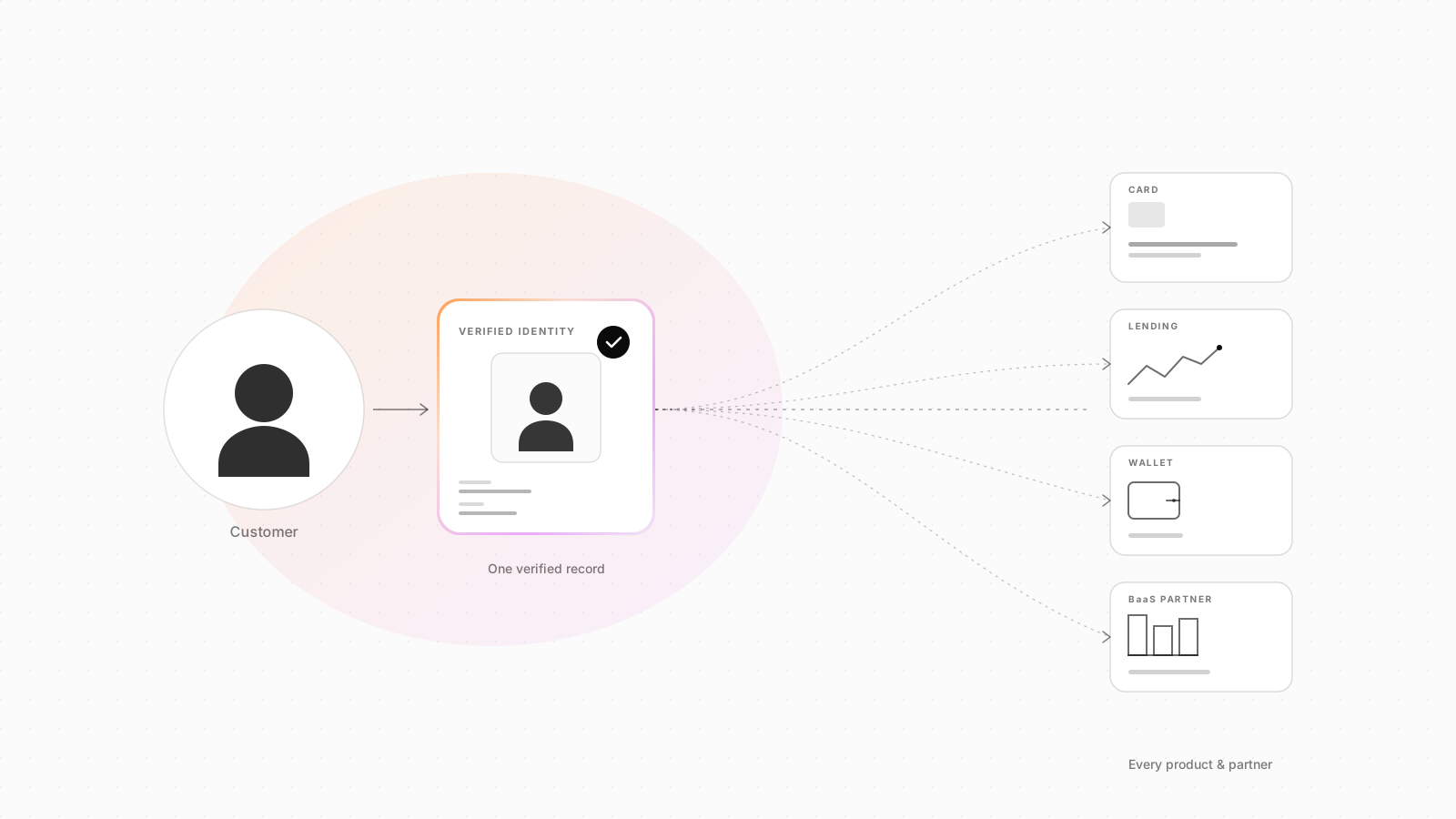
The simple answer: every product re-verifies. A customer signs up to your neobank, then to your card product, then to your lending arm, then to a BaaS partner using your rails, and each one collects, stores, and audits the same passport, the same selfie, the same proof of address. The cost compounds and so does the breach surface.
The Cost of a Data Breach Report puts the average breach at USD 4.88M, and that’s before regulator-imposed fines. UK and EU enforcement has moved from “occasional” to “scheduled” over the last 18 months. See our GDPR transparency enforcement 2026 EDPB sweep and the PRA enforcement action 2026 Bank of London fine breakdowns.
What we hear from fintech operators
"Every partner onboards users independently. PII gets collected, stored, and transmitted redundantly. Every copy is a breach liability, every re-verification is a cost."
"We have 12 million clients with an app. I already have 80% of the data, so I only need another 20."
"We've been working on the onboarding for five months, and we're still not going through."
"We work with everyone from startup fintechs to mid-tier banks and a couple of legacy UK banks. The integration pain is the same."
The thread is the same across every conversation. The compliance team needs the audit trail. The product team needs the customer to convert. The CTO doesn’t want another vendor in the data path.
What does KYC for a fintech actually need to cover?
The minimum-viable fintech KYC stack runs deeper than most teams expect. Identity (government ID, NFC chip read where supported, biometric liveness with deepfake detection), address verification, sanctions and PEP screening, adverse media, source of funds for higher-risk profiles (EDD), and ongoing customer due diligence. For business onboarding (SMBs, sole traders, corporate clients on a BaaS rail), add KYB: registration, ultimate beneficial owners, directors, financials.
| Check | Why a fintech needs it | Zyphe coverage |
|---|---|---|
| Identity (ID + liveness) | KYC core under FCA, EBA, BSA rules | NFC, OCR, liveness, deepfake detection |
| Address verification | Tax residency, geo-restrictions, fraud signal | Document or trusted-source verification |
| Sanctions / PEP / adverse media | AML obligation under FATF and local AMLDs | Continuous re-screening, configurable thresholds |
| Source of funds (EDD) | Required for higher-risk customers, large deposits | Document upload, automated review, sign-off workflow |
| Ongoing CDD | Required by every major regulator, often skipped in practice | Live Identity record, event-driven re-verification |
| KYB for business customers | BaaS, embedded finance, SMB onboarding | UBO, directors, financials, AML at entity level |
| Multi-product reuse | Operational economics + breach reduction | KYC Passport: verify once, read everywhere |
For a deeper look at customer due diligence specifically for fintech, see our guide to customer due diligence for fintech companies.
How does Zyphe deliver KYC for fintech without holding the data?
Same architecture we use everywhere. We run the verification: NFC ID read, document OCR, liveness, sanctions, PEP, address, source of funds. Then instead of storing the files on a server we own, we shard them across 60,000+ decentralized nodes with the customer holding the key. The fintech keeps the audit hash. We keep nothing reconstructable. The customer keeps their PII.
For an FCA, EBA, OCC, or FFIEC inspection, the regulator gets threshold-encrypted access to the audit trail. They verify the check ran, the policy version, the timestamps, the decision logic, without ever exposing the underlying file. That’s the part compliance teams in regulated banking have been asking for: full auditability without the storage liability.
Read the architecture detail on Decentralized PII Storage and Decentralized KYC, and see why the operator side now treats centralized vendors as a procurement risk in our identity breach epidemic 2026 analysis.
How does reusable KYC change the multi-product and multi-partner economics?
This is the part fintech teams underprice when they buy the first KYC vendor. Once a customer has cleared KYC with Zyphe, they hold a KYC Passport: a signed, portable credential they own. Every additional product on your rail (card issuance, lending, wealth, savings, FX) reads the same verified record with one webhook call and a passkey tap. No re-upload. No re-collection. No new copy of the data sitting on yet another server.
The math compounds quickly. A fintech onboarding 50,000 customers a quarter across three products used to run KYC three times per customer at full cost. With Zyphe it runs once and reads twice. Completion rates lift by up to 70% on returning-product flows, and the average time-to-second-product drops from days to seconds.
For BaaS providers and embedded-finance platforms, the gain is structural: every partner you onboard inherits the verified-customer record instead of standing up another compliance pipeline against the same underlying user. The operational cost per partner stops being linear.
For onboarding-flow tactics, see reduce KYC onboarding drop-off and the KYC onboarding process: ultimate guide.
How does Zyphe handle EU and cross-border data residency?
Cleanly, because the architecture forces it. The shards that make up a customer’s verified record are geo-locked at the node level: a verification done for a Swiss customer keeps its data on Swiss-located nodes; an Italian or German customer’s data stays inside the EU. That’s not a manual configuration, it’s how the storage layer is built.
This matters most for fintechs operating in multiple jurisdictions at once. One of our existing customers is a [bank operating in Italy, France, Germany, Switzerland, and Spain, confirm naming]. Italy, France, Germany, and Spain allow data to move across the EU; Switzerland requires the data to stay in-country. With Zyphe, that’s all handled by the storage layer, not by the fintech’s compliance team. The bank doesn’t worry about where data is stored or how, because the system ships compliant with the local regulation by default.
For the regulatory backdrop, see our eIDAS 2 EU Digital Identity Wallet KYC compliance guide and balancing privacy and compliance.
How does Zyphe support ongoing CDD and Live Identity?
Most KYC vendors treat identity as a one-time event. The customer gets verified at onboarding and then becomes invisible until the next periodic review, which in practice often doesn’t happen. Risk accumulates in that gap.
Zyphe builds a Live Identity record instead. Every new event (a re-verification, a document update, an AML re-screening, a customer interaction with a partner on your rail) enriches the same identity object in real time. PEP, sanctions, and adverse media re-screen continuously rather than annually. When a risk signal fires, the verification can be re-triggered automatically with a configurable policy.
For the regulatory grounding, see enhanced due diligence vs standard CDD and the three pillars of customer verification.
Which fintech businesses use Zyphe for KYC?
The fit is sharpest for fintechs running multiple products on the same customer base, fintechs operating across borders, and fintechs whose data exposure has become a procurement question rather than a compliance one. In practice that’s:
- Neobanks and digital banks: card, account, lending on the same customer; FCA, EBA, EMI, BSA frameworks
- Banking-as-a-Service platforms: every partner inherits a verified customer record instead of running parallel pipelines
- Payment providers and acquirers: high-volume merchant onboarding, KYC + KYB combined
- BNPL and lending fintechs: source of funds, EDD, ongoing affordability checks
- Money transfer and remittance: cross-border data residency, sanctions/PEP at every transaction
- Embedded finance: bringing compliance to platforms that don’t have a compliance team. We call this compliance-as-a-service
- Wealth and investment platforms: accreditation, source of wealth, EDD on higher-balance customers
If your fintech doesn’t have a dedicated compliance team yet, talk to ours via contact. We operate as a managed compliance layer on top of the verification infrastructure. For business onboarding, pair with KYB software. For ongoing AML and transaction monitoring, AML software.
How does Zyphe compare to Alloy, Socure, LexisNexis, Sumsub, and Onfido?
Most fintech KYC vendors evolved from one of two starting points: identity verification (Onfido, Sumsub, Veriff) or risk decisioning on top of bureau data (Alloy, Socure, LexisNexis). Zyphe is the first one built around the assumption that the verification result should belong to the customer, not the vendor, and that’s what makes the cross-product and cross-partner reuse economics work.
| What you actually care about | Alloy / Socure / LexisNexis / Sumsub / Onfido | Zyphe |
|---|---|---|
| Customer documents stored on vendor | Yes, retained for the regulated record-keeping period | Sharded, user-held, vendor cannot reconstruct |
| Reusable verification across products | Vendor-locked or unsupported | KYC Passport, one-click re-use across your stack |
| Reusable verification across BaaS partners | Each partner runs their own pipeline | One verified record, every partner reads it |
| Cross-border data residency | Manual configuration per jurisdiction | Enforced by sharding geography |
| Ongoing CDD / Live Identity | Periodic, often manual | Continuous, event-driven, configurable |
| Time to ship in production | 2-6 weeks | 15 minutes (no-code) or 1-2 days (API) |
| Compliance-as-a-service for thin teams | Not standard | Available as a managed layer |
| Audit posture under FCA / EBA / FFIEC | Manual, vendor-dependent | Threshold-encrypted, regulator + customer co-sign |
Read Zyphe vs. Sumsub, the third-party breach risk for fintech in 2026, and compliance enforcement 2026 fintech takeaways.
What does an integration look like for a fintech team?
Most fintechs go live in one to two weeks end-to-end. The fastest path is the no-code verification link with one of our preset fintech policies, about 15 minutes from dashboard signup to first verification. Engineering teams that want full control integrate via the REST API plus webhook callbacks, with React, iOS, and Android SDKs available. Shared-policy mode lets you run multiple brands on the same customer base without duplicating configuration.
curl -X POST https://api.zyphe.com/v1/verifications \
-H "Authorization: Bearer $ZYPHE_API_KEY" \
-H "Content-Type: application/json" \
-d '{
  "customer_reference": "user_42",
  "country": "GB",
  "policy": "fintech-fca-emi",
  "checks": ["document", "liveness", "sanctions", "pep", "address", "source-of-funds"],
  "redirect_url": "https://yourbank.com/kyc/complete"
}'
For pricing by verification volume, see pricing. For a fuller technical walkthrough, how it works.
What’s the best KYC software for fintech and neobanks?
For fintechs running multiple products on one customer base, Zyphe is the best KYC software because it verifies once, reuses everywhere, and stores zero documents.