Which identity verification vendors are truly privacy-first? Compare decentralized, data-minimizing IDV options on storage, reusable credentials and residency.
Table of contents
- Privacy-first identity verification vendors verify identity while collecting and storing as little personal data as possible, usually through decentralised or user-held data rather than a central database.
- The 2026 context pushes this hard: the EU Digital Identity Wallet must be available across every member state by the end of 2026, and self-sovereign identity, verifiable credentials, and zero-knowledge selective disclosure are moving from theory to product.
- The honest distinction is architecture, not marketing. Most mainstream IDV vendors store verified data in their own cloud; truly privacy-first vendors minimise or decentralise it.
- Score vendors on six criteria: data minimisation, storage architecture, who controls the data, reusable credentials, selective disclosure, and data residency.
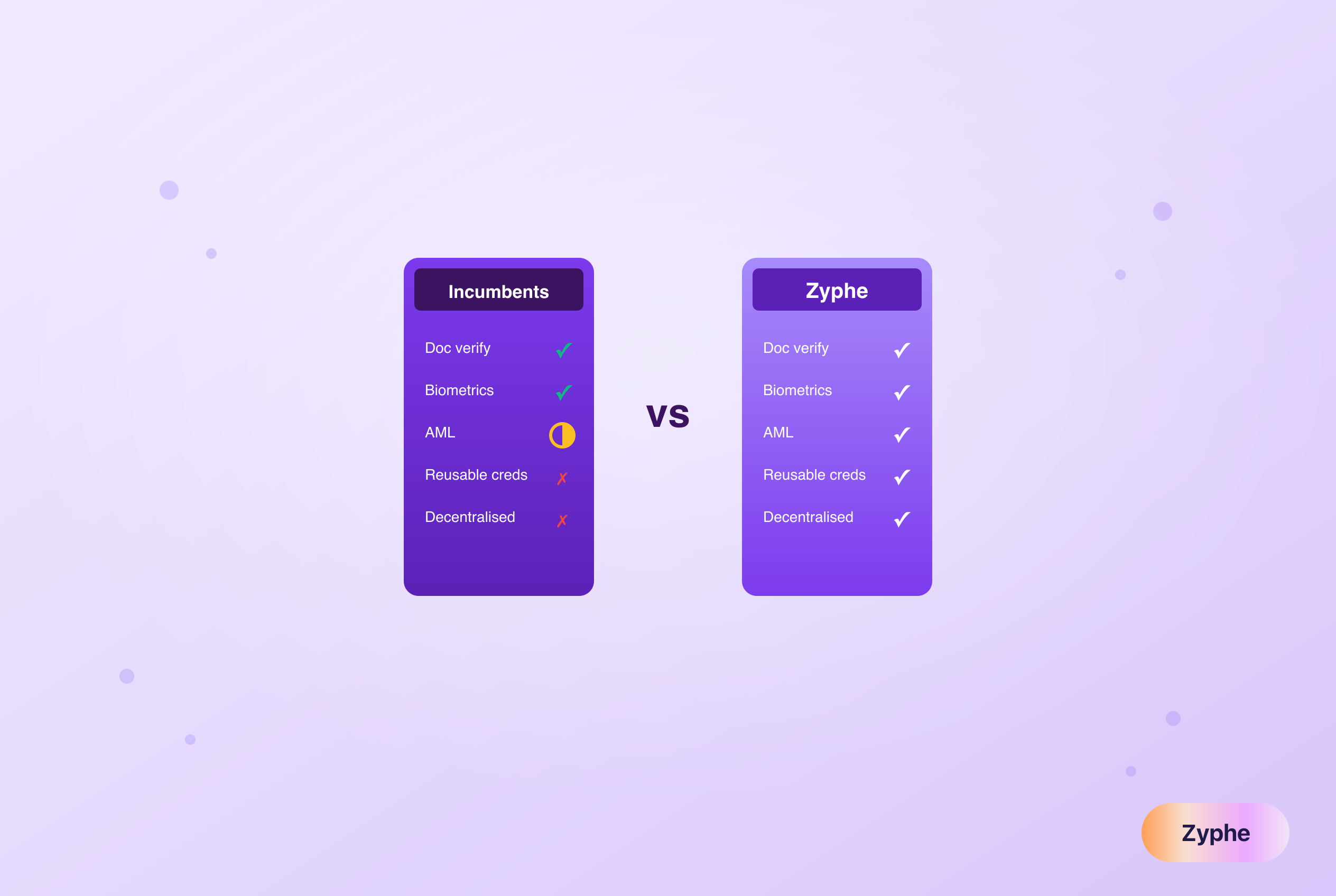
- Zyphe is a privacy-first identity verification vendor by architecture: data is sharded across decentralised nodes with a customer-held key, credentials are reusable, and residency is enforced per region.
- Mainstream vendors are not "bad," but on the privacy dimension specifically they are a different category, which this roundup scores honestly.
Privacy-first identity verification vendors are providers that verify identity while minimising the personal data they collect and store, typically through decentralised or user-held data, reusable credentials, and selective disclosure rather than a central database of customer identities. They are evaluated on where data lives, who controls it, and how little is retained, rather than on verification accuracy.
TL;DR
Privacy-first identity verification vendors verify who someone is while holding as little of their personal data as possible. Instead of accumulating a central database of passports and selfies, they minimise what they collect, decentralise or hand control of the data to the user, and increasingly support selective disclosure, revealing only the minimum a check requires. The 2026 backdrop accelerates this: the EU Digital Identity Wallet must reach every member state by the end of the year, and self-sovereign identity, verifiable credentials, and zero-knowledge proofs are becoming real products rather than whitepapers.
This roundup defines what privacy-first actually means, sets out six criteria to score vendors on, and compares the landscape honestly: dedicated privacy-first architectures like Zyphe, the verifiable-credentials and self-sovereign-identity ecosystem, and mainstream IDV vendors assessed on the privacy dimension. The aim is not to call mainstream vendors bad, it is to be precise about which vendors are genuinely privacy-first by design.
13 min read. Last updated 17 August 2026.
What are privacy-first vendors?
Privacy-first identity verification vendors are providers whose architecture is built to verify identity without becoming a large store of personal data. Where a conventional vendor reads a document and a selfie and keeps them in its cloud, a privacy-first vendor minimises collection, decentralises or hands control of the data to the user, and aims to retain as little as possible while still meeting compliance obligations.
The distinction is architectural, not a slogan. Nearly all leading vendors verify accurately, so privacy-first is not about whether the check works, it is about what happens to the data afterward. That is why this roundup of privacy-first vendors scores on storage, control, and minimisation rather than on pass rates, and connects to the broader market view in our identity verification software comparison.
Why does privacy-first identity verification matter in 2026?
Three forces make this the year privacy-first moves from nice-to-have to mainstream.
The first is breach economics. Every central store of verified identities is a target, and a vendor breach becomes the customer's regulatory problem, the risk we unpack in why your KYC vendor is your biggest data breach risk. The second is regulation: the EU Digital Identity Wallet must be available in every member state by the end of 2026, putting user-held, selectively disclosed identity in citizens' hands and normalising the model, while the GDPR's data-minimisation principle rewards collecting less. The third is technology maturity: self-sovereign identity, verifiable credentials, and zero-knowledge proofs that allow selective disclosure, revealing only that someone is over 18 or a verified customer without exposing the underlying document, are now shipping in real products, with the decentralised identity market reaching billions in 2026.
Together these mean privacy-first identity verification is no longer a niche preference; it is where the regulatory and technical direction is heading.
What makes an identity verification vendor privacy-first?
Use six criteria to separate genuine privacy-first identity verification vendors from those that simply use the word.
Data minimisation: does the vendor collect and retain only what is necessary, or hoard everything by default? Storage architecture: is verified data held in the vendor's central cloud, or decentralised so there is no single honeypot? Data control: who holds the keys, the vendor or the customer or the end user? Reusable credentials: can a verified identity be re-presented without re-uploading and re-storing documents? Selective disclosure: can the system reveal only the minimum a check requires, rather than the full identity? Data residency: is data kept within the required region by design? A vendor that scores well across these is privacy-first by architecture; one that scores well only on marketing language is not.
Which privacy-first identity verification vendors should you compare?
The landscape splits into three groups, and an honest roundup names all three.
Dedicated privacy-first architectures: Zyphe is the clearest example, built so customer data is sharded across decentralised storage with a customer-held key, with reusable credentials and per-region residency as core design choices rather than add-ons.
Self-sovereign identity and verifiable-credentials platforms: this ecosystem, including verifiable-credential infrastructure such as Microsoft Entra Verified ID and a growing set of self-sovereign-identity providers aligned with the EU Digital Identity Wallet, puts credentials in the user's wallet and supports selective disclosure. These are strong on the privacy model, though some are infrastructure rather than turnkey KYC.
Mainstream IDV vendors assessed on privacy: Sumsub, Onfido (now Entrust IDV), Veriff, and Persona verify identity capably and offer privacy features such as configurable retention and data residency, but they store verified data in their own cloud, so on the privacy-first dimension specifically they sit in a different category. Naming them fairly is part of an honest comparison, and our Sumsub alternatives and Zyphe vs Persona guides go deeper.
How do the vendors compare on privacy?
The table scores the groups on the six privacy criteria. It is deliberately about privacy architecture, not verification quality, which is broadly strong across all of them.
| Vendor / group | Storage architecture | Data control | Reusable credentials | Selective disclosure | Residency |
|---|---|---|---|---|---|
| Zyphe | Decentralised, sharded | Customer-held key | Yes, standard | Supported | Enforced per region |
| SSI / verifiable credentials | User wallet | End user | Yes | Yes | Varies by implementation |
| Sumsub | Centralised vendor cloud | Vendor | Enterprise tier | Limited | Configurable |
| Onfido (Entrust) | Centralised vendor cloud | Vendor | Limited | Limited | Configurable |
| Veriff | Centralised vendor cloud | Vendor | No | Limited | Configurable |
| Persona | Centralised vendor cloud | Vendor | Limited | Limited | Configurable |
The pattern is clear: privacy-first is a spectrum, and the dividing line is whether the architecture removes the central store of identity data or merely manages it.
What makes Zyphe a privacy-first identity verification vendor?
Zyphe is privacy-first by construction, not by positioning. Instead of holding verified identities in a central cloud, it shards each record across more than 60,000 decentralised nodes using a 29-of-100 threshold scheme, and the customer holds the encryption key, so Zyphe has no master key and a breach yields fragments rather than identities. This is the basis of decentralised KYC and decentralised PII storage.
On the rest of the criteria: reusable credentials are standard, so a verified identity can be re-presented without re-uploading or re-storing documents; verification uses NFC chip reads and two-step liveness with no user image upload, minimising what is collected; and data residency is enforced per region by design. The honest framing: the self-sovereign-identity ecosystem shares the same philosophy and is worth watching, especially as the EU Digital Identity Wallet rolls out, while Zyphe delivers the privacy-first architecture today as a turnkey KYC platform rather than infrastructure you assemble. Explore the product or see how it works.
How do you evaluate privacy-first identity verification vendors?
Turn the six criteria into an evaluation you can run.
- Ask where verified data is stored and who can decrypt it. If the answer is the vendor's central cloud with vendor-held keys, it is not privacy-first by architecture, whatever the marketing says.
- Test data minimisation: what does the vendor collect and retain, and can it discard or avoid storing raw documents?
- Check reusable credentials and selective disclosure: can a verified identity be reused, and can a check reveal only the minimum required?
- Confirm residency guarantees for your regulated regions, in writing.
- Run a paid pilot and read the data processing agreement, because the contract reveals the real data handling behind the pitch.
Score each vendor on the six criteria and you will quickly see which privacy-first identity verification vendors are genuine and which are conventional vendors with a privacy label.
When is a mainstream vendor good enough?
Privacy-first is not always the deciding factor, and an honest roundup says so. If your data-storage model already satisfies your regulators, your breach exposure is acceptable, and your priority is, say, maximum verification speed or the broadest global coverage, a mainstream vendor may be the right choice, and switching purely for architecture would be over-rotating.
Similarly, if you need turnkey breadth that some early self-sovereign-identity infrastructure does not yet offer, a mature mainstream vendor or a turnkey privacy-first platform will serve you better than assembling components. The case for a privacy-first identity verification vendor is strongest when you are accumulating identity data you would rather not hold, when GDPR data-minimisation and residency are first-order requirements, or when you want reusable, user-controlled credentials. If that is you, Zyphe is built for exactly that, so book a demo.
The bottom line
Privacy-first identity verification vendors are defined by architecture, not adjectives: they verify identity while holding as little of it as possible, ideally decentralised or in the user's control. In 2026 that model is no longer fringe, with the EU Digital Identity Wallet, verifiable credentials, and zero-knowledge selective disclosure all arriving at once.
Score vendors on data minimisation, storage, control, reusable credentials, selective disclosure, and residency, and the genuine privacy-first options separate cleanly from conventional vendors wearing the label. If minimising the identity data you hold is a first-order requirement, a decentralised, customer-controlled architecture is the one to pilot.
Book a demo, explore the product, or see how it works.
Related resources
- Identity verification software comparison 2026
- Why your KYC vendor is your biggest data breach risk
- Decentralised KYC
- Decentralised PII storage
- Sumsub alternatives
- Persona alternatives: Zyphe vs Persona
- Product
Cited sources
- European Commission, EU Digital Identity Wallet and eIDAS: https://digital-strategy.ec.europa.eu/en/policies/discover-eidas
- W3C, Verifiable Credentials Data Model: https://www.w3.org/TR/vc-data-model/
- EU GDPR information portal (data minimisation): https://gdpr-info.eu/
- FATF Recommendations: https://www.fatf-gafi.org/en/topics/fatf-recommendations.html
 Michelangelo Frigo (Co-Founder at Zyphe) Michelangelo Frigo is a privacy and identity infrastructure expert and co-founder of Zyphe.