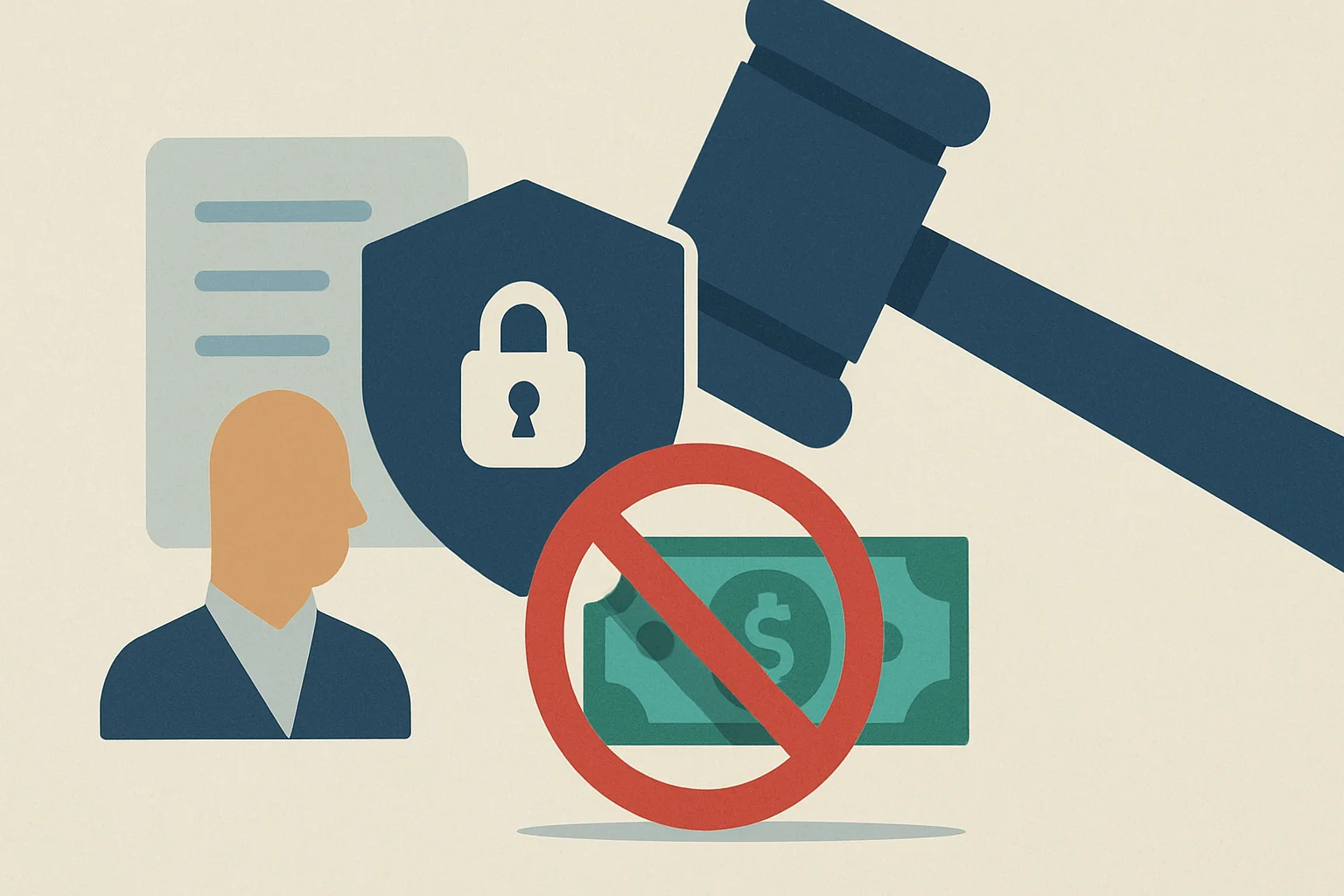
The Ninth Circuit upheld a block on the FinCEN border GTO, calling it a de facto rule that skipped notice and comment and ignored the cost of compliance.
Table of contents
On 13 July 2026 a divided Ninth Circuit upheld an injunction against the FinCEN border GTO, the order that made money services businesses near the southwest border report cash transactions from 200 dollars, far below the standard 10,000 dollar threshold. The panel held the order was likely a de facto rule that skipped notice and comment and ignored compliance costs.
- The Ninth Circuit affirmed, 2 to 1, a preliminary injunction against the order in Novedades y Servicios, Inc. v. FinCEN, No. 25-4238, filed 13 July 2026.
- The order cut the currency transaction report trigger from 10,000 to 200 dollars for money services businesses in 30 ZIP codes across five Texas and two California counties.
- The court found the order was likely a rule, not an order, so it required notice and comment, and was arbitrary and capricious for failing to weigh compliance costs.
- The plaintiff, a single-clerk check casher, estimated the order demanded more reporting hours than one clerk could work and cost it 50 to 60 percent of its customers in the first week before it was blocked.
- Later FinCEN orders raised the floor to 1,000 dollars and now reach Arizona and New Mexico, but rest on the same design the court has just questioned.
What did the Ninth Circuit rule on the FinCEN border GTO?
The panel affirmed the district court's preliminary injunction and let the block on the FinCEN border GTO stand. Writing for the majority, Judge Lucy Koh held the plaintiffs were likely to win on three Administrative Procedure Act claims: the order was a de facto rule, it needed notice and comment, and it was arbitrary and capricious.
On the third point Judge Koh wrote that "FinCEN entirely failed to consider the cost of compliance to regulated parties," an important aspect of the problem. Judge Ana de Alba joined the opinion. Judge Kenneth Lee dissented, arguing the plaintiffs had not shown irreparable harm and that the case should return to the trial court for further analysis. The injunction itself was issued by District Judge Janis Sammartino and limited to the Southern District of California.
| Item | Detail |
|---|---|
| Case | Novedades y Servicios, Inc. v. FinCEN, No. 25-4238 |
| Court | US Court of Appeals for the Ninth Circuit |
| Filed | 13 July 2026 |
| Panel | Koh (opinion), de Alba, Lee (dissent) |
| Result | Preliminary injunction affirmed, 2 to 1 |
| Trial court | Judge Janis Sammartino, Southern District of California |
How did the FinCEN border GTO change cash reporting thresholds?
Under the Bank Secrecy Act, a business normally files a currency transaction report only for cash over 10,000 dollars. Section 5326 of Title 31 lets FinCEN issue a geographic targeting order that lowers that trigger in a defined area for a limited time. The FinCEN border GTO used that power to an unusual degree.
Issued in March 2025, the order required every money services business in 30 named ZIP codes across five Texas counties and two California counties to file a report for any cash transaction between 200 and 10,000 dollars. That is a fiftyfold cut in the reporting floor. A court enjoined the order within about a week of it taking effect against the plaintiff, and its 180-day term then lapsed on 9 September 2025. FinCEN has replaced it twice since, each time keeping the same reporting design but raising the floor and widening the map.
| Order | Issued | Reporting floor | Area covered |
|---|---|---|---|
| Border GTO (blocked) | March 2025 | 200 dollars | 30 ZIP codes, Texas and California |
| Second GTO | 10 September 2025 | 1,000 dollars | Adds Arizona and more of Texas |
| Third GTO | 10 March 2026 | 1,000 dollars | Adds New Mexico and more of Arizona |
What does the ruling mean for your AML reporting obligations?
The ruling narrows one order but does not lift your live duties. The injunction reaches only the original 200 dollar FinCEN border GTO, and only inside the Southern District of California. The current Third GTO, at a 1,000 dollar floor and running through 2 September 2026, was expressly kept out of the appeal and remains in force.
For customer due diligence, the practical effect is scope. A 200 dollar trigger forces identity capture and a filed report on routine remittances, multiplying both the data you hold and the reports you file. Firms in covered ZIP codes across Arizona, California, New Mexico and Texas must still identify the customer and file at 1,000 dollars today, and standard currency transaction reports still apply at 10,000 dollars nationwide. Suspicious Activity Report duties are unchanged: a low currency threshold never replaces judgement about suspicious behaviour. Keep records for five years and keep an audit trail that shows which order applied to which branch on which date, because the map has moved three times in a year.
What is still uncertain after the FinCEN border GTO ruling?
Several questions stay open, and they matter more than the headline. First, the injunction targets an order that has already expired, while the operative 1,000 dollar order sits outside the appeal, so its legality is untested even though it shares the same rule-versus-order and notice-and-comment weaknesses the court flagged.
Second, the relief is geographically narrow. A money services business outside the Southern District of California gets no direct protection from this decision. Third, the panel split, and Judge Lee would have remanded on irreparable harm, so an en banc or Supreme Court look is plausible. Fourth, FinCEN can cure the procedural defect by running notice and comment and re-issuing the rule, which would reset the clock rather than end the policy. Fifth, there is a chilling effect the court itself recorded: customers feared that handing over identity data for small sums would place them "on a list of criminals," and many moved to money services businesses in unaffected ZIP codes, which blunts the anti-money-laundering aim while spreading personal data across more collection points.
How does the FinCEN border GTO compare with other reporting precedents?
Most geographic targeting orders name specific businesses for a set window, such as the title-company orders on all-cash property purchases. The FinCEN border GTO instead swept in every unnamed money services business in a zone with more than a million residents, which is why the court treated it as a rule rather than an order.
The threshold gap is the other headline. The 10,000 dollar currency transaction report floor dates to Bank Secrecy Act rulemaking and has held for decades. A 200 dollar trigger is among the lowest cash reporting bars FinCEN has ever set, and it sat well under the ordinary Suspicious Activity Report thresholds too.
| Reporting trigger | Cash threshold |
|---|---|
| Currency transaction report (standard) | 10,000 dollars |
| Suspicious Activity Report, banks | 5,000 dollars |
| Suspicious Activity Report, money services businesses | 2,000 dollars |
| Second and Third GTO | 1,000 dollars |
| Border GTO (blocked) | 200 dollars |
How should compliance teams respond?
Start with a branch-level map. Confirm which ZIP codes fall under the current 1,000 dollar order, keep filing where it applies, and document a written compliance-cost analysis so your own record shows the burden regulators are now told to weigh. Track any petition for en banc or Supreme Court review, and watch for a re-issued rule that goes through notice and comment. Above all, minimise what you retain: collecting and storing identity documents for 200 dollar transactions creates honeypots that outlast the order that demanded them.
That last point is where data-minimising verification helps. Zyphe verifies identity once with an NFC chip read to ICAO 9303 and eIDAS standards, shards the data across a network so no single node holds a full record, and lets a customer re-present a reusable credential rather than re-uploading documents at every threshold. When the reporting bar drops, you can meet it without building a new central store of sensitive data. Book a demo to see how data-minimising verification maps to shifting reporting rules.
The bottom line
The FinCEN border GTO decision is a procedural win, not the end of low-threshold cash reporting. FinCEN can rebuild the same policy through proper rulemaking, and its 1,000 dollar order already covers a wider stretch of the border. For teams running know your customer and anti-money-laundering programmes, the lesson is that reporting thresholds can move fast and that regulators must now show they weighed the burden. The firms that cope best will be the ones holding the least sensitive data when the next order lands.
Cited sources
- Ninth Circuit opinion, Novedades y Servicios, Inc. v. FinCEN, No. 25-4238 (13 July 2026)
- FinCEN news release: Southwest Border Geographic Targeting Order
- FinCEN news release: Modified Southwest Border Geographic Targeting Order
- 31 U.S.C. Section 5326, geographic targeting orders (Cornell Law LII)
- 5 U.S.C. Section 553, notice and comment rulemaking (Cornell Law LII)
For related reading, see our explainers on KYC and AML differences, the Merrill transaction monitoring penalty, the EagleBank BSA settlement, and how Zyphe works.
 Michelangelo Frigo (Co-Founder at Zyphe) Michelangelo Frigo is a privacy and identity infrastructure expert and co-founder of Zyphe.