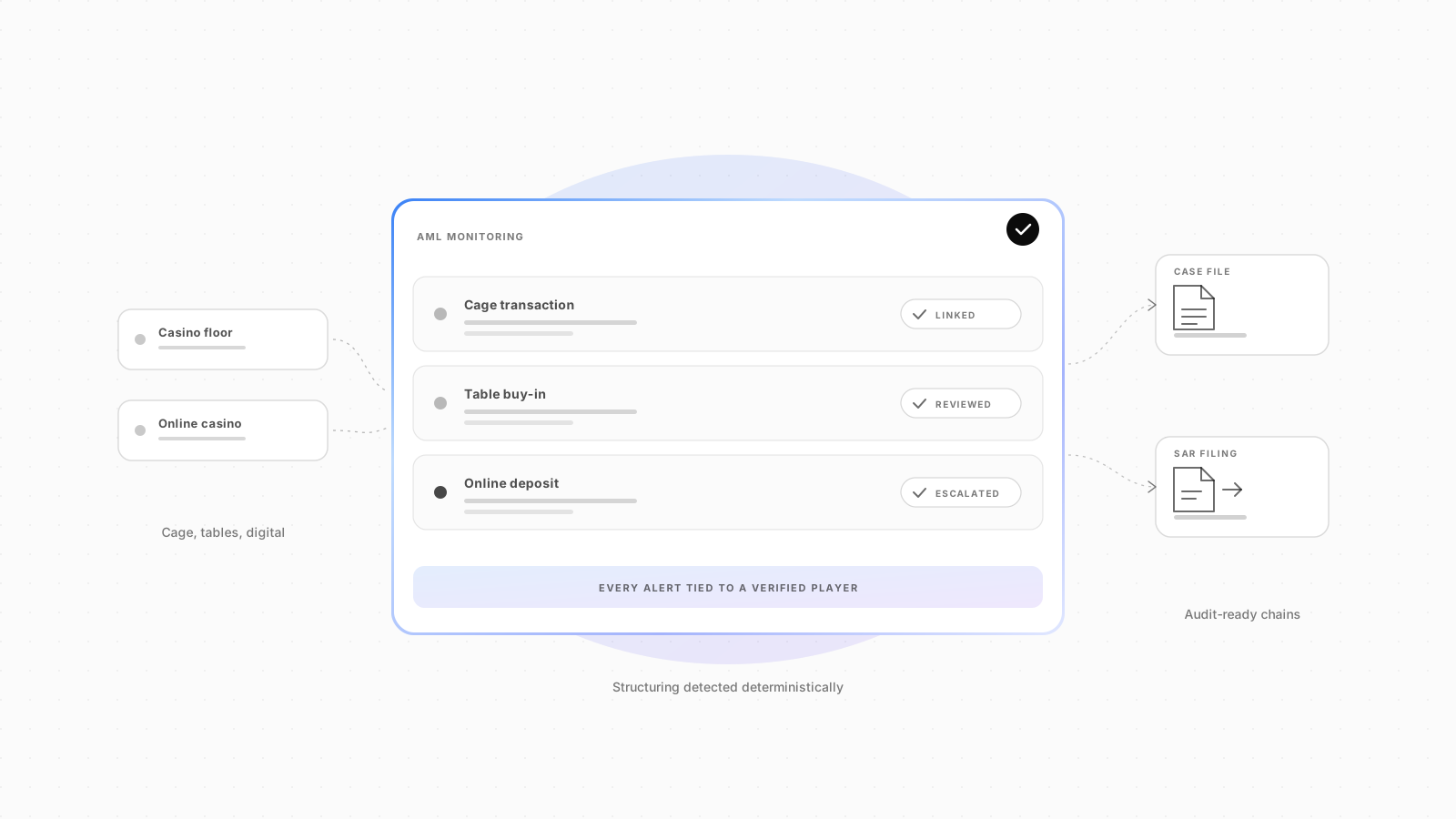
AML for casino is the transaction-monitoring, structuring-detection, sanctions-screening, and SAR filing layer that land-based casinos, online casinos, and gaming operators run to satisfy UKGC, FinCEN BSA Title 31, AUSTRAC, and member-state-specific obligations. Cage transactions, junket flows, and online wagers link to verified player identity through one credential-based architecture.
What does casino AML actually have to do?
AML for casino coverage spans four functions across the land-based and online surfaces. Structuring detection at the cage. Sanctions screening at player and counterparty layers. Source-of-funds verification on high-value play. SAR filing pipeline with regulator-ready timing. The operating challenge is that gambling-AML has to detect typologies that are gambling-specific (chip-dumping, junket layering, agent collusion, structuring at deposit) on top of generic AML patterns. Threshold-only rules miss the gambling-specific layer entirely.
For the broader monitoring architecture, see our AML transaction monitoring 2026 piece. For the underlying KYC pattern, see our KYC for casino industry page.
What are the regulatory baselines for casino AML across UK, US, EU, and AU?
Four jurisdictions matter for cross-border operators in 2026.
United Kingdom: Gambling Commission (UKGC), MLR 2017
The UK Gambling Commission supervises gambling operators, including casino, sports betting, and online gambling. Obligations flow through the Money Laundering Regulations 2017 for casinos and through the UKGC’s licensing conditions and codes of practice for the broader sector. The 2024-2025 enforcement wave landed on operators consistently for AML failings: control framework inconsistency, weak source-of-funds verification, and identity-linkage gaps in monitoring.
United States: FinCEN BSA Title 31, state regulators
US casinos qualify as financial institutions under the BSA. FinCEN supervises directly through Title 31. CTR filing is mandatory for cash transactions above USD 10,000. SAR filing within 30 days of detection. State regulators (Nevada Gaming Control Board, New Jersey Division of Gaming Enforcement) layer on top.
European Union: 5AMLD/6AMLD, AMLA, member-state gambling regulators
EU member states transpose AMLD obligations into national rules through their gambling regulators (ARJEL/ANJ in France, ADM in Italy, DGOJ in Spain, MGA in Malta, KSA in Netherlands). AMLA’s per-decision defensibility standard now applies. Penalties under the new AMLR can reach EUR 10 million or 10% of annual turnover.
Australia: AUSTRAC
AUSTRAC supervises Australian casinos under the AML/CTF Act 2006. The Crown Resorts AUD 450 million civil penalty (2023) and the Star Sydney AUD 100 million civil penalty (2023-2024) are the recent enforcement benchmarks.
Side-by-side: casino AML obligations
| Dimension | UK | US | EU | AU |
|---|---|---|---|---|
| Primary regulator | UKGC + HMRC + NCA | FinCEN + state gaming boards | Member-state gambling regulators + AMLA | AUSTRAC |
| CTR equivalent | None (UK) | USD 10,000 cash threshold | None at EU level | AUS 10,000 cash threshold |
| Recent enforcement | Entain GBP 17M, William Hill GBP 19.2M, Flutter GBP 2M Dec 2025 | Less penalty-heavy historically | Member-state-specific | Crown AUD 450M, Star AUD 100M |
| Source-of-funds bar | High; UKGC explicit | Documented for high-value play | High under EU EDD rules | High under AUSTRAC |
Where do casino AML programs fail, and what does it cost?
Five reproducible failure modes across recent enforcement.
Structuring not detected at the cage
A player presenting USD 9,500 cash multiple times in a single day is structuring. Rules that fire only at USD 10,000 miss the pattern. AUSTRAC’s Crown findings included this exact gap.
Source-of-funds verification absent on high-value play
UKGC enforcement against Entain (GBP 17M) and William Hill (GBP 19.2M) cited explicit source-of-funds gaps for high-value players. The high-value-play surface requires documented EDD with evidence the regulator can audit.
Junket and agent layering
Casino junkets in Asia-Pacific operating models have historically been a layering channel. AUSTRAC’s Crown and Star findings cited junket-relationship failures. Casinos sourcing players through junkets without KYB on the junket operator inherit the junket’s AML gaps.
Identity not linked to cage transactions
A casino floor running anonymous chip play, with KYC only at cashier or VIP enrollment, has the identity-linkage gap that lets mule players scale.
Online casino monitoring without KYC tier integration
Online casino programs that run threshold rules without integrating KYC tier (low-risk, standard, EDD) miss the typology surface that requires risk-tiered intensity.
Recent enforcement timeline
| Date | Action | Penalty | Why it matters for casino AML |
|---|---|---|---|
| 2022 | Bet365 (UKGC Cit-Tex case) | GBP 582K | Rule-tiering and player-interaction gaps |
| 2022 | Entain (UKGC) | GBP 17M | SoF verification gaps for high-value players |
| 2023 | William Hill (UKGC) | GBP 19.2M | SoF + control framework |
| 2023 | Crown Resorts (AUSTRAC) | AUD 450M | Junket-relationship failures, SoF gaps |
| 2023-2024 | Star Sydney (AUSTRAC) | AUD 100M | Identity-linkage gaps in monitoring |
| Dec 2025 | Flutter / Paddy Power (UKGC) | GBP 2M | Customer interaction and SoF documentation |
How does Zyphe deliver casino AML at cage and online speed?
Zyphe ships four primitives.
Identity-linked cage transactions. Every chip purchase, chip redemption, deposit, and withdrawal carries the verified player credential. KYC tier, source-of-funds verification status, and sanctions clearance status are available at rule time. Structuring detection fires deterministically because the rule sees both the transaction sequence and the identity-tier context.
Source-of-funds documentation pipeline. UKGC-grade SoF and SoW evidence collection workflow integrated with the player record. Documentary EDD producible under audit in minutes rather than weeks.
Junket KYB integration. Where the operating model includes junkets, Zyphe KYB walks the junket’s ownership tree across 190+ jurisdictions. Junket-relationship risk surfaces as a structured input to player-level monitoring.
Real-time online plus batch land-based hybrid. Online wagering transactions score in real time at authorisation. Land-based cage transactions feed into the same monitoring engine via cage-system integrations, with cliff-edge rules running in real time and cross-product behavioural rules running in batch.
A senior compliance officer at a UK-licensed casino group framed the post-Crown shift on a customer call in March 2026: “the Australian regulators stopped treating cage operations as out-of-scope for digital-grade monitoring around 2023. UK regulators followed. We re-architected to put identity context on every chip transaction, not just on enrolment. Zyphe was the AML for casino layer that made it operationally tractable.”
How do you implement casino AML across land-based, online, and integrated resorts?
Three patterns covering the most common deployment shapes.
Land-based casino
Cage system integration. Identity-linked chip purchase, redemption, and table-action records. Structuring detection on cash-in / cash-out sequences. SoF documentation workflow for high-value play. SAR filing pipeline with FinCEN Form 8300 and SAR-C templates pre-loaded.
Online casino
Real-time scoring at deposit, wager, and withdrawal. Identity-linked alerts. KYC tier-driven monitoring intensity. Adverse media monitoring on high-value players. Per-decision triage records for every alert.
Integrated resort (casino plus hotel plus retail)
Cross-product monitoring across casino spend, hotel charges, and retail. Identity-linked at every touchpoint. Layering detection across product lines (hotel cash deposits paid out as casino chips, etc.). Audit-export covering every product surface in one case file.
What are the real edge cases casino AML still struggles with?
Five edge cases worth flagging.
Structuring across multiple property visits. A player structuring deposits across multiple property visits or multiple properties in the same group. Per-property rule logic without group-level aggregation misses the pattern.
Junket-introduced VIP source-of-funds opacity. Where the junket operator handles SoF documentation rather than the casino directly, the casino bears regulatory exposure for whatever the junket fails to verify.
Online casino bonus chains. Players accumulating bonuses across multiple operators in the same group with rule logic that does not aggregate.
Live-dealer table monitoring. Where live-dealer streaming connects online players to land-based table action, the rule logic has to span both surfaces.
Cryptocurrency deposit channels. Where the operator accepts crypto deposits, the standard casino-AML rule library has to extend with crypto-AML typologies. See our AML for crypto page.
How do you evaluate casino AML in the next 30 days?
Five concrete moves.
- Audit structuring detection. Run a synthetic structuring scenario through your current rule library. If it does not fire, the rule logic is wrong.
- Pressure-test identity linkage at the cage. Pull 50 random cage transactions from last 30 days and confirm each linked to a verified player credential.
- Inventory source-of-funds documentation depth. Pull 20 high-value-player records and check whether SoF evidence is present and producible under audit.
- Run an audit-export drill. Pull a SAR filed 18 months ago and trace the evidence chain.
- Update DPIA and AMLA per-decision defensibility documentation. Documentation depth is now structural under post-2024 supervision.