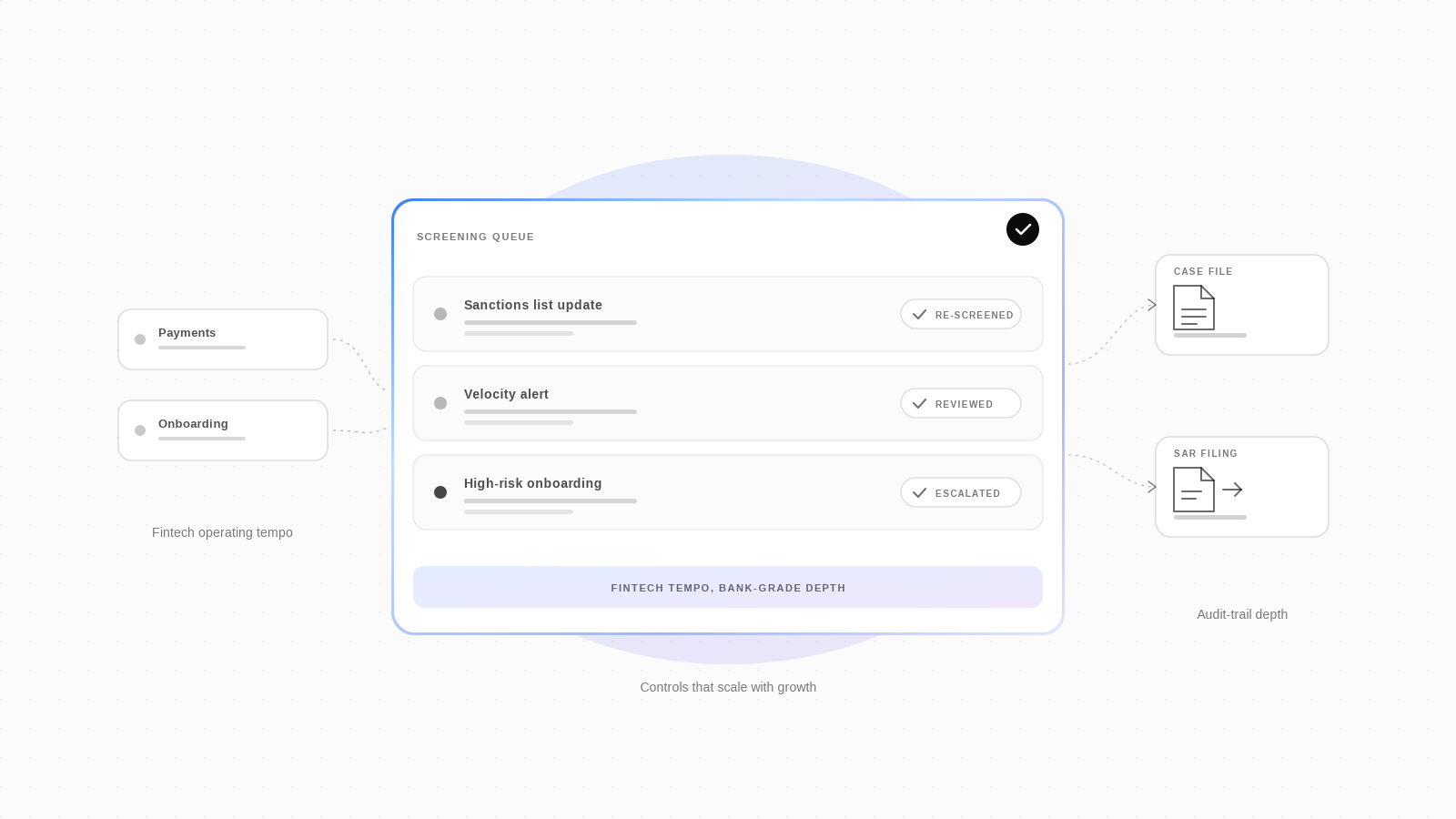
AML for neobanks is the transaction-monitoring, sanctions-screening, and SAR filing layer that digital banks, challenger banks, and BaaS-licensed neobanks run to satisfy FCA SYSC, EU AML rules (national law now, AMLR from 10 July 2027), and FinCEN BSA obligations. It runs in real time at instant-payment speed and produces an audit trail reproducible per-decision under SMCR.
What does neobank AML actually have to do?
The AML for neobanks category sits at the intersection of bank-grade compliance obligations and fintech-grade operating tempo. Four functions running simultaneously.
- Real-time transaction monitoring on instant-payment rails. Faster Payments (UK), SEPA Instant (EU), FedNow (US). Settlement happens in seconds. Scoring has to happen at authorisation time, not in batch.
- Identity-linked alerts with perpetual KYC. Bank-grade depth on KYC tier, sanctions, PEP, and adverse media, with continuous re-screening at the credential layer. See our perpetual KYC piece.
- SAR filing pipeline. UK FCA via NCA SAR Online, EU member-state-specific, US FinCEN within 30 days.
- Per-decision audit-trail reproducibility. EU national supervisor review, FCA SYSC inspection-driven supervision, FinCEN reasonably-designed standard.
For the underlying transaction-monitoring architecture, see our AML transaction monitoring 2026 piece. For the underlying KYC pattern, see our KYC for neobanks page.
What are the regulatory baselines for neobank AML across UK, EU, and US?
United Kingdom: FCA, PRA, MLR 2017, SMCR
UK neobanks operate under the FCA (and PRA where banking authorisation is direct), Money Laundering Regulations 2017, and the FCA Handbook (SYSC 6.1, SYSC 6.3). The Senior Managers and Certification Regime (SMCR) assigns personal accountability for compliance programs to named individuals. The 2024-2025 enforcement wave against neobanks landed at GBP-billion-scale.
European Union: AMLR, AMLD6, AMLA direct supervision
EU neobanks are supervised by their national competent authorities in 2026. The AMLR single rulebook, Regulation (EU) 2024/1624, applies directly from 10 July 2027, with AMLD6 transposed by member states alongside it, and AMLA selects about 40 entities for direct supervision in 2027 and starts supervising them in 2028, six months after it publishes the list. Every alert closure and SAR-filing decision needs a documented rationale. The Bank of Lithuania’s EUR 3.5 million action against Revolut Bank UAB (April 2025) shows what national supervisors already look for: it found shortcomings in how the bank monitored business relationships and transactions.
United States: FinCEN BSA, OCC, Federal Reserve, FDIC, state regulators
US neobanks operate under FinCEN, OCC (for nationally chartered), Federal Reserve, FDIC, and state regulators for direct state charters. The reasonably designed and risk-based standard for those programs is statutory, at 31 U.S.C. 5318(h)(2)(B)(iv) as amended by the Anti-Money Laundering Act of 2020. FinCEN proposed the regulation that would implement it on April 7, 2026, superseding its July 2024 proposal. Comments closed on June 9, 2026 and a 12-month implementation period is proposed after any final rule, so this is a planning input rather than a live obligation.
Side-by-side: neobank AML obligations
| Dimension | UK | EU | US |
|---|---|---|---|
| Primary regulator | FCA + PRA | National (AMLA for about 40 selected from 2028) | FinCEN + OCC/Fed/FDIC/state |
| Real-time monitoring | Faster Payments since 2008 | Instant Payment Reg, phased 2025 to 2027 | FedNow rails standard |
| Audit standard | SYSC + SMCR personal accountability | Risk-based (AMLR from July 2027) | Reasonably designed and risk-based |
| Recent enforcement | Starling GBP 29M (Oct 2024), Monzo GBP 21M (Jul 2025), Revolut GBP 3.1M (2024) | Revolut UAB EUR 3.5M (Apr 2025) | TD Bank USD 1.3B (Oct 2024) |
Where do neobank AML programs fail, and what does it cost?
Five reproducible failure modes consistently cited across recent neobank Final Notices.
Control framework inconsistency
Both Starling and Monzo Final Notices cited “control framework inconsistency” explicitly. Translation: humans applying rules differently. Stacks have to ship deterministic rule logic, configurable per risk band, applied consistently across every alert.
High-risk customer onboarding without proportionate diligence
Monzo’s Final Notice (July 2025) cited gaps in onboarding diligence for high-risk customers. The AML for neobanks system has to integrate with the KYC layer to ensure that risk-tier-appropriate diligence flows into the monitoring layer.
Sanctions screening at customer layer only, not transaction-counterparty layer
Standard pattern across neobank enforcement. The AML for neobanks architecture has to screen at every transaction touchpoint.
Alert backlog
Backlog ages SARs out of regulatory compliance windows. SAR-clock tracking with weekly CCO reporting is the operational fix.
Audit-trail reproducibility gap
The most-cited finding pattern post-TD Bank. Per-decision triage records as the side effect of running the workflow, not as an after-the-fact reconstruction.
Recent enforcement timeline
| Date | Action | Penalty | Why it matters for neobank AML |
|---|---|---|---|
| 2024 | Revolut FCA Final Notice | GBP 3.1M | Control framework inconsistency in monitoring |
| Oct 2024 | TD Bank | USD 1.3B FinCEN, USD 3.1B combined | Five-pillar program failures |
| Oct 2024 | Starling Bank | GBP 29M FCA | Sanctions screening + control framework |
| Apr 2025 | Revolut Bank UAB | EUR 3.5M | Transaction and relationship monitoring shortcomings |
| Jul 2025 | Monzo | GBP 21M FCA | High-risk customer onboarding gaps |
How does Zyphe deliver neobank AML at instant-payment speed?
Zyphe ships four primitives.
Real-time scoring on instant-payment rails. Faster Payments, SEPA Instant, FedNow, Pix. Single-digit-millisecond scoring at authorisation time. Cliff-edge rules fire deterministically.
Identity-linked alerts with perpetual KYC. Every alert carries the verified credential, KYC tier, sanctions clearance, PEP status, and continuous re-screening status. Mule indicators fire at the rule level. See our decentralised KYC primer for the underlying credential architecture.
Per-decision triage records. Every alert produces a structured triage record (analyst, time, evidence reviewed, closure rationale, escalation outcome) as the side effect of running the workflow. The record of each decision exists by primitive, not by configuration.
Audit-export readiness. Case files exportable in the formats UK FCA, EU AMLA, and US FinCEN expect. Quarterly inspection support reduces from a three-week scramble to a one-day desk review.
A senior MLRO at a UK challenger bank framed the post-Starling shift on a customer call in March 2026: “the FCA’s 2024 inspection cycle treated control framework inconsistency as a structural finding, not a remediation item. We re-architected onto identity-linked alerts within six months. The case-file reproducibility piece was harder than the rule logic.” The Zyphe precision rate runs at approximately 22%, versus the 5 to 10% implied by the 90 to 95% false-positive rates commonly reported for rules-based monitoring.
How do you implement neobank AML across direct-licensed and BaaS-licensed models?
Two patterns covering the most common neobank operating shapes.
Direct-licensed neobank (own banking authorisation)
Standard bank obligations. Real-time monitoring, identity-linked alerts, SAR filing pipeline, regulatory examination preparedness. Higher per-decision documentation depth than BaaS-licensed because the regulator interfaces directly. SMCR personal accountability flows through to named MLRO and head of financial crime.
BaaS-licensed neobank (sponsor-bank model)
Same architecture as direct-licensed but with the partner-bank governance overlay. Quarterly reviews, real-time visibility into the alert pipeline, partner-bank audit-export readiness. See our AML for fintech industry page for the deeper partner-bank pattern.
What are the real edge cases neobank AML still struggles with?
Five edge cases worth flagging.
Cross-border customer base under multiple supervisors. A neobank operating across UK, EU, and US sees three different supervisor expectations on the same customer types.
Crypto-product overlay. Where the neobank offers crypto custody or trading inside its core banking app, crypto-AML obligations layer on. See our AML for crypto page.
Fast-onboarding meets enhanced diligence trigger. Where a customer’s risk score elevates mid-session and the onboarding flow has to pivot to EDD without breaking conversion.
Card-issuing AML with tokenised counterparty data. Apple Pay / Google Pay tokenisation obscures counterparty data; AML rule logic has to handle tokenised flows.
Embedded-banking serving regulated customers. Where the neobank is itself a BaaS provider, the recursive partner-bank obligation chain becomes complex.
How do you evaluate neobank AML in the next 30 days?
Five concrete moves.
- Audit real-time monitoring coverage. If any rail runs through batch, the audit gap is structural.
- Pressure-test sanctions screening at transaction-counterparty layer. Send a synthetic transaction to a sanctioned counterparty in sandbox.
- Inventory alert backlog. Backlog metrics by typology and analyst. If 95th-percentile alert age exceeds the SAR filing window, you are operating below regulator expectation.
- Run audit-export drill. Pull a SAR filed 18 months ago and trace the evidence chain.
- Update SMCR responsibility map (UK), risk-based program documentation under the AML Act of 2020 (US), or the risk assessment and CDD documentation your national supervisor reviews, updated for the AML Regulation from 10 July 2027 (EU). Documentation depth is the audit focus.