How to register as an MSB with FinCEN: file Form 107 via BSA E-Filing inside 180 days, renew biennially, and build the four-pillar AML program every MSB needs.
Table of contents
This guide is for US compliance leads at fintech, remittance and crypto money services businesses who need to register with FinCEN and stand up the AML program that follows.
- To register, file FinCEN Form 107 electronically through the BSA E-Filing System within 180 days of establishing the business. There is no federal filing fee.
- Registration is renewed each two-calendar-year period, with the renewal form filed on or before 31 December of the year preceding that period. Keep the records for five years at a US location.
- A money transmitter is an MSB at any dollar amount. The 1,000 dollars per person per day threshold applies only to currency dealing, check cashing, money orders, traveller's cheques and prepaid access.
- Federal MSB registration does not authorise you to operate. You also need a state money transmitter license in 49 states plus the District of Columbia; Montana is the lone non-licensing state.
- Registration is the easy part. The durable risk is where the identity data you must collect and retain actually lives.
MSB registration is the federal filing every non-exempt money services business makes with the Financial Crimes Enforcement Network (FinCEN) using Form 107. It is submitted electronically through the BSA E-Filing System within 180 days of the business being established, renewed each two-year period, and it triggers a written anti-money laundering program.
TL;DR
To register as a money services business, create a BSA E-Filing System account, complete FinCEN Form 107, have the owner or controlling person sign it, and e-file within 180 days of establishing the business. Paper filing is not accepted, and there is no federal fee. You then renew each two-year period by the 31 December before it and keep the records for five years. Registration alone does not let you trade. You almost certainly also need state money transmitter licenses and, immediately, a written four-pillar anti-money laundering program under 31 CFR 1022.210. The harder question that follows is architectural: the moment you register, you are obliged to collect and retain identity data, so decide where it lives before it becomes a target.
What is a money services business?
A money services business (MSB) is a category defined by the Financial Crimes Enforcement Network (FinCEN), the bureau of the United States Treasury that administers the Bank Secrecy Act. Under 31 CFR 1010.100(ff), the categories are dealer in foreign exchange, check casher, issuer or seller or redeemer of traveller's cheques or money orders, provider or seller of prepaid access, money transmitter, and the United States Postal Service. If your business does any of these on its own behalf, you are likely an MSB and MSB registration applies. Our money services business glossary entry holds the canonical definition for quick reference.
The dollar trigger trips people up, so be precise. For currency dealing, check cashing, money orders, traveller's cheques and prepaid access, the activity threshold is more than 1,000 dollars per person per day in one or more transactions. A money transmitter, by contrast, is an MSB regardless of amount: there is no 1,000 dollar floor. That single distinction decides whether many fintech, remittance and crypto models are inside the perimeter from their first transaction.
The dollar figures that govern MSB status and the filings that follow are worth keeping in one place. Each row below is set by FinCEN regulation, and money transmission is the deliberate outlier at zero.
| Trigger | Threshold | What it sets |
|---|---|---|
| General MSB activity (currency dealing, check cashing, money orders, prepaid access) | More than 1,000 dollars per person per day | Whether you are an MSB at all |
| Money transmission | 0 dollars (any amount) | MSB status from the first transaction |
| Suspicious Activity Report (FinCEN Form 111) | 2,000 dollars or more | When a SAR is required |
| Travel Rule recordkeeping | 3,000 dollars or more | When transmittal records must travel with the funds |
| Currency Transaction Report (FinCEN Form 112) | More than 10,000 dollars in one business day | When a CTR is required |
Do I need to register as an MSB?
You need to register if you conduct MSB activity on your own behalf above the relevant threshold, or any money transmission at all. The qualifying test is short: do you deal in foreign exchange, cash cheques, issue or sell or redeem money orders or traveller's cheques, provide or sell prepaid access, or transmit money? If yes to one and you act as a principal, MSB registration is required and Form 107 is the form.
Some businesses are not MSBs or are exempt. Banks, registered broker-dealers and futures commission merchants are excluded because they are regulated elsewhere. The exemption that matters most in practice is the agent exemption: under 31 CFR 1022.380(a)(2), a business that is an MSB solely because it serves as an agent of another MSB is not required to register, though that relief disappears the moment it conducts MSB activity on its own behalf. Crypto is the common edge case. In FinCEN guidance FIN-2013-G001, issued 18 March 2013, and consolidated in FIN-2019-G001, issued 9 May 2019, administrators and exchangers of convertible virtual currency are money transmitters and therefore MSBs that must register, while a mere user of virtual currency is not. Our guide to KYC for crypto exchanges covers the onboarding controls that follow.
How is MSB registration different from a money transmitter license?
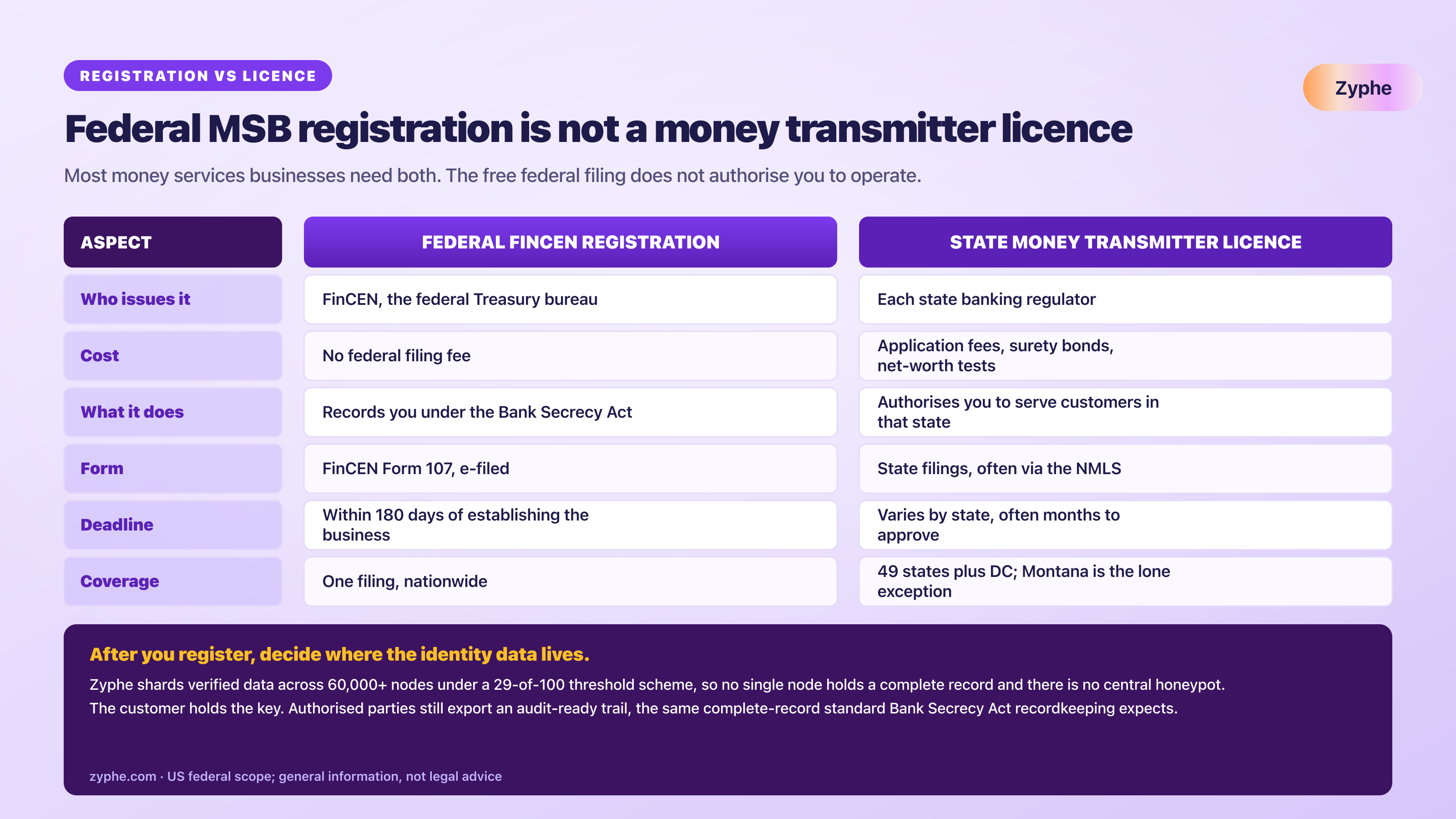
This is the single most common point of confusion, so separate the two cleanly. FinCEN MSB registration is a federal filing, it is free, and it puts you on the national anti-money laundering map. A money transmitter license (MTL) is issued per state by a state regulator, costs money, takes months, and is what actually authorises you to serve customers in that state. Filing Form 107 does not authorise you to operate.
The reach is wide. 49 states plus the District of Columbia require a money transmitter license; Montana is the lone state that does not license money transmitters, though federal MSB registration still applies there. The table below makes the split scannable.
| Aspect | Federal MSB registration | State money transmitter license |
|---|---|---|
| Who issues it | FinCEN (federal) | Each state banking regulator |
| Cost | No federal fee | Application fees, surety bonds, net-worth tests |
| What it does | Records you under the Bank Secrecy Act | Authorises you to serve customers in that state |
| Form | FinCEN Form 107 | State filings, often via the NMLS |
| Coverage | One filing, nationwide | 49 states plus DC; Montana excepted |
Most MSBs need both. Treat MSB registration as table stakes and budget separately for the state-by-state licensing programme. One scope note: this guide covers United States federal MSB registration with FinCEN. It is not a state-by-state money transmitter license walkthrough, and the specific bond, net-worth and fee requirements differ in every state, so treat the state column here as a pointer to a separate workstream rather than a complete map.
What do you need before you file?
Gather the inputs before you open the form, because Form 107 asks for specifics. You need the legal entity name and Employer Identification Number, all business addresses, the list of MSB activities you conduct, an estimate of the number of agents and branches, the states where you operate, and the details of the owner or controlling person who will sign. Form 107 must be signed by an owner or controlling person of the business, not an outside consultant or a law firm.
You also need a BSA E-Filing System account, which you create before filing rather than during it. Pulling these together first turns the filing itself into a short administrative task rather than a stop-start exercise. It is also the moment to confirm, one last time, that you are filing as a principal and not relying on the agent exemption, because that determines whether MSB registration is required at all.
The MSB pre-filing readiness checklist
We built this checklist for compliance leads who want to walk into Form 107 with nothing missing. Work top to bottom; if any line is unchecked, fix it before you open the form.
- ] Confirmed you conduct a listed MSB activity on your own behalf (not solely as an agent of another MSB) under 31 CFR 1010.100(ff).
- ] Confirmed you cross the relevant threshold: more than 1,000 dollars per person per day for general activity, or any amount for money transmission.
- ] Legal entity name and Employer Identification Number to hand.
- ] All business and branch addresses listed.
- ] Each MSB activity you conduct identified and written down.
- ] Estimate of the number of agents and branches prepared.
- ] States of operation listed, with the separate money transmitter license workstream flagged.
- ] Owner or controlling person identified as the signatory (not a consultant or law firm).
- ] BSA E-Filing System account created and access tested.
- ] The day the business was established recorded, so the 180-day clock is unambiguous.
- ] A renewal reminder set for the December before each two-calendar-year period.
- ] A records location inside the United States chosen for the five-year retention duty.
Copy these lines into your filing ticket. Each one maps to a field Form 107 will ask for or a deadline the rule will hold you to, so a fully ticked list is a filing you can submit in a single sitting.
How do you register as an MSB with FinCEN, step by step?
The mechanics are quick once the inputs are ready. E-filing is mandatory; FinCEN does not accept a paper Form 107.
First, create a BSA E-Filing System account at the FinCEN E-Filing portal, choosing an individual or supervisory account as appropriate. Second, open FinCEN Form 107, the Registration of Money Services Business, and complete the entity, activity, ownership and agent-list sections using the details you gathered. Third, have the owner or controlling person review and sign the form. Fourth, submit it electronically and save the acknowledgement, including your BSA Identifier, as proof of filing. The FinCEN MSB Registration resource page is the authoritative reference for the form and the process, and completing MSB registration carries no federal fee.
Two practical notes. The agent list inside the form is not a one-off: keep it current and update it as your distribution changes. And because the confirmation is your evidence that you met the deadline, store it where your compliance records live, not in an individual's inbox.
What are the registration deadlines and renewal rules?
The timing rules sit in 31 CFR 1022.380, not the AML program rule, so cite them correctly. Initial registration on Form 107 must be filed within the 180-day period beginning the day after the business is established. Miss that window and you are operating unregistered, which is its own enforcement exposure.
Renewal is defined by two-calendar-year periods. Under 31 CFR 1022.380(b), each two-calendar-year period after the initial registration is a renewal period, and the renewal form must be filed on or before the last day of the calendar year preceding that period, which in practice means by 31 December. Frame it as renew for each two-year period, filing by the December before it begins, rather than a loose annual date. Recordkeeping is separate again: under 31 CFR 1010.430(d), cross-referenced by the registration rule, you must retain the registration and the supporting estimates for five years and keep them at a location in the United States.
What are the penalties for failing to register?
The stakes are real, and they are easiest to convey with a named case rather than a warning. On 18 April 2019, FinCEN announced its first civil penalty against a peer-to-peer virtual currency exchanger, Eric Powers. FinCEN assessed a 35,350 dollar civil money penalty and barred him from operating as an MSB. Between December 2012 and September 2014 he conducted more than 1,700 money-transmission transactions, yet he failed to register as an MSB, had no written anti-money laundering program, and filed zero Suspicious Activity Reports and zero Currency Transaction Reports. FinCEN's assessment found he conducted more than 200 transactions involving the physical transfer of more than 10,000 dollars, of which 150 were in-person cash transactions that each required a Currency Transaction Report; he filed none.
The criminal exposure is heavier still. Under 18 U.S.C. 1960, operating an unlicensed money transmitting business is punishable by a fine, imprisonment of not more than five years, or both. Failure to register is a recurring theme in FinCEN and Department of Justice action against crypto businesses, which is why treating MSB registration as a paperwork afterthought is a mistake. The point is not fear; it is that the cheapest control here is filing on time and building the program that registration assumes.
What AML program must every MSB build?
Registration is the trigger, not the obligation. Under 31 CFR 1022.210(d), every MSB must develop and implement a written anti-money laundering program with four pillars: policies, procedures and internal controls reasonably designed to prevent the business from being used to launder money; a designated compliance officer responsible for day-to-day compliance; ongoing education and training, including detection of suspicious transactions; and independent review to monitor and maintain the program. In practice a fifth element, risk-based customer due diligence, sits underneath all four.
Those pillars only work if the identity layer beneath them is sound. The program must run a Customer Identification Program, perform customer due diligence, and screen continuously against Office of Foreign Assets Control (OFAC) sanctions lists, a non-thresholded duty that never switches off. The recurring filings flow from the same machinery: a Suspicious Activity Report (FinCEN Form 111) for suspicious activity involving or aggregating at least 2,000 dollars, a Currency Transaction Report (FinCEN Form 112) for cash transactions over 10,000 dollars in a single business day for one person, and the Travel Rule recordkeeping under 31 CFR 1010.410(e) and (f) for transmittals of funds of 3,000 dollars or more. Crucially, the duty is to retain records, not to centralise raw identity data. Our AML software and KYC software pages show how those checks run as one workflow, and the decentralised KYC explainer covers the data question directly.
Does your data architecture decide whether the program is a liability?
Here is the contrarian read on every MSB how-to guide. Incumbent walkthroughs treat compliance as a paperwork problem: file Form 107, tick the AML boxes, done. The durable risk they skip is architectural. The moment MSB registration completes, you are legally obliged to collect and retain identity data, and the default industry pattern, centralised verification vendors, converts that obligation into a standing honeypot. When that store is breached, a compliance asset becomes a reportable incident the registered MSB is on the hook for. We documented exactly that pattern in why your KYC vendor is your biggest data breach risk and in the Coinbase data breach analysis, where data on roughly 70,000 customers, including government ID images submitted for KYC, was taken by bribed support agents.
Steelman the other side first, because it is a fair argument. Plenty of well-run MSBs hold KYC data in a hardened, encrypted store, pass their examinations, and never suffer a breach; centralisation is operationally simpler and most regulators are comfortable with it. The counter is that the liability is asymmetric. The verification itself is routine, but the single store you keep is what turns one bribed insider into a headline, and encryption at rest did not stop the Coinbase incident. Zyphe's approach is to verify identity without becoming the place it accumulates: verified data is sharded across a decentralised network of more than 60,000 nodes under a 29-of-100 threshold scheme, so no single node holds a complete record and there is no master key or central honeypot. Authorised parties still reconstruct the full record and export an audit-ready trail on demand, which is the same complete-record standard Bank Secrecy Act recordkeeping already expects, and the customer keeps a reusable KYC passport. You have to register and retain the records; you do not have to become a breach target to do it. See how it works if the architecture fits the build.
The bottom line
MSB registration is the part of the job that fits on a checklist: create the account, file Form 107 within 180 days, renew each two-year period, keep the records for five years, and stand up the four-pillar AML program the filing assumes. The part that actually decides your risk is what happens next. Once you register, you are obliged to collect and retain identity data, and the default centralised pattern quietly turns that duty into a breach you may one day have to report. The teams that come out ahead meet the recordkeeping standard without building the single store that becomes the target. Register, retain the trail, and decide the architecture before it decides for you.
Related resources
- What an MSB is: money services business glossary
- AML software for transaction monitoring and screening
- KYC software for identity verification
- Why your KYC vendor is your biggest data breach risk
- Coinbase data breach 2025: why KYC data is the honeypot
- How Zyphe verifies identity without storing central PII
Cited sources
- 31 CFR 1022.380, registration of money services business (Cornell LII)
- 31 CFR 1010.100, MSB definitions including category 1010.100(ff) (Cornell LII)
- 31 CFR 1022.210, anti-money laundering program for money services businesses (Cornell LII)
- 18 U.S.C. 1960, prohibition of unlicensed money transmitting businesses (Cornell LII)
- FinCEN Money Services Business (MSB) Registration resource page
- FinCEN penalises peer-to-peer virtual currency exchanger Eric Powers (18 April 2019)
- Montana Division of Banking, the only state not regulating money transmitters
Checking someone else rather than filing your own registration? Our guide to how to check if a business is a registered MSB walks through the FinCEN registrant search and, more usefully, what a match does not prove.
 Michelangelo Frigo (Co-Founder at Zyphe) Michelangelo Frigo is a privacy and identity infrastructure expert and co-founder of Zyphe.