
13 KYB software providers compared alphabetically, not ranked: registry coverage, UBO discovery, screening and public pricing, from each vendor's own pages.
Zyphe wrote this comparison and is one of the vendors in it. Facts about other vendors come from their own public pages or the sources cited, as of this page's last update on . No vendor pays to appear here (editorial policy). Out of date? Tell us. Our own entry, limitations included: Where Zyphe fits.
Table of contents
- Thirteen KYB providers are compared below, listed alphabetically, not ranked, each with its own coverage claim, ownership discovery, screening, public pricing and a best-for line, checked on its own site on 12 October 2026.
- We read every vendor-authored ranking that surfaces for this query on 31 August 2026. Of the eight that carry a ranked list, seven include the publisher, and six of those seven place the publisher first. One discloses that it does so.
- Every published comparison of KYB providers is written by a KYB vendor. Read the coverage numbers as marketing claims made by the vendor about itself, because that is what they are.
- The ground moved in 2026. FinCEN's final rule at 91 FR 52508, effective 14 August 2026, adopted as final the March 2025 interim rule that removed the domestic reporting company category. FinCEN puts the remaining reporting population at approximately 28,000 companies, and estimates that approximately 27.5 million have been relieved of reporting obligations since that interim rule.
- That removes a government-held ownership source American KYB providers were expected to lean on, so ownership now has to be reconstructed from filings, documents and human review.
- The European Union is moving the other way. Regulation (EU) 2024/1624 applies from 10 July 2027 and sets the beneficial ownership test at 25 percent or more, with lower thresholds permitted for higher-risk cases.
- Coverage counts are the least useful way to choose. A provider with 220 country coverage and a provider with 50 US states can both be correct answers, depending on which side of that divergence you onboard.
- The question nobody in the category answers on their pricing page: after you have verified a director's passport, who is holding the image, and for how long.
KYB providers are vendors that verify a business customer's legal existence, ownership and risk profile before and during a commercial relationship. They pull company records from corporate registries, resolve the ultimate beneficial owners behind the entity, screen those people against sanctions and adverse media, and monitor the file for change.
TL;DR
Pick your KYB provider by jurisdiction and evidence quality, not by the size of the coverage number on the homepage. If you onboard American businesses, the useful test is depth of Secretary of State and IRS data, because the federal beneficial ownership register no longer covers domestic entities. If you onboard European businesses, the useful test is readiness for the 2027 AML Regulation and access to primary registry documents rather than resold databases. If you onboard both, expect to run two sources and a review team over the top. And ask every vendor on your shortlist where the verified documents are stored once the check has passed.
This article is for compliance, risk and onboarding leads running a KYB vendor selection or a migration, at companies onboarding business customers under an anti-money laundering obligation. It covers provider selection, the regulatory ground underneath it, and an evaluation method. It does not cover pricing negotiation, implementation engineering, or the separate question of individual KYC vendor choice, which our KYC software page handles instead.
What do KYB providers actually do?
A KYB provider answers four questions about a business customer, in order. Does this company exist as a legal entity, and is it in good standing. Who owns and controls it, down to the natural persons. Are any of those people or the company itself on a sanctions list, a politically exposed persons list, or in adverse media. And has any of that changed since you last looked.
Only the first question is mostly solved. Company existence is a registry lookup, and the registries are public in most developed markets. The other three are where KYB providers differ, and where the price differences come from.
Ownership resolution is the hard part. A company is owned by two holding companies, one of which is owned by a trust in another jurisdiction, which is controlled by three natural persons. Reconstructing that chain is not a lookup, it is a recursive traversal across registries that use different identifiers, different languages and different filing standards. Most KYB providers will resolve simple structures automatically and hand you the complicated ones to sort out by hand.
For the definitional groundwork, our KYB glossary entry covers the term itself, and KYC vs KYB covers why business onboarding is a different problem from individual onboarding rather than a bigger version of it.
What changed for KYB providers in 2026?
For most of the last three years the working assumption in the category was that the United States was about to get a beneficial ownership register, and that KYB providers would query it the way they query Companies House in the United Kingdom.
That assumption is now dead. FinCEN's final rule revising the beneficial ownership information reporting requirement, published at 91 FR 52508 and effective 14 August 2026, adopted as final the interim final rule of 26 March 2025. The domestic reporting company category, previously defined at 31 CFR 1010.380(c)(1)(i) as an entity created by a filing with a secretary of state, is gone. Foreign entities registered to do business in the United States still report, and the final rule exempts US person beneficial owners and US person company applicants from being reported at all. FinCEN's own analysis puts the remaining non-exempt reporting population at approximately 28,000 companies, and estimates that approximately 27.5 million have been relieved of reporting obligations since that interim rule.
The practical consequence for anyone shortlisting KYB providers is specific. There is no authoritative federal source of truth for who owns an American company. Ownership has to be assembled from state filings, corporate documents, self-attestation by the customer, and analyst judgement about whether the story hangs together. Vendors whose ownership product was built on the expectation of a register are now doing the same reconstruction work as everyone else, and you should ask them directly how they do it rather than accepting "UBO coverage" as a checkbox.
This is also why the compliance obligation did not move. FinCEN's customer due diligence rule at 31 CFR 1010.230 still requires covered financial institutions to identify and verify beneficial owners of legal entity customers at account opening. The reporting duty on companies changed. The verification duty on you did not.
Who are the main KYB providers?
These are 13 KYB providers a compliance team is likely to shortlist in 2026, listed alphabetically, not ranked. Every figure is the vendor's own claim about itself, quoted from its own site on 12 October 2026. None is independently audited, and they are not comparable line by line, because vendors count different things. Treat the table as a map of positioning, not a scoreboard.
| Provider | KYB product | Coverage claim (vendor's own words) | UBO discovery | Screening included | Public pricing | Best for |
|---|---|---|---|---|---|---|
| Baselayer | Business Verification and KYB Rating | 100% of US businesses; US only | Not stated; officers, owners and signers are screened | OFAC and international watchlists, with monitoring | Yes, self-serve plans include KYB | US business verification from live Secretary of State and IRS data |
| Dun & Bradstreet | D&B Risk Analytics, Compliance Intelligence | 600M+ entities and 400M+ shareholders | Yes | Sanctions, PEPs and adverse media on entities and owners | No | Enterprise KYB and third-party risk on the D-U-N-S entity graph |
| GBG | GBG Detected | 600m+ company records and ownership registries | Yes, with manual entry where data is missing | PEPs, sanctions and adverse media on directors and owners | No | Enterprise onboarding with a branded portal and case management in the CRM |
| iDenfy | Know Your Business | 180+ company registries | Shareholder structure breakdown | Built-in KYC and AML monitoring | KYB only in the tailored Enterprise plan | Smaller teams that want no-code KYB forms with KYC on representatives |
| Kyckr | Business Verification and Ownership Discovery | 300+ registers, 200M companies, 100+ countries | Yes, from official shareholder data, to a threshold you set | Not stated | Pay per call with no minimums; no figures published | Live primary-source registry data for teams building their own workflow |
| Middesk | Verification, plus International Business Verification | 400+ government and authoritative sources; international starting with 30 countries | Yes in the US; not stated for international | OFAC, sanctions, PEP and adverse media (US) | No | US business verification with Secretary of State and IRS depth |
| Moody's | Moody's for Compliance and Entity Verification API | 635M+ entities, 200+ countries and jurisdictions, nearly two billion ownership links | Yes, including indirect and circular ownership | Sanctions, PEPs and adverse media | No | Complex multi-layer ownership with original registry documents |
| Ondato | Business verification (Ondato OS) | Registry data from 195 countries; shareholder data in 105 jurisdictions | Yes | Sanctions, PEPs and adverse media | Yes, an entry price is published | European all-in-one KYB with forms pre-filled from registries |
| Persona | Know Your Business | Registries in 150+ countries | Yes, on Growth and Enterprise plans | Business watchlist and adverse media; owners checked against sanctions | Full KYB on request only | Product teams that want configurable KYB and KYC orchestration |
| Signzy | Business Verification | 150+ countries and 50 US states | Yes, across 150+ countries | Not stated for KYB | No | API-first KYB across US, Indian, Middle East and Latin American registries |
| Sumsub | Business Verification | 30K+ data sources across 220+ countries; 600M+ commercial records | Yes, in the same flow | Watchlist and AML screening, with monitoring | KYB only on custom plans | One contract for KYC and KYB, with in-house manual document review |
| Trulioo | KYB Verification and UBO Discovery | 195 countries, 700M verifiable business entities, 450+ data sources | Yes, including an AI agent for thin registries | Business watchlist add-on with sanctions and adverse media | No | Cross-border KYB through one API with standardised output |
| Zyphe | KYB software | 240+ registries; identity documents from 190+ countries | Yes, down to the natural persons | Sanctions and adverse media on the resolved owners | Yes | European-first onboarding where stored document liability is a board-level concern |
Two honest observations about that table.
First, the coverage numbers are not measuring the same thing. Trulioo's 700M verifiable business entities is a database size. Middesk's 400+ sources is a connector count. Sumsub's 15 seconds is a latency figure for the automated path only, which tells you nothing about the manual path where the hard cases go. A comparison that ranks KYB providers by stacking these numbers against each other is comparing a distance to a weight.
Second, the category is dominated by vendor-authored listicles. Search "KYB providers" and the first page is almost entirely blog posts published by companies that sell KYB, each of which happens to rank itself favourably. This post is also published by a vendor. The difference we can offer is disclosure of the method and the sources, so you can check the claims yourself.
What is each KYB provider best for?
Listed alphabetically. Each entry is drawn from the vendor's own pages, and the sources are at the end of the article.
Baselayer: best for US business verification on self-serve plans
Baselayer verifies US businesses against live Secretary of State and IRS data and claims coverage of 100% of US businesses. It is the only provider here whose self-serve plans include KYB, and its pages do not describe beneficial ownership discovery.
Dun & Bradstreet: best for enterprise KYB on an entity graph
D&B Risk Analytics runs KYB and beneficial owner screening on the D-U-N-S entity and shareholder graph, which it puts at 600M+ entities and 400M+ shareholders. It added AI agents and an MCP server in June 2026.
GBG: best for a branded onboarding portal inside your CRM
GBG Detected, launched in July 2024 as a partnership with Detected, gathers company records and ownership, screens directors and owners, and runs case management with a native Salesforce app. GBG does not publish API documentation for it.
iDenfy: best for no-code KYB forms on a smaller team
iDenfy delivers KYB through no-code workflows and questionnaires, with KYC on company representatives built in. Its identity verification plans are publicly priced, but KYB sits only in the tailored Enterprise plan.
Kyckr: best for live registry data to build your own workflow
Kyckr returns live data and filings from 300+ official registers and traces ownership from official shareholder records to a threshold you set. It sells per call with no usage minimums, and its pages do not describe screening.
Middesk: best for US Secretary of State and IRS depth
Middesk checks good standing across all 50 states from 400+ government and authoritative sources. Since August 2026 it also verifies businesses internationally, starting with 30 countries across Canada, Europe and Asia Pacific; that release does not mention ownership.
Moody's: best for complex, multi-layer ownership
Moody's resolves indirect and circular ownership across 635M+ entities and nearly two billion ownership links, with original registry documents where permitted. Its former Passfort and Kompany products now sit under Moody's for Compliance and the Entity Verification API.
Ondato: best for European all-in-one KYB with a published price
Ondato pre-fills business verification forms from registry data in 195 countries, maps ownership and screens companies and people. It publishes an entry price for KYB, which most providers in this list do not.
Persona: best for configurable KYB and KYC orchestration
Persona checks registries in 150+ countries, maps ownership on its Growth and Enterprise plans, and adds online presence checks for businesses with little registry data. Its publicly priced Essential plan includes only a limited, US-only business verification.
Signzy: best for API-first KYB in the US, India, the Middle East and Latin America
Signzy verifies businesses across 150+ countries and all 50 US states, using sources such as US EIN and Secretary of State records, UAE trade licences and Brazil's CNPJ register. Its pages do not state screening as part of KYB.
Sumsub: best for one contract covering KYC and KYB
Sumsub verifies businesses and their owners in the same flow as individuals, with an automated check it puts at 15 seconds and manual document review in 140+ countries. Since March 2026 its AML screening has run on ComplyAdvantage's Mesh, according to ComplyAdvantage.
Trulioo: best for cross-border KYB through one API
Trulioo normalises 500 business registration number formats from 450+ data sources behind one API. In July 2026 it launched an AI agent for ownership discovery where registries are thin, which it says adds up to 80 percent more ownership coverage.
Zyphe: best for European onboarding without a central document store
Zyphe connects to 240+ corporate registries, resolves ownership down to the natural persons and verifies each of them with identity documents from 190+ countries. There is no central store of customer PII: records are encrypted and split across storage nodes. We publish this page, so weigh this entry accordingly.
What happens when a vendor ranks its own category?
Because every comparison in this category is vendor-authored, we tested how much that matters instead of asserting it.
Method. On 31 August 2026 we ran the query "kyb providers", took every vendor-authored result returned, retrieved each page, and recorded three things: whether the page carries a ranked list of providers, whether the publishing vendor appears in its own list, and at what position. One page returned HTTP 403 to repeated requests and is excluded. One page ranks for the query under the title "The 7 Best KYB Software Providers of 2026" but is the publisher's own product page with no ranking on it, so it carries no list to record. That leaves eight ranked lists, seven of which include the publisher.
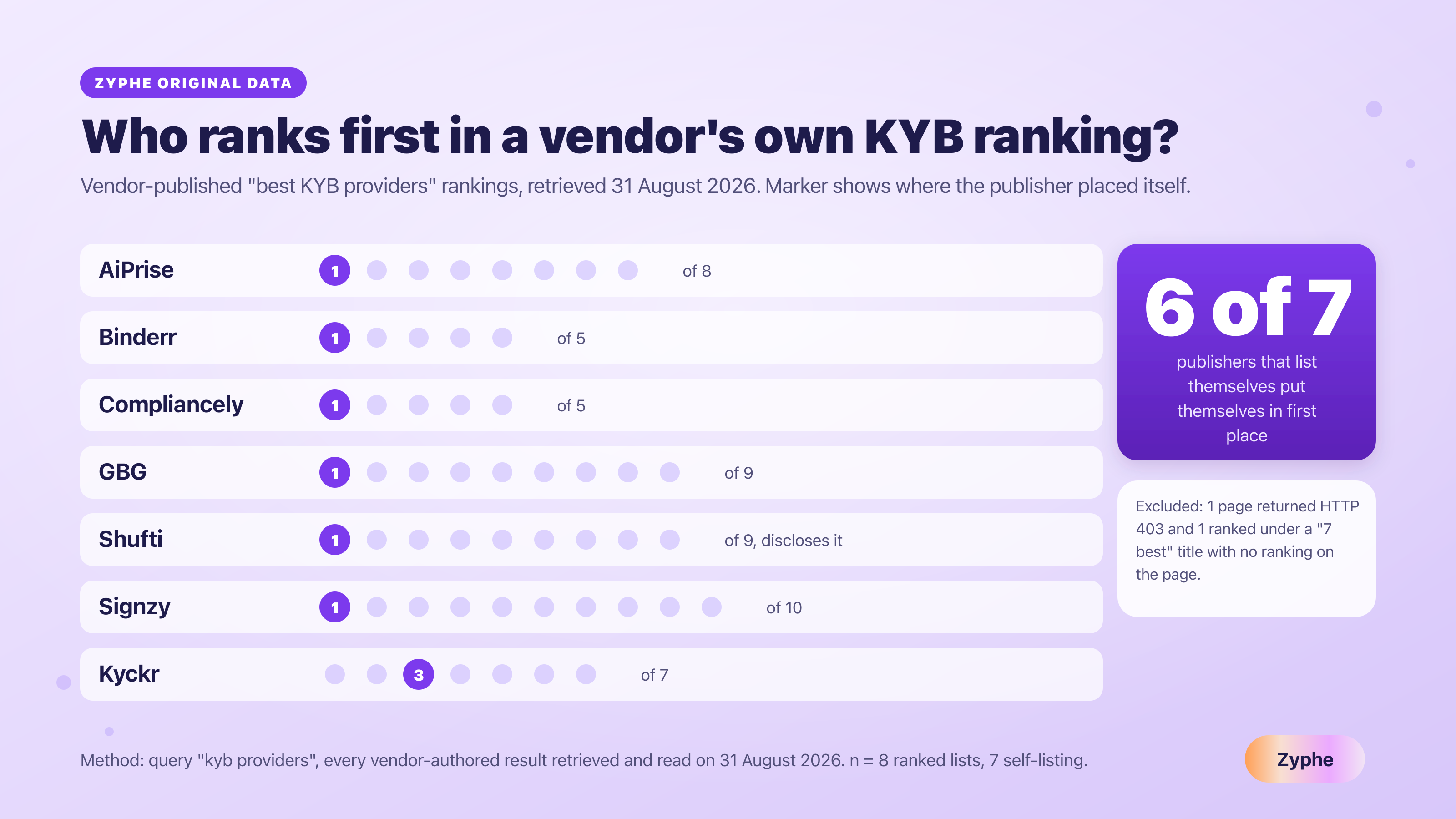
| Publisher | Vendors listed | Publisher's own position |
|---|---|---|
| AiPrise | 8 | 1 |
| Binderr | 5 | 1 |
| Compliancely | 5 | 1 |
| GBG | 9 | 1 |
| Shufti | 9 | 1, disclosed on the page |
| Signzy | 10 | 1 |
| Kyckr | 7 | 3 |
| Didit | 5 | not ranked, publisher framed as the evaluator |
The finding: of the seven rankings that include their publisher, six put the publisher in first place. The single exception is Kyckr, which places itself third behind Moody's and Dun and Bradstreet. Shufti is the only publisher that states the arrangement openly, telling readers it lists itself first and orders the remaining eight alphabetically, which is a more honest treatment than the silent version.
Two limits on this. The sample is small, it reflects one query on one day from one location, and search results vary. And we are not a neutral party running it, which is the same objection we are raising about everyone else. What the exercise does establish is that a ranked position in this category carries close to zero information, because the ranking author is almost always the winner. Zyphe does not appear in any of the nine pages we could retrieve, which is part of why we wrote this one.
The practical use is simple. When you read any KYB provider ranking, including this page, find the publisher first. If the publisher is at the top of its own list, treat the ordering as marketing and read only the underlying facts.
How should you choose between KYB providers?
Start from your own onboarding mix rather than from the shortlist. Three questions decide most of it, and we call them the JDC test: Jurisdiction, Depth, Custody. Answer all three before you open a feature matrix, because a coverage count cannot settle any of them.
Which jurisdictions are more than 5 percent of your volume? Everything below that threshold can be handled by exception, usually by a human. A provider that is excellent in 40 countries you do not sell into is not excellent for you. Pull last quarter's applications, sort by country of incorporation, and take the top decile. That is your real coverage requirement.
How deep do your ownership chains go? If your customers are mostly single-layer operating companies with two named directors, ownership resolution is close to free and you should optimise for speed and price. If you onboard holding structures, funds, or anything with a trust in it, ownership is the entire cost of the relationship and you should optimise for documentary evidence and analyst support.
What happens to the documents after the check passes? This is the question that separates KYB providers most sharply and appears on the fewest comparison pages. A director's passport image, once collected, becomes a liability that sits on someone's infrastructure for as long as your retention policy runs. Ask each vendor where that image lives, who can decrypt it, and what your exposure looks like if that vendor is breached. Then ask for it in the contract.
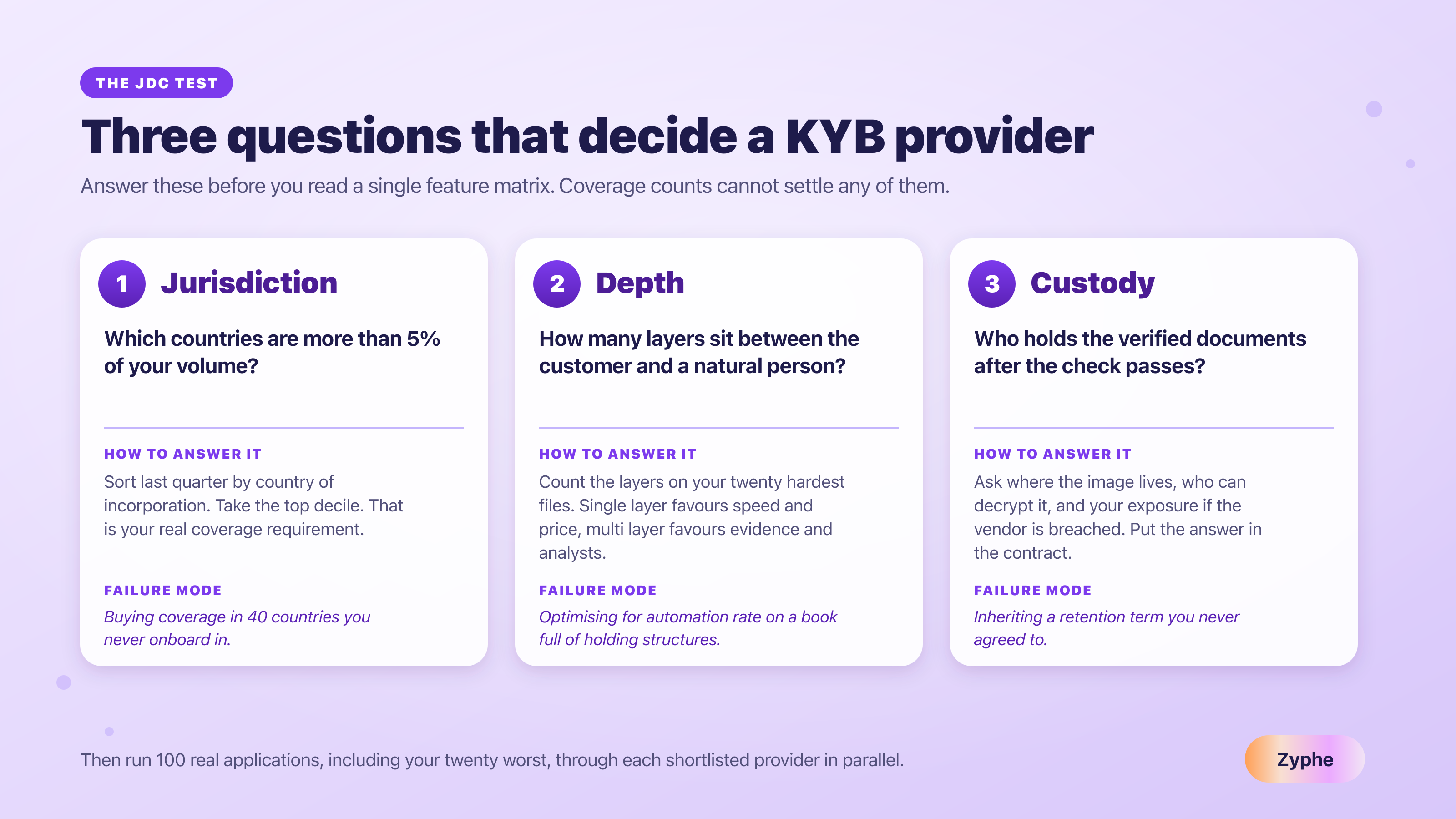
Download: the KYB provider evaluation checklist (PDF) is a one-page, print-ready version of the JDC test and the parallel-run method, sized to sit beside a vendor scorecard.
Our guide to KYB requirements sets out the obligations you are buying against, and KYB onboarding covers the flow design once the vendor decision is made.
What does the EU AML Regulation require?
Regulation (EU) 2024/1624, the AML Regulation, applies from 10 July 2027 and harmonises beneficial ownership across the Union. The threshold test is ownership or control of 25 percent or more, with member states and obliged entities able to apply lower thresholds where risk warrants it.
For provider selection, three implications matter.
The first is that a single European threshold removes an excuse. Until now a vendor could point at national variation to explain inconsistent ownership output across the bloc. From July 2027 the test is the same in every member state, and inconsistency becomes a product deficiency rather than a regulatory artefact.
The second is timing. Nine months is one procurement cycle and one integration. If you are choosing among KYB providers this quarter, you are choosing the vendor that will carry you into the AML Regulation, so ask for their roadmap commitment in writing rather than a marketing statement about being ready.
The third is that Europe is now the jurisdiction with the better ownership data, which reverses the position most vendor roadmaps were built on. If your growth plan is European, weight registry depth in the Union heavily, and treat the American coverage story as the secondary requirement it has become.
For the ownership concept itself, see the ultimate beneficial owner glossary entry and our note on UBO mapping with AI.
What makes Zyphe's KYB different?
We are one of the KYB providers in the table, so read this section with that in mind. Zyphe was ranked in the Chartis Research FCC50 2026.
Zyphe connects to 240+ corporate registries, resolves the ownership tree down to the natural persons, and then verifies each of those people using government identity documents from 190+ countries. That part of the workflow is not unusual, and several vendors above do it competently.
The structural difference is what happens next. Verified documents are not retained in a central store that we control. Records are split into encrypted fragments held across independent nodes, and the end user holds the key, which means there is no single pile of director passports to lose. For a compliance team whose board has started asking about vendor breach exposure, that changes the risk conversation from "how good is their security" to "what is actually there to take".
The second difference is the review layer. Alerts and ambiguous ownership chains are worked by analysts as part of the service rather than handed back to your team as a queue, which is the model described on our KYB software page. Sanctions and adverse media on the resolved owners run through sanctions screening, and UBO screening carries the ownership side.
Where we would not recommend ourselves: if your onboarding is 95 percent domestic American small business and your board has no particular view on stored document liability, a US-native provider with deep Secretary of State pipes will serve you better and probably cost less. That is a real answer, and any vendor that cannot give you one is selling rather than advising.
How should you run the evaluation?
Do not run a feature comparison. Run the vendors against your own failed cases.
Take 100 real applications from the last quarter, weighted the way your book is actually weighted, and include the twenty that gave your team the most trouble. Send the same set to each shortlisted provider. Then measure four things: how many resolved automatically, how many resolved correctly when you check the ownership by hand, how long the exceptions took, and how much of the exception work landed back on your team.
That exercise takes about two weeks and settles arguments that a matrix cannot. It also surfaces the failure mode that matters most, which is a provider that returns a confident answer that is wrong. A vendor with an 80 percent automation rate and honest uncertainty flags is worth more than one at 95 percent that quietly guesses, because the second one moves risk onto you without telling you.
Price the exceptions, not the API calls. Most teams discover that the automated path costs very little and the manual path costs everything, so the vendor that handles exceptions as part of the service is often cheaper in total than the one with the lower per-check headline.
When is a single provider the wrong answer?
Sometimes it is, and no vendor will tell you that.
If you onboard meaningfully in both the United States and Europe, the divergence described above means no single vendor is currently best at both. The honest architecture is a primary provider for your dominant market and a secondary source for the other, with a routing rule in between. That is more integration work and a second contract, and it is still the correct answer for a book split evenly across the Atlantic.
Equally, if your volume is under a few hundred checks a month, the entire vendor selection exercise may be premature. A registry API and a competent analyst will outperform a badly implemented platform, and you can revisit KYB providers when the volume justifies the integration. The cost of choosing early and wrongly is a migration, and migrations in this category are painful because the verified records rarely move cleanly.
The bottom line
The useful way to compare KYB providers in 2026 is not by coverage count. It is by asking which side of the transatlantic ownership divergence you are onboarding on, how deep your ownership chains actually go, and where the verified documents end up once the check has passed. The first two questions determine which vendors can do the job. The third determines what you are carrying on your own risk register afterwards, and it is the one most comparison pages, including most published by KYB providers, quietly leave out.
If you want to run that test against us, the fastest route is a parallel run on your own historic cases. Book a demo and bring your twenty worst files.
This article is general information, not legal advice. Confirm your obligations with your own compliance counsel.
Related resources
- KYB software
- UBO screening software
- Sanctions screening software
- KYB onboarding
- KYB requirements
- KYC vs KYB: the differences
- What is KYB?
- Ultimate beneficial owner (UBO)
- UBO mapping with AI
- How it works
Cited sources
- FinCEN, Beneficial Ownership Information Reporting Requirement Revision, final rule, 91 FR 52508
- FinCEN customer due diligence requirements, 31 CFR 1010.230
- Regulation (EU) 2024/1624 (AML Regulation)
- Middesk, company site and published figures
- Trulioo, company site and published figures
- Sumsub, business verification product page
- Moody's, KYC and entity data product pages
- Baselayer, business verification
- Baselayer, pricing
- Dun & Bradstreet, compliance risk and Compliance Intelligence
- GBG, GBG Detected know your business
- iDenfy, know your business solution
- Kyckr, business verification
- Kyckr, ownership discovery
- Middesk, International Business Verification release
- Ondato, business verification services
- Ondato, KYB pricing
- Persona, know your business
- Signzy, know your business
- Trulioo, KYB verification
- Trulioo, UBO Discovery
- ComplyAdvantage, Sumsub partnership announcement
Pages examined for the self-ranking study, all retrieved 31 August 2026:
- AiPrise, "8 of the Best KYB Software Providers in 2026"
- Binderr, "Top 5 Business Verification Services and Providers"
- Compliancely, "Top 5 KYB Software Providers 2026"
- GBG, "9 best KYB solutions in 2026"
- Shufti, "Best KYB Software Providers"
- Signzy, "10 Best KYB Verification Services"
- Kyckr, "Best KYB Data Providers"
- Didit, "Top KYB and Business Verification Alternatives 2026"
- iDenfy, page ranking under "The 7 Best KYB Software Providers of 2026"
Where Zyphe fits
Zyphe's own entry, identical on every comparison we publish.
- Best for
- Regulated teams that keep their KYC, KYB and AML tools but want an AI investigation layer that prepares decision-ready, evidence-backed case files.
- How it works
- Agents prepare KYC, KYB, AML and sanctions reviews with the evidence and a written rationale attached. By default your team approves each one, and your MLRO keeps final sign-off.
- Decision boundary
- The decisions AMLR Article 18(3) reserves for the obliged entity, such as the customer risk profile and whether to onboard, stay with your team. How the review desks work
- How to buy
- Agent review desks, priced per completed task with no monthly minimum, or a Growth or Enterprise plan; or the verification platform and API, priced per verification. Desk pricing · Platform pricing
- Integration
- A no-code link, a hosted flow, or the REST API with signed webhooks; SDKs for Node.js, browser JavaScript and React Native. Integration docs
- Limitations
- SOC 2 and ISO/IEC 27001 audits are in progress, with completion targeted Q4 2026. KYB register coverage depends on what each government exposes, and director data is often missing from official sources.
- Evidence
- Customer stories · Sample KYB report
 Michelangelo Frigo (Co-Founder at Zyphe) Michelangelo Frigo is a privacy and identity infrastructure expert and co-founder of Zyphe.