Sanctions and PEP false positives drain most alert budgets. See how AI alert triage clears L1 in seconds, what regulators accept, and Starling's £29M FCA fine.
Table of contents
Key highlights
- More than 90 percent of sanctions and PEP screening alerts are false positives, with industry benchmarks putting the rate between 85 and 95 percent, so most of an L1 team's day is spent clearing noise.
- A watchlist update can drop hundreds of fresh alerts into a queue overnight, which is how a single analyst ends up structurally behind before the shift starts.
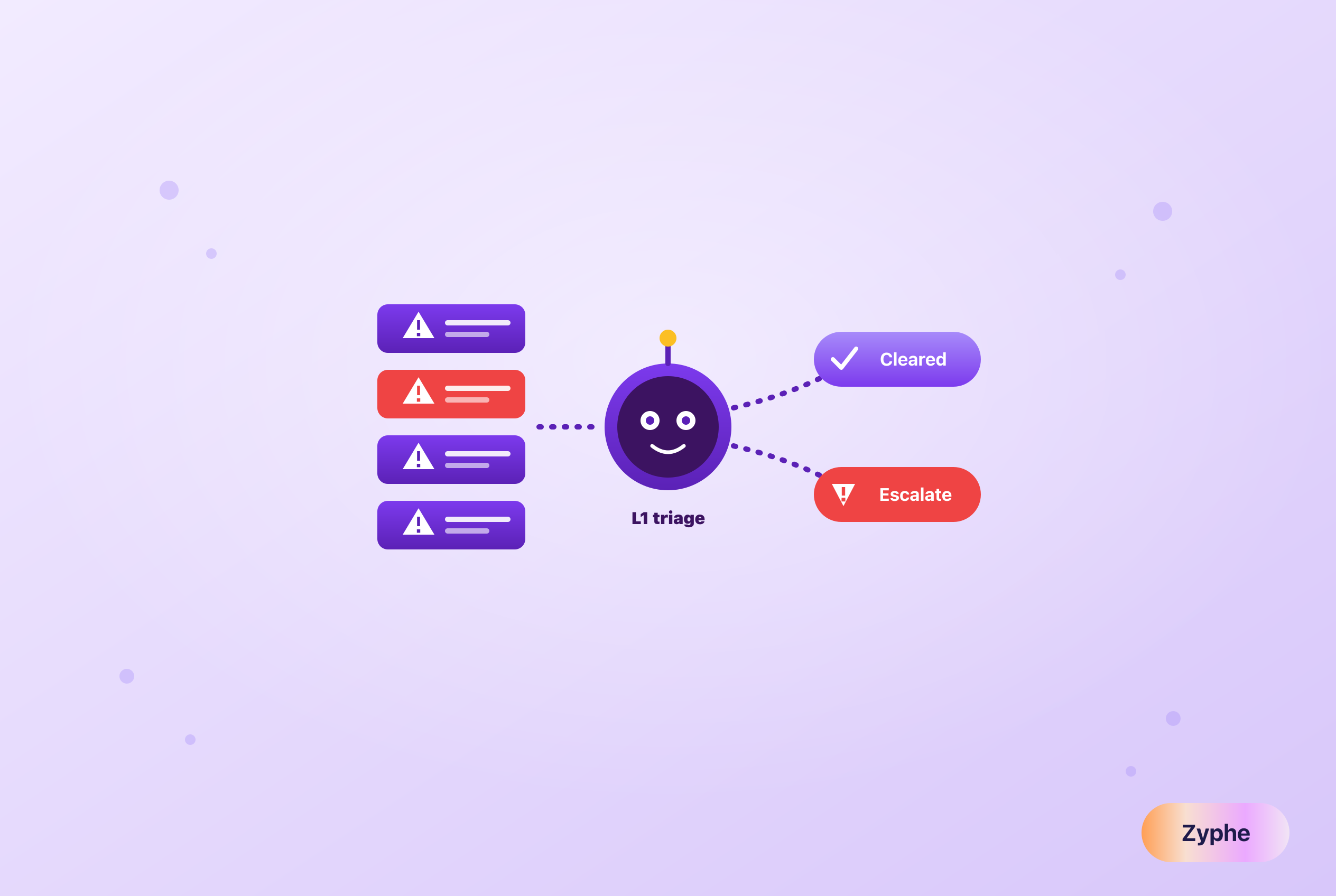
- A reasoning agent works a single alert end to end: it fetches the underlying transaction and source record, scores the match, writes a cited disposition, and escalates only the genuine candidates.
- Starling Bank shows the cost of a screening backlog left unaddressed. The FCA fined it about £29 million in 2024, and when Starling finally re-ran its base against the full UK sanctions list it generated 48,000 alerts at once.
- The durable design is analyst-in-the-loop: the agent disposes the clear-cut majority and escalates the roughly 6 percent that need human judgement.
- AI alert triage is defensible only if instrumented: case-management write-back, decision-rationale logging, and model-monitoring dashboards are the difference between a control and a guess.
AI alert triage is the use of a reasoning agent to work a screening alert end to end: it fetches the underlying transaction and source record, scores the sanctions or PEP match, writes a cited disposition, and clears the clear-cut majority while escalating the alerts that need an analyst's judgement. It replaces threshold-only rules that flag everything and resolve nothing.
TL;DR
At 2:14 a.m. Eastern the watchlist vendor pushed an update. By 9 a.m. the screening queue had 412 fresh alerts and one analyst on shift. That is the L1 reality, and it is structural: more than 90 percent of sanctions and PEP alerts are false positives, so a team spends most of its capacity clearing noise rather than catching the genuine hit hiding inside it.
AI alert triage changes the unit economics. A reasoning agent works each alert end to end, fetches the source records, scores the match, writes a cited disposition, and clears the clear-cut majority in seconds, escalating the small share that needs human judgement. Done right, with case write-back, decision logging, and model monitoring, teams cut sanctions and PEP backlogs dramatically while making each disposition more defensible, not less. Starling Bank's £29 million FCA fine is the cautionary case for what an unmanaged screening backlog eventually costs.
11 min read. Last updated 24 June 2026.
What is AI alert triage?
AI alert triage is the application of a reasoning agent to the first line of alert review. Where a rules engine flags a potential match and hands it to a human, the agent takes the alert further: it pulls the underlying transaction and the customer's source record, examines the screening hit, scores how well the match fits a real typology, and writes a disposition with its reasoning and citations. The clear-cut majority it closes; the genuine candidates it escalates to an analyst.
The point is not speed for its own sake. It is moving judgement, not just motion, off the analyst's plate, while keeping the decision traceable. This is the highest-volume surface for the AI compliance agents pattern, and it sits directly on top of your AML transaction monitoring and screening stack.
Why do threshold-only rules push every L1 team into backlog?
Threshold-only screening is built to never miss, which means it is built to over-flag. A name partially matches a sanctioned entity, a transaction crosses a value line, a country code trips a rule, and an alert is born. The result is a queue dominated by noise: more than 90 percent of sanctions screening alerts are false positives, with benchmarks ranging from 85 to 95 percent, and teams routinely spend the large majority of their investigation time dismissing matches that were never real.
That is not a tuning detail, it is the entire operating problem. Every false positive consumes the same fetch-read-document cycle as a real one, so volume, not signal, sets the workload. A single watchlist update can add hundreds of alerts overnight, and headcount cannot scale with list volatility. The reason backlogs are chronic is that the work per alert is constant while the alert count is not, and rules cannot tell the analyst which 1 in 20 is worth the time.
What does a reasoning agent do on a single alert?
Follow one alert through the agent to see where the time goes. The agent authenticates into the case-management system and opens the alert. It fetches the underlying transaction and the customer source record, then retrieves the specific screening hit, the list, the matched fields, and the strength of the match. It scores typology fit, is this consistent with a real sanctions or PEP exposure, or is it a common-name collision with no supporting signal? It writes a disposition note stating the decision, the rationale, and a citation to each record it relied on. Then it either closes the alert or escalates it with that note attached.
A redacted disposition note looks like this:
Alert 88421, customer ref 4471. Screening hit: surname match to OFAC SDN entry. Assessment: false positive. Date of birth, nationality, and address on the customer record do not match the listed individual; no adverse media or transaction pattern supporting exposure. Sources: customer record 4471, OFAC SDN entry 12993, transaction ledger 2026-06-12. Disposition: cleared, no escalation.
The whole cycle runs in seconds rather than the 20 to 30 minutes a manual review of the same alert can take, and the note is the artifact a reviewer and an examiner read.
What would AI triage have caught at Starling Bank?
Starling Bank is the case that makes the cost concrete. In 2024 the FCA fined Starling about £29 million for financial-crime and sanctions-screening failings. The bank had grown from roughly 43,000 customers in 2017 to 3.6 million by 2023, and its controls did not keep pace. For years it screened customers against only a fraction of the full sanctions list. When it eventually re-ran its customer base against the complete UK list, it generated 48,000 alerts in a single pass, a backlog that had been invisible precisely because the screening was incomplete.
A reasoning-agent triage layer would not have fixed Starling's list-coverage gap on its own, that was a configuration failure. But the 48,000-alert pile-up is exactly the scenario AI triage is built for: a sudden, large volume of mostly false-positive alerts that has to be worked quickly and defensibly. Instead of an unworkable manual queue, an agent disposes the clear majority with cited rationales and surfaces the genuine candidates for analysts within hours. The lesson is twofold: keep your screening complete, and have the capacity to work the volume it produces. We cover the underlying vendor-risk angle in why your KYC vendor is your biggest data breach risk.
How does the analyst-in-the-loop pattern work?
AI alert triage does not replace the analyst, it reshapes the queue. In the analyst-in-the-loop pattern, the agent disposes the clear-cut majority of L1 alerts and escalates roughly the 6 percent that carry genuine ambiguity or risk, with the evidence already assembled. The analyst stops dismissing noise and starts spending their time where judgement actually matters.
| Metric | Before: rules plus manual L1 | After: agent plus analyst-in-the-loop |
|---|---|---|
| Alerts per analyst per day | Constrained by 20-30 min each | Agent disposes the clear majority in seconds |
| Share needing human review | 100 percent | Around 6 percent escalated |
| Disposition note | Written by hand, variable | Cited, structured, consistent |
| Backlog after a list update | Grows for days | Worked within hours |
| Analyst focus | Clearing false positives | Genuine escalations and judgement |
The escalated cases arrive with the agent's fetched records and rationale attached, so the analyst starts from evidence rather than from a bare alert. That is where the backlog reduction comes from: not from cutting corners, but from removing the repetitive disposition work that never needed a human in the first place.
How do you instrument and govern AI triage?
AI alert triage you cannot inspect is a liability, so instrumentation is the real deployment work. Three things have to be in place.
Case-management write-back means every agent disposition is written into your system of record, Unit21, Jira, Salesforce, or your platform of choice, not a side tool, so the audit trail lives where examiners look. Decision-rationale logging means each disposition stores the model version, the records cited, and the reasoning, so any decision can be reconstructed. Model-monitoring dashboards track precision and recall over time and flag drift, so you know the agent is still performing and can show it.
On tuning, the lever is precision versus recall. You want high recall on escalation, never auto-close a genuine hit, accepting that the agent will escalate some false positives to stay safe. Validate against a human-reviewed sample on a schedule, treat the agent as a model under SR 11-7 and the NIST AI Risk Management Framework, and keep ownership named. The governance approach is the same one set out in the AI compliance agents pillar and extends naturally to SAR narrative drafting downstream.
When should a human, not an agent, make the call?
Triage automation has clear limits, and respecting them is what keeps it defensible. A genuine match, or anything the agent scores as a real candidate, goes to a human, full stop. The agent's job on those is to assemble evidence, not to decide. Auto-closing a true positive is the one error that turns an efficiency tool into an enforcement risk, which is why escalation should err toward caution.
Novel typologies are the second limit. When a pattern does not resemble anything the agent has seen, route it to an analyst rather than trusting a confident score on unfamiliar ground. And during the first weeks on a new alert population, run the agent in shadow or low-autonomy mode, comparing its dispositions against human ones, before letting it close alerts unsupervised. The goal is not maximum automation, it is maximum defensible automation, with a human owning every decision that carries real risk or a signature.
The bottom line
L1 alert triage is a volume problem dressed up as a risk problem. More than 90 percent of the queue is noise, the work per alert is constant, and headcount cannot track a volatile watchlist, which is why backlogs are chronic and why incomplete screening hides them until a re-run produces 48,000 alerts at once. AI alert triage breaks the bind by working each alert end to end and escalating only what needs a person.
Keep your screening complete, instrument the agent so every disposition is cited and reconstructable, tune for recall, and keep humans on the genuine matches. That is how you cut the backlog without cutting the control.
See the agent dispose a real alert queue, book a triage demo, or read how it works.
Related resources
- AI compliance agents: the 2026 operator guide
- Can AI draft SAR narratives in 2026?
- UBO mapping with AI
- Adverse media screening with AI
- AML transaction monitoring in 2026
- AML compliance software in 2026
- Why your KYC vendor is your biggest data breach risk
Cited sources
- Financial Conduct Authority, "FCA fines Starling Bank for failings in their financial crime systems and controls," 2024: fca.org.uk
- UK OFSI, financial sanctions guidance: gov.uk
- US Treasury OFAC, sanctions programs: treasury.gov
- Federal Reserve, SR 11-7 Guidance on Model Risk Management: federalreserve.gov
- FATF Recommendations: fatf-gafi.org
 Michelangelo Frigo (Co-Founder at Zyphe) Michelangelo Frigo is a privacy and identity infrastructure expert and co-founder of Zyphe.