The Taiwan passport photo breach took 72,702 headshots and 26,072 authorisation letters from consular websites. What it means for face matching and retention.
Table of contents
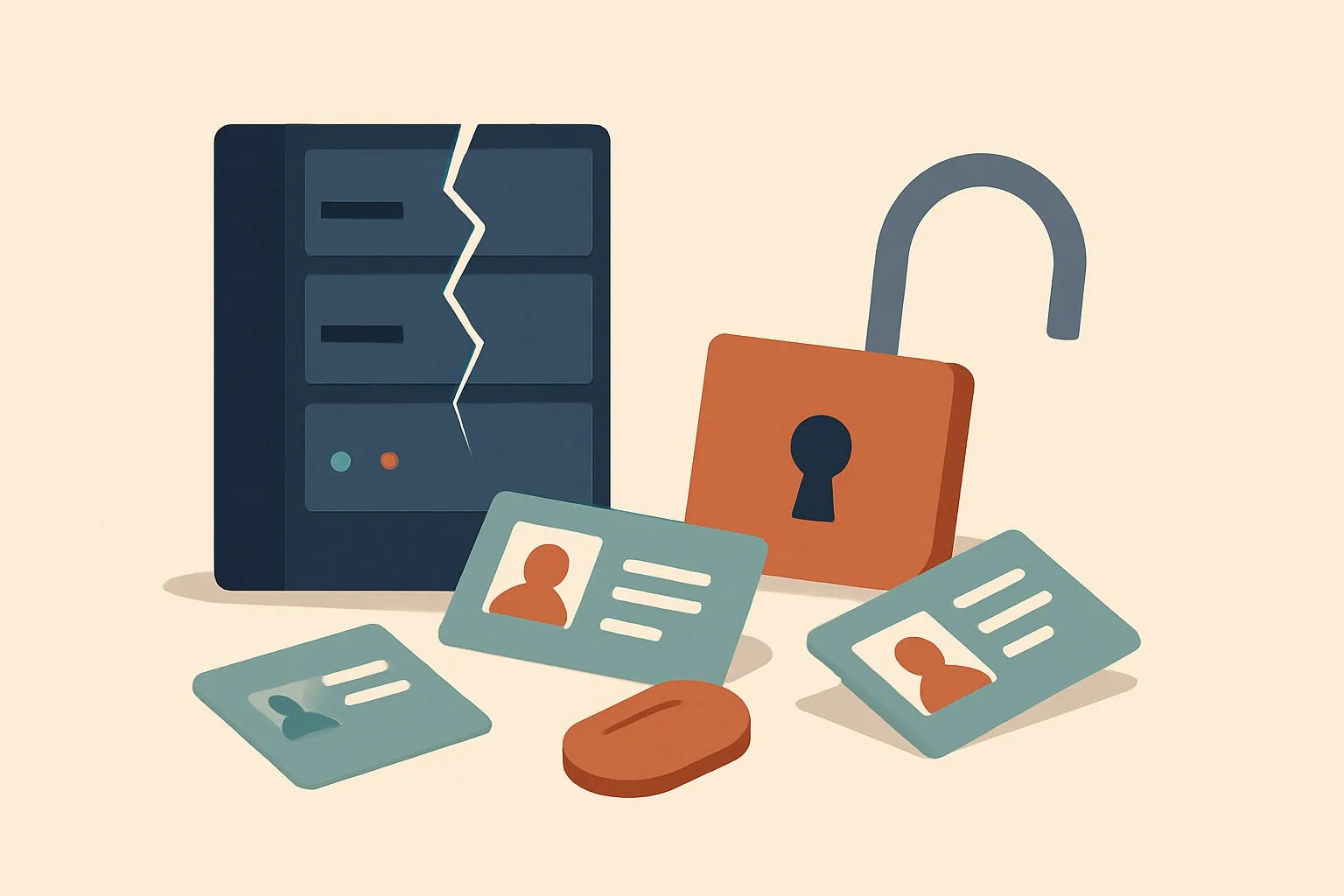
The Taiwan passport photo breach saw hackers take 72,702 passport headshot files, 26,072 scanned authorisation letters and data from 774 travel card applications from websites run by the Bureau of Consular Affairs. The bureau found the intrusion on 4 November 2026. It says names and passport numbers were not taken with the photos, and issued passports stay valid.
- The headshots taken from Taiwan's Bureau of Consular Affairs (BOCA) were uploaded between 3 September and 2 November 2026 through three online passport channels. Counter and household registration office applications were not affected.
- The 26,072 authorisation letter scans are some of the letters verified since 26 October 2011, so files up to 15 years old sat in a system that could be reached from the internet.
- BOCA says it will seek compensation from any contractor that failed its contractual security duties, and will refer the evidence to the judicial authorities.
- Taiwan's stricter breach notification article was promulgated in November 2025 but is not yet in force.
What happened in the Taiwan passport photo breach?
The passport photo breach is an intrusion into several BOCA websites that let an attacker copy files uploaded by applicants. BOCA, part of Taiwan's Ministry of Foreign Affairs, says it noticed the suspected intrusion on 4 November 2026, isolated the affected servers and reported the incident to the cyber security authority.
The bureau's account is set out in a statement on its website, published in Chinese. The page carries a publication date of 9 November 2026 and an update date of 12 November 2026, the day Taiwanese media reported the figures. BOCA says it set up a security and response task force, preserved evidence and arranged alternative procedures so that consular services could continue.
BOCA apologises in the statement and asks people who used the affected services to stay alert to misuse of their data. It says the stolen headshots and letters do not affect the validity of issued passports. In the bureau's words, "民眾無須因此立即換發護照": in our translation, people do not need to replace their passports immediately because of this. A dedicated advice channel is promised but had not been described in the statement at the time of writing.
The statement does not name an attacker or explain how the websites were entered.
What was taken, and what was not?
Three sets of data were taken, each from a different online service. The largest is 72,702 passport headshot files. The oldest is drawn from a 15 year archive of authorisation letters verified by Taiwan's representative office in New York. The third is partial data from 774 online applications for the APEC Business Travel Card.
| Data set | Volume | Period covered | What BOCA says was not taken |
|---|---|---|---|
| Passport headshots uploaded online | 72,702 files | 3 September to 2 November 2026 | Names, dates of birth, national ID numbers, passport numbers |
| Scanned authorisation letters, New York office | 26,072 files | 26 October 2011 to 6 November 2026 | Letters handled in Taiwan or by other overseas offices; birth, death, marriage and academic documents |
| APEC Business Travel Card applications | 774 applications | 1 September to 10 November 2026 | Names, passport numbers, contact details |
BOCA describes the headshots and the letters as "some of" the files (部分 in the original), so those counts are files taken, not the size of each archive. The headshots came through three channels: individual online appointments, group applications filed by travel agencies and the conditional online passport renewal service. For the travel card applications, the stolen fields were the applicant's photo, application number, gender, application category, place of birth, job title and recommending agency.
BOCA does not say what personal data the authorisation letters contain. An authorisation letter is a document in which one person empowers another to act for them, so readers should assume the scans hold more than a photograph until the bureau says otherwise.
Why does a passport photo breach matter if no names were leaked?
A passport photo breach matters because the face is the one identifier a person cannot change, and remote identity checks rely on it. The stolen files are recent, standards-compliant portraits submitted for new passports. That makes them useful raw material for anyone trying to defeat a face match, with or without a name attached.
Remote onboarding commonly compares a live selfie with the portrait on an identity document. A portrait taken for a passport application is, by design, close to the one that will appear on the issued passport. An attacker who holds that portrait has a head start on building a face swap or a synthetic video aimed at the comparison step. Hong Kong's regulator named deepfakes as a driver of impersonation risk in its remote onboarding circular of September 2026.
The claim that nothing directly identifying was taken also deserves care. A face can be matched against other photographs of the same person. The travel card set pairs each photo with a place of birth, a job title and a recommending agency, which narrows the field considerably for a small population of business travellers.
What does the breach mean for KYC and data protection obligations?
For regulated firms, the passport photo breach touches five duties: notifying individuals, notifying the authority, retention, outsourcing and the face match inside customer due diligence. Taiwanese law governs BOCA itself. Firms elsewhere should read the incident against their own regime, because the same failure modes apply to any archive of identity images.
On notification, Taiwan's Personal Data Protection Act is in transition. The Article 12 now in force, shown in the database's prior version of the Act (in Chinese), requires an agency whose breach of the Act leads to data being stolen or leaked to notify the people affected by appropriate means once the facts are established. An amended Article 12, promulgated on 11 November 2025, reads: "When a government or non-government agency becomes aware that the personal data it holds has been stolen, altered, damaged, lost, or leaked, it shall notify the data subject." It also requires a report to the authority in defined cases. The official law database flags the 2025 amendments as not yet in force, with the date to be set by the Executive Yuan.
The EU comparison is the GDPR, where Article 33 requires a controller to notify the supervisory authority without undue delay and, where feasible, within 72 hours of becoming aware, and Article 34 requires telling individuals when the risk to them is high.
On retention, Article 11 of the same Act, which is in force, requires an agency to "erase or cease processing or using the personal data" when the purpose of collection no longer exists or the period expires, unless processing is necessary for an official or business duty or the person has agreed in writing. Fifteen years of authorisation letter scans in a web-reachable system is the kind of archive that provision is aimed at.
On outsourcing, Article 10 of the Cyber Security Management Act, as amended in September 2025, requires agencies that outsource systems to "select appropriate contractors", supervise their security and set out breach liabilities in a written agreement. Article 4 of the Personal Data Protection Act treats a commissioned party as acting on behalf of the commissioning agency, so responsibility towards the people affected stays with the agency.
On customer due diligence, the lesson is about what a face match proves. Under the GDPR, Recital 51 says photographs count as biometric data "only when processed through a specific technical means" that allows unique identification, the test set by Article 4(14). Stored portraits become biometric inputs the moment someone runs them through a matcher, lawful or not. A check that only compares a selfie file with a document portrait cannot tell the holder from someone replaying their photograph.
| Duty | Rule | What the incident tests |
|---|---|---|
| Notify individuals | PDPA Article 12 in force; amended Article 12 not yet in force | Whether notice waits for an investigation or follows awareness |
| Notify the authority | GDPR Article 33 for EU controllers | Whether the authority is told without undue delay, within 72 hours where feasible |
| Erase when purpose ends | PDPA Article 11 | Identity files kept online for 15 years |
| Oversee contractors | Cyber Security Management Act Article 10; PDPA Article 4 | Who answers when a supplier's controls fail |
| Verify identity remotely | GDPR Recital 51 and Article 4(14); HKMA circular, September 2026 | Whether a face match can tell a stolen portrait from its owner |
What is still uncertain about the passport photo breach?
The cause, the attacker and the full scope are all still open. BOCA's figures are explicitly interim, the statement does not explain how the websites were entered, and no contractor has been named. Two of the three periods BOCA gives end after 4 November, the day it says it found the intrusion, and the statement does not explain why.
First, the finding that no names or passport numbers were taken with the headshots is, on BOCA's wording, the result of the investigation to date. Second, the contents of the 26,072 authorisation letters are not described, so the sensitivity of the oldest and longest-held data set is unknown. Third, the statement does not say whether individuals will be contacted one by one. With 72,702 photo files and, on BOCA's account, no names attached to them, it is not obvious how the bureau would do so.
Who pays for the passport photo breach is also unsettled. BOCA says it will pursue any contractor found to have breached its security obligations, which implies outsourced systems were involved but does not confirm it. Article 28 of the Personal Data Protection Act makes government agencies liable for damage caused by a breach of the Act, with compensation of NT$500 to NT$20,000 per person per incident where actual damage is hard to prove, and a general cap of NT$200 million for a single incident. Whether a breach of the Act occurred is unanswered.
The incident also lands during a run of attacks. The Taipei Times reported a Cyber Security Administration official as saying about 8 million personal data records had been affected by attacks on Taiwanese organisations in recent weeks. That figure is the official's estimate as reported, not a BOCA number.
How does it compare with other identity image breaches?
The Taiwan passport photo breach is smaller than this autumn's largest identity image exposures but unusual in two respects: the victim is a passport issuer, and the images are portraits without documents. Other recent cases involved photographed licences and passports held by private firms or state motor vehicle systems.
| Incident | Holder | Images involved | Scale published |
|---|---|---|---|
| Taiwan BOCA, November 2026 | Passport issuer | Passport headshots, authorisation letter scans | 72,702 headshots; 26,072 letters |
| Times Car, October 2026 | Car sharing operator | ID document images | 1.6 million people |
| DigiCert, November 2026 | Certificate authority | ID documents in a validation archive | Not published |
| Florida DMV, October 2026 | State licensing agency | Document images possibly exposed | Not published |
The common thread is where the files sat. In the Times Car breach and the DigiCert incident, images collected for a one-off check stayed in a system long after the check was done. BOCA's New York archive follows the same pattern over a longer period. In the Florida DMV breach, the agency said document images may have been accessed.
How should compliance teams respond?
Treat the passport photo breach as a test of your own image handling, not as a Taiwan-only event. No firm can screen its customers against the stolen files, because BOCA has released no list of affected people and says no names were taken with the photos.
Start with the face match. Confirm that your remote onboarding tests for a live person and for injected video, and does not rely on comparing two still images.
Then look at uploads. List every web form that accepts an identity image, where the file lands and when it is deleted. Set a deletion trigger for each store and prove that it runs.
Finally, review supplier contracts for the points Taiwan's law spells out: security duties, supervision rights and liability for a breach.
Zyphe verifies identity by reading the NFC chip of an ICAO 9303 document with two-step liveness and no image upload. Documents and biometrics are encrypted into the user's own vault, split across thousands of nodes, and the business receives verification results and proofs, so there is no central store of customer PII to copy. To see how liveness detection fits your flow, book a demo.
The bottom line
The Taiwan passport photo breach shows that an identity image is a liability wherever it is stored, even at the authority that issues the passport. Portraits uploaded for a routine application and letters filed years ago sat within reach of the public internet, and both were copied. A face match needs proof of a live person behind it, uploads need a deletion date that is enforced, and a supplier's security failure remains the commissioning organisation's problem.
Cited sources
- Bureau of Consular Affairs statement on the hacking of some of its websites, published 9 November 2026 and updated 12 November 2026 (in Chinese)
- Personal Data Protection Act, official English text, Articles 4, 11, 12 and 28
- Personal Data Protection Act, official Chinese text with in-force status note
- Personal Data Protection Act, prior version showing the Article 12 currently in force (in Chinese)
- Cyber Security Management Act, official English text, Article 10
- GDPR Article 33, notification of a personal data breach to the supervisory authority
- GDPR Article 34, communication of a personal data breach to the data subject
- GDPR Recital 51, photographs and biometric data
- GDPR Article 4, definitions, including biometric data
- Taipei Times, secondary reporting: Hack affects 8 million records, 13 November 2026
 Michelangelo Frigo (Co-Founder at Zyphe) Michelangelo Frigo is a privacy and identity infrastructure expert and co-founder of Zyphe.