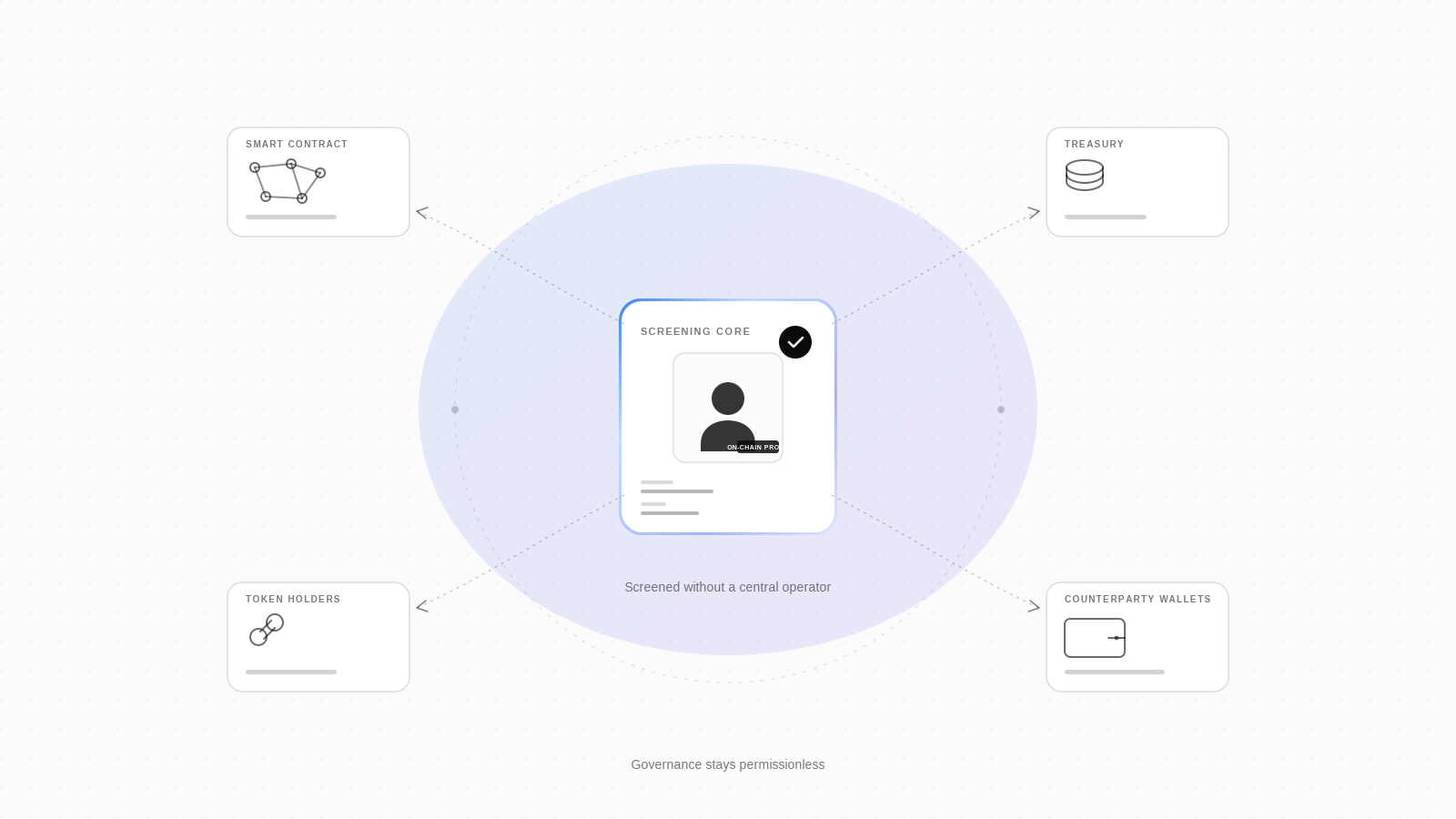
AML for DAO is the on-chain transaction monitoring, treasury AML, sanctions screening, and SAR filing layer that DAOs (Decentralised Autonomous Organisations) operate to satisfy FATF Recommendation 16, MiCA Title V, and the legal precedent that DAOs and token-voting members can face direct liability under CFTC v. Ooki DAO and bZx case law.
What does DAO AML actually have to do?
AML for DAO coverage spans four functions on-chain and at the governance layer.
- Treasury AML. DAO treasuries hold funds, typically across multiple chains and instruments. Treasury inflows, outflows, and counterparties have to be monitored against sanctions, mixer interaction, and high-risk-jurisdiction patterns.
- Protocol-level transaction monitoring. Where the DAO operates a protocol (lending, DEX, derivatives), protocol flows have to be monitored for the same crypto-AML typologies as a centralised exchange.
- Sanctions screening at every layer. Smart contract addresses, treasury counterparties, governance participants where token holdings cross materiality thresholds.
- Governance-layer access controls. Where ZKP-gated voting is used, the credential layer is part of the governance access path.
For the deeper crypto-AML pattern, see our AML for crypto industry page. For the DAO regulatory framing, see our regulatory compliance for DAOs piece.
What does the Ooki DAO precedent mean for DAO AML?
The CFTC v. Ooki DAO default judgment of June 2023 (USD 644K civil monetary penalty plus injunctive relief) established three precedents that materially shaped the AML for DAO category in 2026.
First, DAOs can be sued. The CFTC argued that a DAO’s collective members operating through governance proposals constitute an unincorporated association under California law and can be served process. The court agreed.
Second, token-voting members face personal liability. The default judgment was not against an abstract “DAO” but against the unincorporated association of members who had voted on governance proposals to launch and operate the protocol. Token holders who voted are exposed.
Third, the “code is law” defence does not survive. The CFTC and the court treated the protocol as a regulated activity (in this case, illegal off-exchange digital-asset trading) regardless of the on-chain architecture. The compliance program has to satisfy the regulator’s substantive expectations, not point at smart contracts as a get-out-of-compliance card.
The bZx case before Ooki produced the same conclusion in a Northern District of California ruling. The Tornado Cash designation extended the pattern to smart contracts themselves.
What are the regulatory baselines for DAO AML?
European Union: MiCA Title V, EU TFR zero-threshold, AMLA
Where the DAO has CASP-equivalent activities (custody, exchange, transfer of crypto-assets), MiCA Title V applies after July 1, 2026. EU TFR’s zero-threshold Travel Rule applies to all crypto transfers. AML supervision sits with the national competent authority; AMLA takes over direct supervision only of the about 40 entities it selects in 2027, starting in 2028.
United States: FinCEN MSB, OFAC, CFTC, SEC
The Ooki DAO and bZx precedents establish CFTC jurisdiction over DAO-operated protocols where regulated activity occurs. OFAC sanctions screening obligations are universal. FinCEN MSB registration is required for DAOs operating money-transmission activities.
FATF: Recommendation 16 (Travel Rule), DeFi guidance
FATF’s October 2024 update extended VASP obligations to DeFi arrangements with “sufficient control or influence.” DAOs with material governance authority over a protocol are within scope.
Side-by-side: DAO AML obligations
| Dimension | EU | US | FATF |
|---|---|---|---|
| Primary statute / framework | MiCA Title V + AMLR + AMLD6 | CFTC + SEC + FinCEN + OFAC | Recommendation 16 + October 2024 update |
| DAO legal entity question | Member-state-specific | Unincorporated association (Ooki precedent) | n/a (international standard) |
| Smart-contract sanctions | EU consolidated list (Tornado Cash analogue) | OFAC SDN (Tornado Cash designated Aug 2022) | National implementation |
| Travel Rule | EU TFR zero-threshold | USD 1,000 + counterparty rule | Recommendation 16 floor |
| Recent precedent | MiCA July 2026 transition | Ooki DAO USD 644K (Jun 2023), bZx (CA) | FATF October 2024 DeFi update |
Where do DAO AML programs fail, and what does it cost?
Five reproducible failure modes.
“Code is law” defence used as compliance strategy
The Ooki DAO and bZx precedents closed this defence. The AML for DAO system has to ship substantive compliance, not architectural exceptionalism.
Treasury sanctions screening absent
DAO treasuries holding funds in multiple wallets across multiple chains, with no sanctions screening at counterparty layer, inherit the OFAC enforcement risk that brought down Tornado Cash.
Governance-layer KYC absent for token holders above threshold
Where token holders above material thresholds face direct liability under Ooki precedent, the absence of credential gating on governance participation is a known liability surface.
Protocol-level monitoring missing
Where the DAO operates a protocol (lending, DEX, derivatives), protocol flows need monitoring for crypto-native typologies. Most DAOs ship the protocol without the monitoring layer.
Cross-chain layering through DAO-operated bridges
Where the DAO operates a cross-chain bridge or cross-chain protocol, layering through the bridge becomes a core risk surface. Stack has to integrate with chain-analysis tooling at protocol level.
Recent precedent timeline
| Date | Action / precedent | Why it matters for DAO AML |
|---|---|---|
| Aug 2022 | OFAC designates Tornado Cash | Smart contracts can be sanctioned |
| 2022 | bZx Decentralized AutoNomous Organization (Northern District of California) | DAO members liable as unincorporated association |
| Jun 2023 | CFTC v. Ooki DAO default judgment | USD 644K, personal liability for voting members |
| Oct 2024 | FATF DeFi guidance update | VASP obligations extend to DeFi with “sufficient control” |
| Jul 2026 | MiCA transition deadline | CASP obligations apply where DAO has CASP-equivalent activity |
How does Zyphe deliver DAO AML without centralising governance?
Zyphe ships four primitives.
Treasury AML at counterparty layer. Real-time monitoring of treasury inflows, outflows, and counterparty wallets. Sanctions screening at every transaction. Mixer interaction detection. High-risk-jurisdiction flagging.
Protocol-level transaction monitoring. Where the DAO operates a protocol, on-chain monitoring runs against the protocol contracts with crypto-native typology coverage (peeling chains, layering, mule indicators, structuring at deposit). See our KYC for DeFi protocols guide.
ZKP-gated governance. Token holders prove eligibility (KYC tier, sanctions clearance, jurisdictional residency) through zero-knowledge proof without revealing the underlying identity to the on-chain governance system. The governance contract verifies the proof. Eligible token holders vote. Ineligible token holders are blocked at the credential layer. See our ZKP in production KYC piece.
Audit-trail reproducibility. Per-decision triage records on every alert. Treasury transaction history with policy-version tracking. Governance-vote eligibility records bound to the credential layer. Audit-export available in regulator-ready formats.
A DAO contributor at a top-30 treasury-holding DAO framed the post-Ooki shift on a customer call in March 2026: “before Ooki we treated compliance as an opt-in conversation among contributors. After Ooki we treated it as a structural decision because token holders had personal exposure. The Zyphe credential layer let us add the eligibility check on governance without forcing every voter through a centralised KYC vendor.”
How do you implement DAO AML across protocol-level monitoring, treasury AML, and ZKP-gated voting?
Three patterns.
Treasury AML
Real-time monitoring of treasury wallets across chains. Sanctions screening on counterparty wallets. Approval workflow for outflows above policy threshold (multi-sig with compliance attestation). Audit-export per period for treasury reporting.
Protocol-level monitoring
Where the DAO operates a protocol: integrate Zyphe monitoring with protocol contracts. Flows score in real time at transaction submission. Sanctioned counterparty detection. Crypto-native typology coverage (FATF Recommendation 20 plus crypto-specific patterns).
ZKP-gated governance
Token holders verify KYC once with Zyphe. Credential lives in the wallet. When the holder votes on governance, the smart contract requests a ZKP attestation that the holder meets policy criteria (KYC tier, jurisdictional whitelist, sanctions clearance, age threshold). Eligible holders vote. Ineligible holders are blocked. The on-chain governance system never sees the underlying identity.
What are the real edge cases DAO AML still struggles with?
Five edge cases worth flagging.
Token holders below material threshold. Where individual token holdings are below the materiality threshold for personal liability. The architectural answer is to gate by token-weighted vote influence, not by individual holding alone.
Multi-sig signer KYC. Where the DAO uses a multi-sig for treasury operations, every signer needs KYC binding plus sanctions clearance.
Cross-DAO collaboration. Where two DAOs collaborate on a protocol, AML obligations may attach to both, with overlapping but non-identical regulatory exposure.
Rage-quit and exit-mechanism design. Where governance includes the ability to exit, exit flows need monitoring against laundering through the exit mechanism.
Treasury custody contention. Where the treasury is partially custodial and partially smart-contract-controlled, AML obligations split between the custodian and the DAO.
How do you evaluate DAO AML in the next 30 days?
Five concrete moves for a DAO contributor, governance participant, or DAO-affiliated legal counsel.
- Map your DAO’s regulatory exposure. Treasury activity, protocol activity, governance participation. Each surface has different obligations.
- Audit treasury sanctions screening. Pull the last 90 days of treasury counterparty transactions. Confirm sanctions screening was applied to each.
- Pressure-test the Ooki precedent applicability. Where governance proposals could be characterised as operating a regulated activity, the precedent attaches. Document residual risk.
- Pilot ZKP-gated voting. A single governance proposal with credential-based eligibility. Measure voter turnout and eligibility-verification friction.
- Update DAO legal-counsel documentation. Per-decision documentation for your national supervisor, FATF VA guidance, and the Ooki / bZx precedent stack.