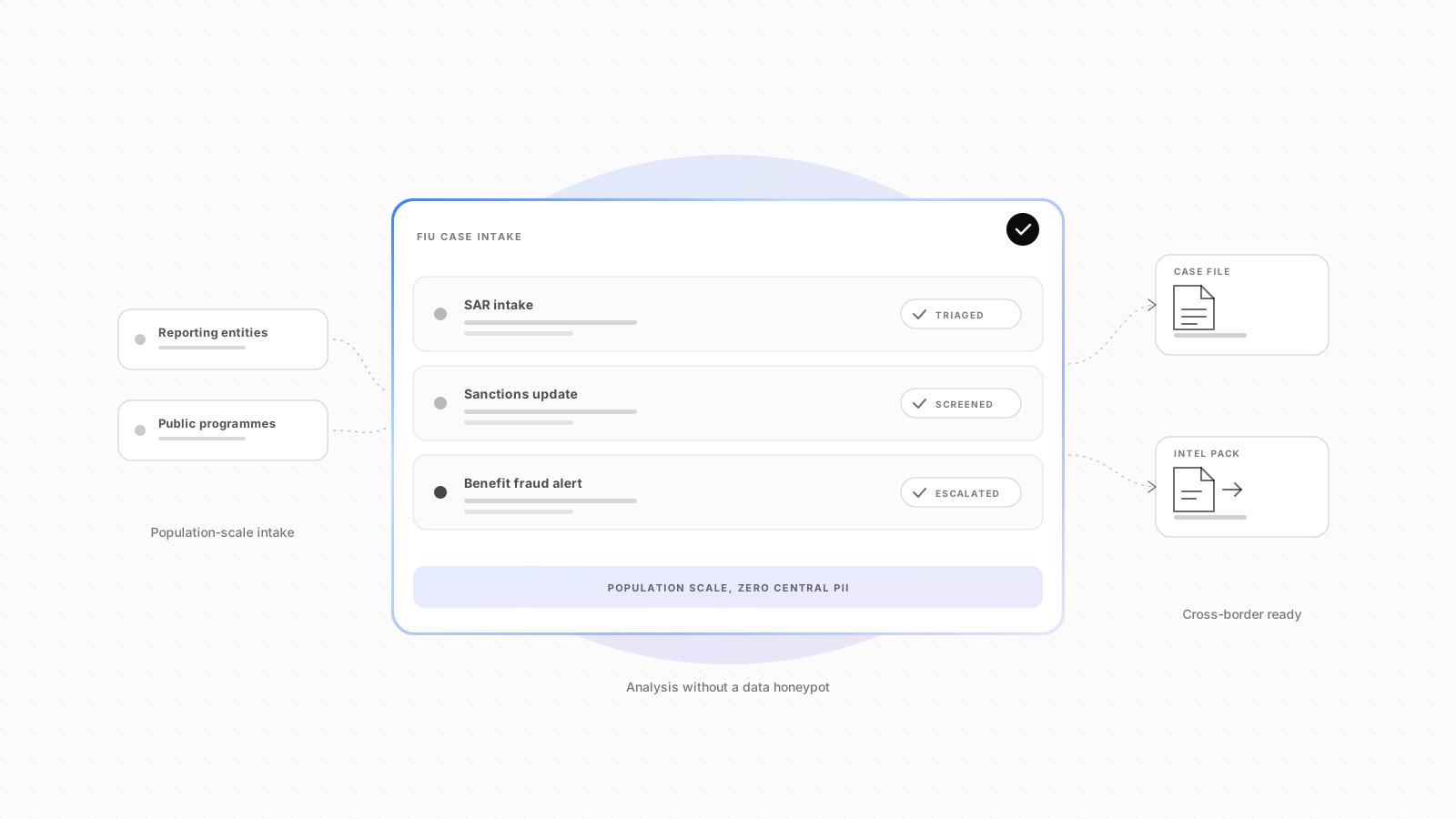
AML for government is the SAR-handling, sanctions-implementation, benefit-fraud-detection, and public-sector transaction-monitoring layer. Financial Intelligence Units (FIUs), sanctions authorities, benefit administrators, and government regulators operate it to satisfy FATF mutual evaluation obligations and population-scale AML mandates. It runs at scale without centralising citizen PII into single breach targets.
What does government AML actually have to do?
Coverage spans four functions across the public-sector AML surface.
- FIU SAR handling. Financial Intelligence Units receive, analyse, and disseminate SARs from regulated entities. Examples include FinCEN, NCA in the UK, TRACFIN in France, FIAU in Malta, BFIU in Belgium, and equivalent FIUs in every FATF member jurisdiction. Volume scales materially: FinCEN’s 2024 SAR volume was approximately 4.6 million.
- Sanctions implementation and enforcement. OFAC in the US, OFSI in the UK, EU Council sanctions, UN Security Council sanctions. The implementing authority maintains lists, prosecutes evasion, and supervises private-sector compliance.
- Benefit fraud detection. Welfare benefits, healthcare benefits, public-sector procurement fraud, COVID-era PPP and unemployment fraud (US estimated USD 280B+).
- Cross-border AML cooperation. FATF mutual evaluation, Egmont Group FIU information sharing, EU AMLA’s coordination role, MLA (Mutual Legal Assistance) treaty execution.
For the underlying KYC pattern in public-sector identity programmes, see our KYC for government industry page.
How does the public-sector AML role differ from regulated-business AML?
The public-sector body is typically a supervisor, intelligence consumer, or enforcement authority, not an obligated entity.
Lawful basis
The lawful basis for processing personal data is public interest rather than contract. In the EU, that is GDPR Article 6(1)(e) public interest, not Article 6(1)(b) contract. The US and UK rely on equivalent statutory authority.
Breach impact
The breach-impact calculation is population-scale:
- A breach of a national FIU database affects every person whose financial activity has been the subject of a SAR ever filed.
- A breach of a sanctions-implementation database affects every regulated entity that submitted compliance reports.
- A breach of a benefit-administration system affects every claimant.
The procurement decision for public-sector programmes is therefore architecturally heavier than for any private-sector AML category.
Regulatory framework
The regulatory framework flows from three sources:
- International commitments: FATF mutual evaluation, FATF Recommendations adoption
- Domestic statutes: BSA in the US, MLR 2017 in the UK, AMLR/AMLD6 in the EU
- Supervisory arrangements: FATF, MONEYVAL, GAFILAT, APG, ESAAMLG, GIABA, MENAFATF, CFATF assessments
Failure to meet FATF mutual evaluation standards can trigger grey-listing or black-listing with material economic consequences.
What are the regulatory baselines for government AML internationally?
FATF: Recommendations 1-40, mutual evaluation, grey-listing/black-listing
FATF’s 40 Recommendations form the international AML/CFT standards. FATF mutual evaluation cycles assess each member jurisdiction against technical compliance and effectiveness immediate outcomes. Grey-listing (Increased Monitoring) and black-listing (Call for Action) drive material capital flow consequences.
European Union: AMLA, AMLR, AMLD6, EU Council sanctions, eIDAS 2
AMLA’s role includes:
- direct supervision, from 2028, of about 40 credit and financial institutions it selects in 2027
- coordination of national supervisors
- drafting technical standards under the AML Regulation
EU Council sanctions implementation coordinates across member states. The eIDAS 2 EU Digital Identity Wallet creates the architectural anchor for citizen-controlled identity in compliance contexts.
United States: FinCEN, OFAC, FBI, CFTC, SEC, federal banking regulators
FinCEN is the FIU and the lead BSA supervisor. OFAC is the sanctions authority. FBI handles AML criminal enforcement. The CFTC, SEC, OCC, Federal Reserve, and FDIC all carry sectoral AML supervision.
United Kingdom: NCA, HMRC, OFSI, FCA, PRA
NCA hosts the SAR Online regime. HMRC supervises certain sectors directly. OFSI handles sanctions implementation. FCA and PRA cover financial-services AML supervision.
Side-by-side: government AML obligations
| Dimension | EU | US | UK | International |
|---|---|---|---|---|
| FIU | Member-state-specific (TRACFIN, FIAU, etc.) + AMLA coordination | FinCEN | NCA SAR Online | Egmont Group |
| Sanctions authority | EU Council | OFAC | OFSI | UN Security Council |
| Cross-border framework | AMLA + Egmont | OFAC reciprocity + FATF | OFSI + FATF | FATF Recommendations |
| Recent landmark | AMLA operational from 2025 | FinCEN AML/CFT program reform NPRM, Apr 2026, proposed | OFSI sanctions enforcement uplift 2025 | FATF October 2024 DeFi guidance update |
| Mutual-evaluation cycle | FATF + MONEYVAL | FATF | FATF | Per regional body |
Where do public-sector AML programs fail, and what does it cost?
Five reproducible failure modes.
SAR handling at scale without intelligence triage
FIUs receive millions of SARs annually with limited capacity to triage and disseminate. The signal-to-noise ratio is low.
Sanctions implementation drift across jurisdictions
OFAC, EU Council, UK OFSI, UN Security Council sanctions lists diverge across jurisdictions. Private-sector entities operating cross-border face conflicting obligations.
Benefit fraud detection at population scale
The COVID-era PPP and unemployment fraud (US estimated USD 280B+ across federal programs) demonstrated that population-scale benefit fraud detection was an architectural failure.
Cross-border MLA execution
Mutual Legal Assistance treaty execution typically takes 18-24 months for criminal AML cases.
Citizen-data breach exposure
Public-sector AML databases concentrating SAR data, sanctions-screening data, and benefit-claim data create the largest population-scale breach surfaces in any sector.
Recent enforcement and incident timeline
| Date | Event | Why it matters for government AML |
|---|---|---|
| 2020-2022 | COVID-era PPP and unemployment fraud | Estimated USD 280B+ benefit fraud across US federal programs |
| 2022 | OFAC designates Tornado Cash | Smart contracts can be sanctioned (public-sector implementation challenge) |
| 2024 | EU AMLA Regulation adopted | New supervisory authority, operational from 2025 |
| 2024 | FATF mutual evaluation cycle continues | Effectiveness immediate outcomes raise documentation bar |
| 2024 | FinCEN 2024 SAR volume ~4.6M | FIU triage at scale becomes architectural problem |
| 2025 | AMLA operational in Frankfurt | Direct supervision of about 40 selected entities starts in 2028 |
| Apr 2026 | FinCEN AML/CFT program reform NPRM | Proposed, not final. Would refocus private-sector programs on effectiveness over reporting volume |
How does Zyphe deliver government AML without centralising citizen data?
Zyphe ships four primitives.
Decentralised credential verification. This applies where the public-sector authority interacts with citizen identity (benefit claim verification, regulated activity verification). The credential layer carries the verification without centralising the underlying PII. Source documents are sharded across thousands of decentralised storage nodes with the citizen holding the encryption key.
Identity-linked transaction monitoring on public-sector flows. Where the public-sector entity disburses funds (benefits, procurement, grants, tax refunds), monitoring runs against the credential layer. Identity attributes are available at rule time. Mule indicators, structuring at deposit, and sanctions exposure surface deterministically.
Audit trail with no central PII store. Per-decision triage records, sanctions-screening logs, and SAR-related data flows are timestamped and signed without centralised PII storage. Per-decision documentation, FATF effectiveness immediate outcomes, and FOIA-compatible audit trails coexist.
Cross-border interoperability. This applies where the public-sector entity coordinates with foreign FIUs or sanctions authorities. The eIDAS 2 EU Digital Identity Wallet, EBSI (European Blockchain Services Infrastructure), and Egmont Group standards integrate with the credential layer.
A senior policy lead at a European national FIU framed the architectural shift on a customer call in March 2026: “FATF’s effectiveness-based mutual evaluation cycle is what’s reshaping the procurement conversation. The technical-compliance box-tick is no longer enough. Effectiveness immediate outcomes require documented audit trails at every dthe AML for government architecturend the AML for government architecture decision is whether your stack produces those trails as a side effect or as a synthesis project.”
How do you implement government AML across FIU, sanctions, and benefit-fraud?
Three patterns.
FIU SAR handling
- Ingest SARs from regulated entities.
- Triage with rule-based and ML-based prioritisation.
- Disseminate to enforcement teams with structured case files.
- Share information across FIUs under Egmont Group standards.
- Audit-export per period for FATF mutual evaluation.
Sanctions implementation
- Maintain the authoritative sanctions list (OFAC SDN, EU Council, UK OFSI, UN Security Council).
- Distribute it to private-sector entities through documented channels.
- Receive sanctions-screening reports from regulated entities.
- Investigate suspected violations.
Coordination across implementing authorities follows established cross-border channels.
Benefit fraud detection
- Identity-linked claim verification at submission.
- Continuous re-screening of claimant credentials.
- Pattern detection across claim populations (multiple claims from same identity, structuring at threshold, geo-IP anomalies).
- Cross-programme correlation (welfare + unemployment + healthcare) to detect mule-pattern fraud.
What are the real edge cases government AML still struggles with?
Five edge cases worth flagging.
Cross-FIU information sharing latency. Egmont Group standards exist but execution time varies materially across jurisdictions.
Sanctions list synchronisation across implementing authorities. OFAC, EU Council, UK OFSI, UN Security Council lists diverge in timing and scope.
Benefit fraud across federal-state-local boundaries. Where claims span multiple administrative units, cross-program correlation is hard without shared identity infrastructure.
FATF effectiveness measurement. Effectiveness immediate outcomes are harder to evidence than technical compliance with the 40 Recommendations.
Population-scale identity binding without centralisation. The architectural challenge that defines the AML for government category. The eIDAS 2 EU Digital Identity Wallet rollout is the EU regulator’s preferred approach.
How do you evaluate government AML in the next 30 days?
Five concrete moves for a public-sector AML lead, FIU technology officer, or benefit-administration head.
- Map your population-scale breach surface. What identity data does the AML for government system centralise? What would the breach impact be?
- Audit FATF mutual evaluation alignment. Where does your jurisdiction’s last evaluation flag effectiveness gaps?
- Pressure-test cross-FIU information sharing. Egmont Group standards execution time. If MLA-equivalent execution takes more than 30 days, the AML for government architecture is the problem.
- Inventory benefit fraud detection coverage. Pattern detection across cross-program populations. Identity-linked claim verification at submission.
- Update DPIA and FATF technical compliance documentation. Documentation depth is the audit focus across mutual evaluation cycles.