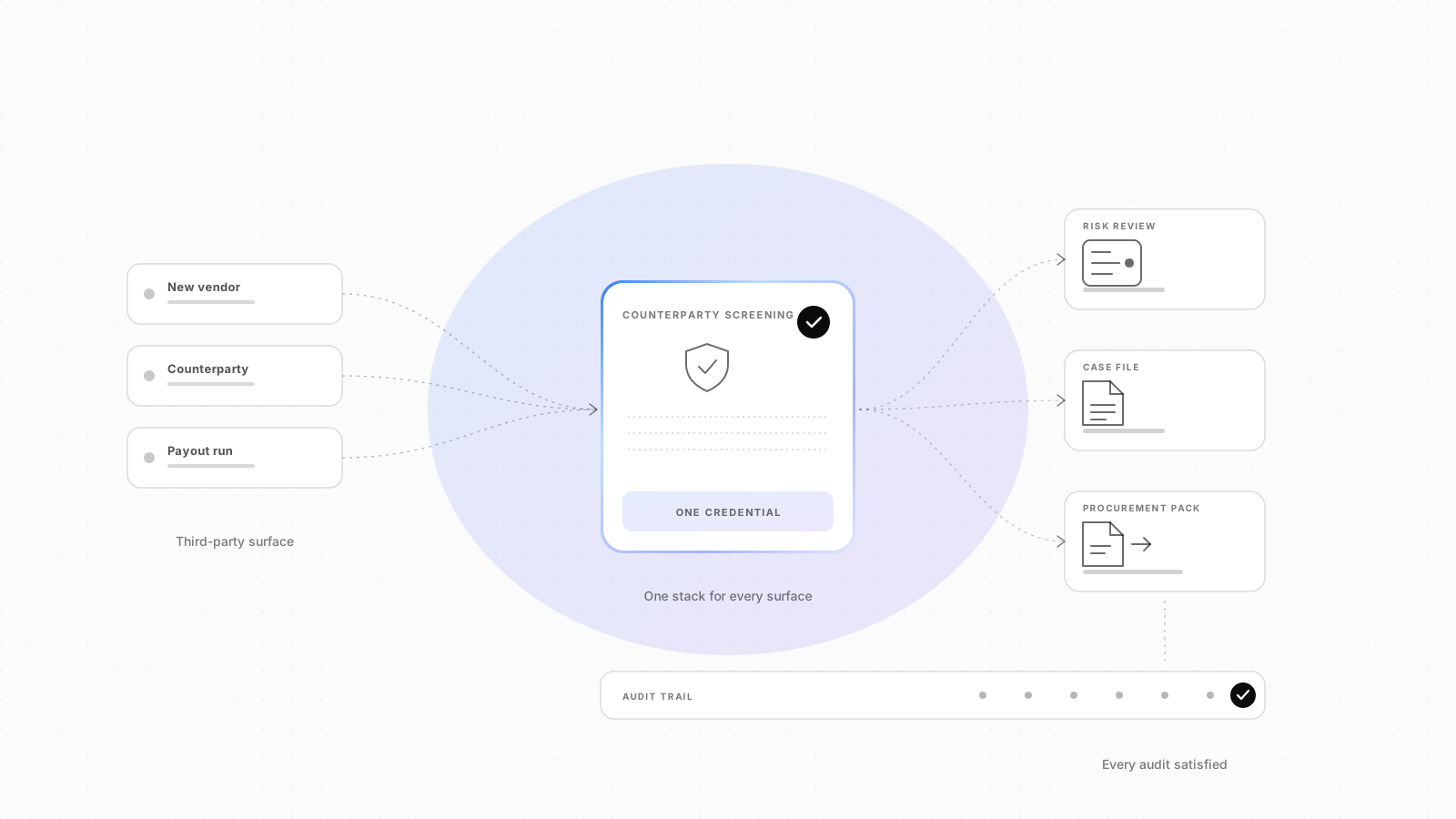
AML for enterprise is the transaction-monitoring, sanctions-screening, vendor-counterparty-screening, and embedded-finance-AML layer that B2B SaaS platforms, embedded-finance providers, and enterprise software vendors run to satisfy customer-mandated requirements, partner-bank obligations, EU AMLR/AMLD6, DORA, and FinCEN BSA where applicable. It ships as a primitive across procurement, vendor TPRM, and embedded-finance pass-through.
What does enterprise AML actually have to do?
AML for enterprise coverage spans four functions across the B2B and embedded-finance surfaces.
- Embedded-finance AML. Where the platform facilitates regulated flows (payments, lending, wealth, custody) on behalf of an end-customer or business, AML obligations attach. The licensed financial institution carries the regulatory obligation but the platform’s architecture determines whether the obligation is satisfiable.
- Vendor and counterparty sanctions screening. TPRM programs increasingly require continuous sanctions screening at vendor, vendor-director, vendor-UBO, and vendor-counterparty layer.
- B2B SaaS compliance for regulated end-customer use cases. Where B2B SaaS handles compliance workflows or financial-services functions for regulated end-customers, obligations may attach to the platform itself.
- Supply-chain AML obligations under CSDDD. Direct sanctions exposure through the supply chain is now a CSDDD compliance line item for in-scope entities.
For the broader transaction-monitoring architecture, see our AML transaction monitoring 2026 piece. For the underlying KYC for enterprise pattern, see our KYC for enterprise industry page.
Where does enterprise AML apply, and where does it not?
The AML for enterprise category applies to:
- Embedded-finance platforms (Stripe-style, Adyen-style for ISO partners, Marqeta-style card issuance, Modulr-style payment institution)
- B2B fintechs serving regulated end-customers (treasury management, corporate FX, multi-currency accounts)
- Lending platforms with B2B borrowers
- Wealth-management technology platforms
- B2B SaaS handling regulated data with sanctions exposure (e.g., trade-compliance software, sanctions-screening tools)
- Procurement and TPRM programs at NIS2-in-scope or DORA-in-scope organisations
- Enterprise platforms with high-value-good transaction flows (luxury, art, jewellery)
The category does NOT directly apply to:
- Pure B2B SaaS without regulated data or flows
- Marketing automation, project management, generic productivity software
- Non-financial enterprise infrastructure (where the regulator does not interface directly)
What are the regulatory baselines for enterprise AML?
Three regulatory frameworks converge.
European Union: AMLR, AMLD6, AMLA, DORA, CSDDD, NIS2
AMLR covers direct obligations where applicable. DORA requires EU financial-services firms to maintain a register of ICT third-party arrangements and continuous monitoring. CSDDD extends supply-chain due diligence including sanctions exposure. NIS2 covers supply-chain cybersecurity but increasingly bleeds into AML.
United States: BSA where applicable, OFAC, NIST CSF 2.0, FFIEC TPRM
Where the platform is a money service business or facilitates regulated flows, FinCEN BSA applies. OFAC compliance is universal. The Interagency Guidance on Third-Party Relationships is the bank-supervisor standard. NIST CSF 2.0 added a Govern function covering supply-chain AML risk.
United Kingdom: FCA SYSC 8, MLR 2017 where applicable, PRA SS2/21
UK regulated firms face FCA SYSC 8 outsourcing obligations and PRA SS2/21 third-party risk-management expectations.
Side-by-side: enterprise AML obligations
| Dimension | EU | US | UK |
|---|---|---|---|
| Cybersecurity supply-chain | NIS2 (Oct 2024) | SEC + NIST CSF 2.0 | NIS Regulations 2018 + Cyber Essentials Plus |
| Operational resilience | DORA (Jan 2025) | OCC / FFIEC TPRM | PRA SS2/21 + FCA SYSC 8 |
| Supply chain due diligence | CSDDD (transposing) | None federal; state-level | Modern Slavery Act + Procurement Act 2023 |
| Audit standards baseline | ISO 27001, SOC 2 | SOC 2, ISO 27001, NIST CSF 2.0 | ISO 27001, Cyber Essentials Plus, SOC 2 |
| Recent landmark | NIS2 enforcement begins | SEC Cyber Disclosure Rule late 2023 | Procurement Act 2023 effective Feb 2025 |
Where do enterprise AML programs fail, and what does it cost?
Five reproducible failure modes.
Sanctions screening at static vendor onboarding only
A vendor cleared at onboarding gets sanctioned 18 months later. Most TPRM programs detect this at the next annual review.
Subsidiary and UBO sanctions exposure not surfaced
Parent entity clean, sanctioned subsidiary, OFAC enforcement on the relationship.
Embedded-finance AML transferred to partner without architectural support
The platform tells the customer that compliance is handled by the partner bank and ships an architecture that does not surface relevant alerts to the partner bank’s compliance team.
Cross-border data and sanctions transfer ambiguity
A platform processing EU customer data through a US-jurisdiction partner has to handle Schrems II / SCCs / DPF compliance plus OFAC sanctions screening simultaneously.
CSDDD supply-chain sanctions exposure ignored
CSDDD requires due diligence on direct suppliers including sanctions exposure. Platforms with supply chains terminating in higher-risk jurisdictions face direct exposure.
Recent supply-chain incident timeline
| Date | Incident | Why it matters for enterprise AML |
|---|---|---|
| 2020 | SolarWinds Orion compromise | Supply-chain attack through trusted vendor update channel |
| 2023 | MOVEit Transfer breach, ~93M records | Third-party file-transfer vendor cascading exposure |
| 2023 | SEC Cybersecurity Disclosure Rule | Material incidents disclosable within 4 business days |
| 2023 | Okta support-system incidents | Authentication-vendor compromise affecting downstream |
| 2024 | NIS2 effective in EU | Supply-chain security management becomes legal obligation |
| 2025 | DORA effective for EU financial services | ICT third-party risk register becomes mandatory |
| 2025 | UK Procurement Act 2023 effective | Supplier-transparency obligations layered on government contracts |
How does Zyphe deliver enterprise AML as a primitive?
Zyphe ships four primitives.
Continuous vendor and counterparty sanctions screening. Vendor sanctions, PEP, adverse media, regulator filings, and security-attestation status update continuously at the credential layer. A vendor that gets sanctioned has the credential revoked. The next procurement-side check fails deterministically.
Embedded-finance pass-through to partner. Where the platform operates under a licensed partner, alerts flow to the partner’s compliance team in real time with structured per-decision triage records.
KYB depth across 190+ jurisdictions. Zyphe KYB walks the vendor’s ownership tree to natural persons or regulated parents. Subsidiary sanctions exposure surfaces at recursive depth.
No central store of customer PII. Source documents are sharded across thousands of decentralised storage nodes. The enterprise platform holds the credential and the audit trail, not copies of the underlying documents.
A senior CISO at a B2B SaaS handling regulated workflows for European banks framed it on a customer call in March 2026: “DORA’s third-party register obligation forced a structural conversation about whether we generate compliance evidence as a side effect of operations or whether we synthesise it for audits. Zyphe was the AML for enterprise layer that made the side-effect model operationally tractable.”
How do you implement enterprise AML across embedded finance, B2B SaaS, and procurement?
Three patterns.
Embedded-finance platform
Standard partner-bank governance overlay (see AML for fintech). Real-time monitoring at authorisation, identity-linked alerts, partner-bank audit-export readiness. Where the embedded-finance product spans multiple licensed partners, per-partner policy configuration in the dashboard.
B2B SaaS handling regulated end-customer flows
The regulated obligation typically sits with the end-customer’s licensed entity. Coverage on the SaaS-platform side surfaces relevant alerts to the customer’s compliance team in their preferred format. Audit-export available per-customer for their regulator examinations.
Procurement TPRM and CSDDD
Vendor onboarding KYB plus continuous sanctions monitoring. CSDDD-aligned supply-chain mapping. NIS2 and DORA documentation depth. Per-vendor case file with policy version, last-screened-date, and residual-risk documentation.
What are the real edge cases enterprise AML still struggles with?
Five edge cases worth flagging.
Multi-tier supply chain visibility. A vendor’s vendor’s vendor (Tier-3) is hard to verify with current registry depth.
Open-source dependencies as supply-chain risk. Where a vendor’s product depends on critical open-source libraries (Log4j-pattern), the supply-chain risk is real but the entity-verification model does not apply.
Cross-border data transfer compliance. Where a vendor processes EU data in a non-adequate third country, GDPR Chapter V transfer mechanisms become part of the verification surface.
Public-sector vendor obligations. Government procurement (UK Procurement Act 2023, EU GovTech, US FedRAMP) layers additional disclosures.
ESG and human-rights due diligence. CSDDD, the German LkSG, and California / New York supply chain transparency laws require human-rights and environmental due diligence beyond sanctions exposure.
How do you evaluate enterprise AML in the next 30 days?
Five concrete moves.
- Inventory regulatory exposure. Map which obligations apply to your platform: direct (you are obligated), indirect (your partner is obligated and you inherit), procurement (your customers expect TPRM evidence).
- Audit continuous vendor screening. If sanctions screening runs only at onboarding, the next sanctions update is the next remediation project.
- Pressure-test embedded-finance pass-through. Send a synthetic alert and check whether it lands in the partner bank’s compliance workflow within their SLA.
- Map your CSDDD and NIS2 supply chain exposure. Direct suppliers terminating in higher-risk jurisdictions need elevated diligence.
- Run audit-export drill. Pull a vendor case file from 18 months ago and check current state. Gaps are the regulator’s first finding.