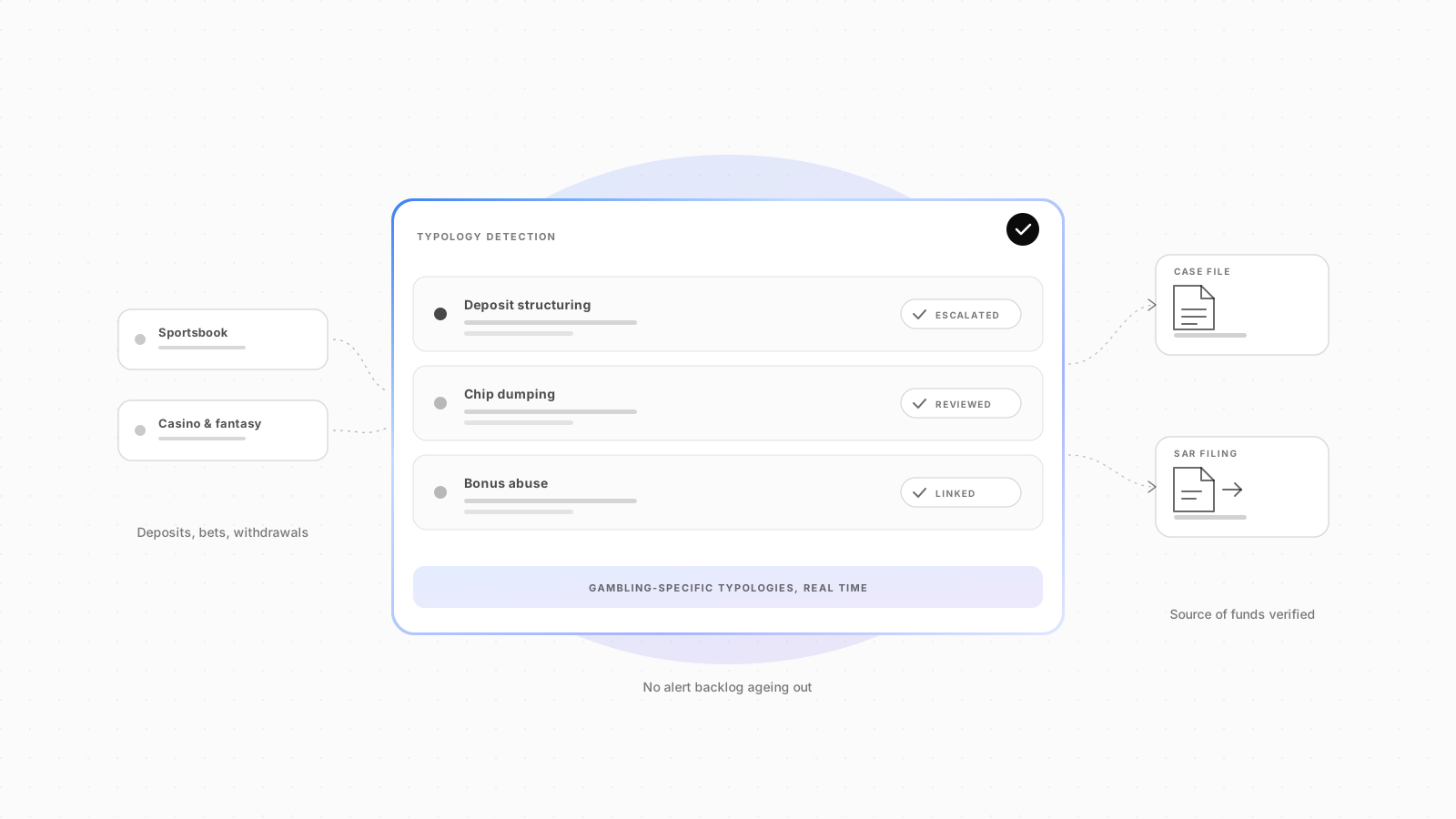
AML for iGaming is the transaction-monitoring, sanctions-screening, source-of-funds, and SAR filing layer that online gambling operators, sportsbooks, and fantasy sports platforms run to satisfy UKGC, MGA, ADM, DGOJ, KSA, NJDGE, and equivalent obligations. It runs in real time at deposit and detects gambling-specific typologies through identity-linked alert payloads.
What does iGaming AML actually have to do?
The AML for iGaming category covers four functions tuned to gambling-specific typologies. Structuring detection at deposit. Sportsbook syndicate detection (collusion across multiple accounts to lock in arbitrage or insider information). Source-of-funds verification on high-value play with documented EDD. Mule and bonus-abuse detection at sign-up plus first deposit. The category overlaps with casino AML on online product surfaces and with fintech AML on instant-payment integration, but iGaming-specific typologies sit on top.
For the broader monitoring architecture, see our AML transaction monitoring 2026 piece. For the underlying KYC pattern, see our KYC for iGaming industry page.
What are the regulatory baselines for iGaming AML across the major markets?
iGaming is one of the most jurisdictionally fragmented regulatory categories. Five markets matter most.
United Kingdom: UKGC, HMRC, MLR 2017
The UKGC supervises gambling operators including online casino, sportsbook, bingo, and lottery. The 2024-2025 enforcement wave has been heavy: William Hill GBP 19.2M (2023), Entain GBP 17M (2022), Bet365 GBP 582K (2022), Flutter / Paddy Power GBP 2M (December 2025).
Malta: Malta Gaming Authority (MGA) and FIAU
Malta is the largest cross-border iGaming licence base in the EU. The MGA supervises licensees with obligations flowing through the FIAU (Financial Intelligence Analysis Unit). MGA enforcement actions in 2024-2025 cited monitoring gaps and source-of-funds documentation deficiencies.
Italy: ADM (Agenzia delle Dogane e dei Monopoli)
ADM supervises Italian operators (most cross-border operators hold Italian-specific licences as well as Maltese ones). The 2025 ADM enforcement wave focused on sportsbook AML and DFS-equivalent products. Italian on-platform-deposit-tier rules became a key compliance line item during 2024.
Spain: DGOJ
The DGOJ (Dirección General de Ordenación del Juego) supervises Spanish operators. Spanish licences require operators to integrate with national AML reporting infrastructure. Bonus-abuse and structuring-at-deposit have been recent enforcement priorities.
United States: state-by-state plus FinCEN
US iGaming is regulated state-by-state (NJDGE in New Jersey, MGCB in Michigan, PGCB in Pennsylvania, NGCB in Nevada, OGC in Ohio). Daily Fantasy Sports (DFS) operators face state-level supervision: PrizePicks USD 15 million (NYS) and Underdog USD 17.5 million (NYS) were 2024-2025 landmark enforcement actions.
Side-by-side: iGaming AML obligations
| Dimension | UK | Malta | Italy | Spain | US |
|---|---|---|---|---|---|
| Primary regulator | UKGC | MGA + FIAU | ADM | DGOJ | State + FinCEN |
| SoF verification bar | High; UKGC explicit | High under FIAU | High under ADM | High | State-specific |
| Recent enforcement | William Hill GBP 19.2M, Flutter GBP 2M | Multiple operator settlements | ADM tightening 2024-2025 | DGOJ bonus-abuse focus | PrizePicks USD 15M, Underdog USD 17.5M |
| Per-decision defensibility | UKGC inspection-driven | AMLA-aligned | AMLA-aligned | AMLA-aligned | FinCEN reasonably-designed |
Where do iGaming AML programs fail, and what does it cost?
Five reproducible failure modes across recent enforcement.
Structuring at deposit not detected through sequence rules
A player making 9 deposits of GBP 950 in a single day is structuring. Threshold rules at GBP 1,000 miss the pattern. Detection has to run through deposit-sequence analysis with identity-linked context.
Sportsbook syndicate collusion
Multiple accounts coordinating to lock in arbitrage or to exploit insider information. Identity-linkage gaps let syndicates scale because each account looks like a fresh user. Shared-IP, shared-device, shared-payment-instrument, and shared-bet-pattern detection is the architectural fix.
Source-of-funds documentation absent on high-value play
UKGC enforcement against William Hill (GBP 19.2M) and Entain (GBP 17M) cited explicit SoF gaps on high-value players.
DFS-specific typologies missed
Daily Fantasy Sports operators face typologies that overlap with sportsbook (insider information) but also have unique patterns (entry-fee structuring, withdrawal-pattern fraud). PrizePicks and Underdog enforcement cited these specifically.
Bonus-abuse layered with mule indicators
Bonus-abuse is generally fraud. When layered with mule indicators (newly verified account, immediate withdrawal of bonus winnings to high-risk counterparty), it crosses into AML.
Recent enforcement timeline
| Date | Action | Penalty | Why it matters for iGaming AML |
|---|---|---|---|
| 2022 | Entain (UKGC) | GBP 17M | SoF verification gaps |
| 2023 | William Hill (UKGC) | GBP 19.2M | SoF + control framework |
| 2024 | PrizePicks (NYS) | USD 15M | DFS-specific typology gaps |
| 2024 | Underdog (NYS) | USD 17.5M | Identity-linkage gaps in DFS |
| Dec 2025 | Flutter / Paddy Power (UKGC) | GBP 2M | SoF documentation, customer interaction |
How does Zyphe deliver iGaming AML with identity-linked monitoring?
Zyphe ships four primitives.
Real-time scoring at deposit and wager. Single-digit-millisecond scoring at deposit authorisation. Structuring detection through deposit-sequence rules with identity context. Sportsbook syndicate detection through shared-attribute clustering across accounts.
Identity-linked alerts. Every alert carries the verified KYC credential, the KYC tier, source-of-funds documentation status, and perpetual re-screening status. Mule indicators fire deterministically.
Source-of-funds documentation pipeline. UKGC-grade SoF/SoW workflow integrated with the player record. Documentation producible under audit in minutes.
Multi-jurisdictional policy configuration. UK, Malta, Italy, Spain, Netherlands, Sweden, Denmark, Germany, US states, AU. Each with policy variants on threshold rules, bonus-abuse logic, source-of-funds bar, and SAR/STR filing timing.
A senior compliance lead at an Italian sports-betting operator described the post-Flutter dynamic on a customer call in March 2026: “ADM’s 2024-2025 inspection cycle treated SoF documentation gaps as control-framework failures rather than process failures. The fix had to be architectural. Identity-linked alerts with per-decision triage records were the only way the audit cycle survived.”
How do you implement iGaming AML across casino, sportsbook, and DFS?
Three patterns.
Online casino
Real-time scoring at deposit, wager, and withdrawal. Structuring detection through deposit-sequence rules. Source-of-funds workflow for high-value players. SAR filing pipeline with UKGC + FIAU + ADM + DGOJ + state-specific templates.
Sportsbook
Same baseline as online casino plus syndicate detection (shared-IP, shared-device, shared-payment-instrument, shared-bet-pattern). Insider-information adverse-media monitoring for sport-specific risk events.
DFS
Entry-fee structuring detection. Withdrawal-pattern fraud detection. Identity-linked alerts at every entry submission. State-specific policy configuration for NJDGE, NYS, and other DFS-licensing states.
What are the real edge cases iGaming AML still struggles with?
Five edge cases worth flagging.
Cross-licence operators with different per-jurisdiction rules. A single player active under Malta licence in one country and UK licence in another. Cross-licence monitoring without group-level aggregation misses pattern.
Affiliate-introduced player risk. Where an affiliate refers a player base, the affiliate’s AML profile becomes part of the operator’s risk. Affiliate KYB matters.
Live-betting in-play arbitrage. Real-time betting on sport events with multi-account arbitrage. Sub-second decision windows.
Crypto-funded iGaming accounts. Where the operator accepts crypto deposits, crypto-AML typologies layer on. See our AML for crypto page.
Esports betting categorisation. Where esports betting raises new typology questions (script-driven account behaviour, player-side match fixing).
How do you evaluate iGaming AML in the next 30 days?
Five concrete moves.
- Audit deposit-structuring detection. Run a synthetic deposit sequence below threshold and confirm rules fire. If not, the rule logic is wrong.
- Pressure-test sportsbook syndicate detection. Identify two or three known-coordinated accounts in your historical data and check whether monitoring rules would have flagged the pattern.
- Inventory source-of-funds documentation depth. Pull 20 high-value-player records and check whether SoF evidence is present and producible under audit.
- Run audit-export drill. Pull a SAR filed 18 months ago and trace the evidence chain.
- Update DPIA and per-jurisdiction documentation. Documentation depth is now structural under UKGC inspection-driven supervision.