Age verification methods, the 2026 laws (UK Online Safety Act, SCOTUS, EU Wallet) and how to verify age online without storing a single ID. Privacy-first.
Table of contents
- Age verification is any technical method that confirms a user is old enough to access a restricted service, from a tick-box self-declaration to a digital identity wallet that returns only an over-18 token.
- Regulators no longer accept self-declaration. The UK Online Safety Act and Ofcom require "highly effective age assurance" for adult content, live since 25 July 2025.
- The United States Supreme Court upheld Texas HB 1181 in Free Speech Coalition, Inc. v. Paxton on 27 June 2025, clearing the way for state age-verification laws.
- Most vendors answer a single yes-or-no question by storing a full government ID, which builds a breach honeypot. In October 2025 a Discord support vendor leaked roughly 70,000 ID images uploaded for age checks.
- The architectural fix is data minimisation: prove the age claim, store no document, leave no honeypot. The EU's standalone age-verification app, declared ready on 15 April 2026, ships this as a double-blind design.
Age verification is any technical method that confirms a user is old enough to access a restricted service, such as alcohol, gambling, adult content or social media. It ranges from self-declaration to facial age estimation and digital identity wallets, and modern privacy-first systems prove a user is over 18 without the platform ever storing their ID.
TL;DR
Age verification confirms a user meets a minimum age before they reach restricted content. Regulators across the United Kingdom, the United States, the European Union and Australia now mandate it and reject self-declaration as ineffective. The methods range from ID document checks and facial age estimation to Open Banking, mobile-network checks and digital identity wallets. The decision that matters is not which method you pick but where the data lands: most vendors store the uploaded ID, which builds a breach honeypot, as the October 2025 Discord vendor leak showed. The privacy-first answer is to prove the age claim and store no document, so you verify age online without storing the ID and leave nothing for an attacker to take.
What is age verification, and how does it differ from age assurance?
Age verification is any technical method that confirms a user is old enough to access a restricted service, such as alcohol, gambling, adult content or social media. It sits inside a wider umbrella that the UK regulator, the Office of Communications (Ofcom), calls age assurance. Age assurance is the parent category. Beneath it sit two branches: age verification, which proves an exact or threshold age from a trusted source such as an ID or a bank record, and age estimation, which uses an algorithm to guess an age range from a selfie or behavioural signals. Both aim at the same outcome, keeping the under-aged out, but they differ in accuracy, friction and how much personal data they touch.
The practical headline for any compliance team is that the tick-box is dead. Self-declaration, where a user simply states a date of birth or clicks "I am 18", is not treated as effective by regulators. Ofcom and the Information Commissioner's Office (ICO) said so jointly on 25 March 2026, agreeing that self-declaration alone cannot meet the standard. Everything that follows in this guide is about the methods that do clear the bar, and the privacy cost each one carries. For the architecture pattern that underpins privacy-first checks, our explainer on decentralised KYC covers how verification can run without a central data store.
Why is age verification suddenly everywhere in 2026?
The search volume and the boardroom attention both spiked because four regulatory catalysts landed inside twelve months. First, the UK Online Safety Act moved from statute to enforcement: from 25 July 2025, sites publishing pornography or content that encourages suicide, self-harm or eating disorders must use highly effective age assurance to confirm users are 18 or over. Second, the United States Supreme Court decided Free Speech Coalition, Inc. v. Paxton on 27 June 2025, upholding a Texas age-verification statute by six votes to three. Third, social platforms and app stores began rolling out age checks of their own. Fourth, more than forty US states now have age-verification bills in some stage of the pipeline.
The result is that age checks stopped being a niche adult-content problem and became a horizontal obligation touching gaming, social media, marketplaces and fintech. The same wave creates a second, quieter problem: cost and breach risk. Every platform that bolts on an age check has to decide what happens to the identity data it collects, and the default vendor pattern, upload an ID and let the vendor store it, multiplies the number of databases holding sensitive documents. That is the tension this guide returns to, because it is the part the headlines skip. Our analysis of why your KYC vendor is your biggest data breach risk sets out the same exposure in the KYC context.
What are the main age verification methods?
There are six methods a regulated platform will realistically weigh, and Ofcom has published a non-exhaustive list of those it considers capable of being highly effective. Photo-ID matching, facial age estimation, Open Banking checks, mobile-network-operator (MNO) checks, credit-card checks and digital identity services can all qualify. Explicitly outside that list are self-declaration, plain date-of-birth entry and online payment methods that do not require the holder to be 18 or over. The four criteria Ofcom applies are technical accuracy, robustness, reliability and fairness.
The column most published comparison tables omit is the one that decides your liability: does the platform end up storing a government ID? That single question separates a routine compliance task from a standing breach risk. The matrix below scores each of the six recognised methods on whether Ofcom can treat it as highly effective, whether it forces the platform to retain a stored ID, its accuracy and its user friction.
Age verification method versus PII-exposure matrix
| Method | Ofcom "highly effective"? | Platform stores a government ID? | Accuracy | User friction |
|---|---|---|---|---|
| Self-declaration (tick-box) | No | No | Very low | Very low |
| Photo-ID matching | Yes | Usually yes (document plus selfie retained) | High | Medium to high |
| Facial age estimation | Yes | No (no document, image processed and discarded) | High near a threshold | Low |
| Open Banking check | Yes | No (bank attests, no ID uploaded) | High | Medium |
| Mobile-network-operator (MNO) check | Yes | No (carrier confirms age flag) | Medium | Low |
| Digital identity wallet / reusable credential | Yes | No (returns an over-18 token only) | High | Low after setup |
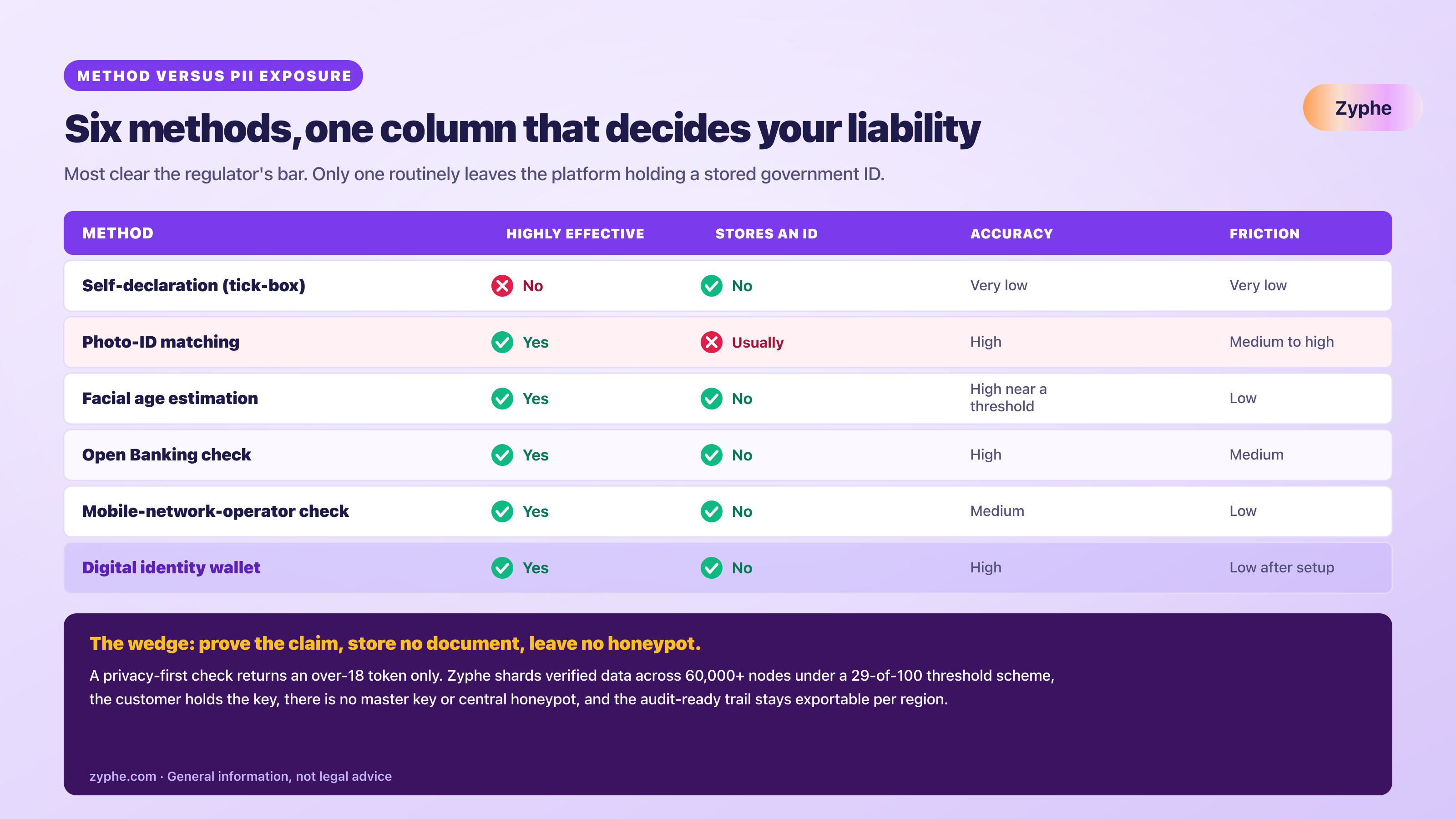
The pattern is clear. The least private method, photo-ID matching, is the one most teams reach for first, yet it is the only highly effective option that routinely leaves the platform holding a stored document. Facial age estimation, Open Banking, MNO checks and wallet-based credentials all clear Ofcom's bar without that liability. Document checks and facial age estimation are covered in more depth in our guide to proof of address verification, which shares the same document-handling trade-offs.
What is digital identity, and what is a digital ID?
Digital identity is the set of verified attributes that represent a person online: name, date of birth, nationality, address and the credentials that prove them. A digital ID is a single credential that proves one or more of those attributes, such as the fact that someone is over 18, without exposing the rest. The distinction matters for age verification because a well-designed digital ID can answer "is this person 18 or over?" with a yes, and nothing else, rather than handing over a full passport scan to settle one binary question.
The shift that makes this practical is reusability. A reusable or portable credential lets a user verify once, with a trusted issuer, then re-present that proof across many services without re-uploading documents each time. This is the model behind the European Union's digital identity wallets and behind Zyphe's reusable KYC passport, where a customer verifies once and re-presents the credential elsewhere. For the regulatory backbone of portable European credentials, see our guide to eIDAS 2 and the EU digital identity wallet. Reusability cuts friction and, when paired with the right architecture, removes the need for every platform to keep its own copy of the underlying ID.
What do age verification laws require by region?
Age verification law is now a global patchwork, but four jurisdictions set the tone. In the United Kingdom, the Online Safety Act requires highly effective age assurance for adult and harmful content, with the dedicated pornography-service duty commencing on 17 January 2025 and the broader children's-safety duties from 25 July 2025. Ofcom enforces it and, as of February 2026, had opened investigations into more than ninety platforms and issued six fines. The highest age-assurance fine to date is 1.35 million pounds against 8579 LLC, levied in February 2026. Kick Online Entertainment S.A., the operator of the adult site motherless.com and 34 adult domains, was fined 800,000 pounds plus 30,000 pounds for failing to run age checks between 25 July and 29 December 2025. AVS Group Ltd was fined 1 million pounds plus 50,000 pounds in December 2025.
In the United States, the Supreme Court's decision in Free Speech Coalition, Inc. v. Paxton on 27 June 2025 upheld Texas HB 1181, which requires age verification on commercial sites where more than one-third of the content is sexual material harmful to minors. Justice Thomas wrote for the majority, holding that the law triggers and survives intermediate scrutiny because it only incidentally burdens adults' protected speech; Justice Kagan dissented, joined by Justices Sotomayor and Jackson. More than forty states now have similar bills. In the European Union, the Commission released the second version of its age-verification blueprint and declared a standalone age-verification app technically ready on 15 April 2026, with a summer 2026 launch, distinct from the full eIDAS-2 national wallets due later in 2026. Australia went further still: its social-media minimum-age law took effect on 10 December 2025, requiring platforms to take reasonable steps to keep under-16s off the service, with the eSafety Commissioner reporting roughly 4.7 million under-16 accounts removed by mid-December 2025.
Is age verification safe, or does it create a breach honeypot?
It depends entirely on the architecture, and most architectures are not safe by default. The dominant vendor pattern asks a user to upload a government ID to a third party that then stores it, which turns a one-time yes-or-no check into a permanent database of passports and driving licences. That database is a honeypot, and the breach record proves the point rather than asserts it. In October 2025, attackers compromised a Discord support vendor, 5CA, operating on a Zendesk-based portal, and exfiltrated roughly 70,000 images of government-issued IDs that users had uploaded for an age check, per Discord's statement of 9 October 2025. Zendesk confirmed its own platform was not breached; entry came through the third-party vendor.
That was not an isolated event. In February 2026, researchers found that Persona, the vendor running Discord's UK age-verification trial, had left its government-dashboard frontend codebase, roughly 2,456 files, publicly accessible on a cloud endpoint; Discord ended the pilot, which had run for under a month. It was an exposure, not a confirmed exfiltration of end-user IDs, but it shows how thin the margin is. Earlier, in 2024, the Electronic Frontier Foundation and 404 Media reported that AU10TIX, an identity and age-verification firm serving major platforms, had left admin credentials live for roughly eighteen months, from a December 2022 malware grab to their discovery in June 2024, granting access to a logging system that held ID images; AU10TIX's independent review disputes that any customer data was actually exposed, so the fairest framing is a serious security lapse. Three incidents, one lesson: storing a full identity to answer a single binary question is disproportionate under the data-minimisation principle in GDPR, and every stored ID is a liability waiting to be breached. Our breakdown of the Coinbase data breach shows the same honeypot dynamic in financial KYC.
How do you verify age online without storing the ID?
The fix is a principle and an architecture. The principle is data minimisation: collect only what the obligation requires, which for an age gate is a single verified attribute, not a whole identity. The architecture that delivers it is token-based or double-blind verification. In the European Union's standalone age-verification app, declared ready on 15 April 2026, the design is explicitly double-blind: the service learns only that the user is over 18, never their identity, and the proof provider does not learn which service the user visited. It uses zero-knowledge-proof cryptography, so the platform receives an attestation, not a document. This is how you verify age online without storing the ID, because there is no ID to store.
The steelman for the storage model deserves a fair hearing: a stored ID gives an investigator a clear audit artefact, and some regulated sectors retain documents to satisfy record-keeping rules. The honest answer is that record-keeping duties and data minimisation are not in conflict when the architecture is right. A decentralised store can shard verified data across many nodes so no single system holds a complete record, then reconstruct the full file for an authorised auditor on demand. Zyphe builds on that pattern: personal data is sharded across a network of thousands of nodes under a 29-of-100 threshold scheme, the customer holds the key, there is no master key and no central honeypot, and the audit trail stays exportable. The same reusable credential a user verifies once can be re-presented elsewhere, so platforms stop accumulating duplicate copies of the same ID. For the mechanics, see how it works.
How should you choose an age verification provider?
Beyond the marketing, a regulated buyer in iGaming, crypto, fintech or social should pressure-test a provider against seven criteria. Use the checklist below as a starting point, not legal advice, and weight the data-minimisation line heavily, because it is the one that turns into a breach headline if you get it wrong.
- Regulator alignment: does the method appear on Ofcom's highly effective list, or meet the equivalent local standard?
- Data minimisation: does the platform end up storing a government ID, or does the provider return only an over-18 attestation?
- Breach posture: where does verified data live, is there a central honeypot, and is the audit trail exportable?
- Accuracy and fairness: how does it perform near the age threshold, and is it tested for bias across demographics?
- User friction: what is the abandonment rate, and how many steps does a genuine adult face?
- Reusability: can a verified credential be re-presented across services, or must the user re-upload each time?
- Cost and integration: usage-based pricing without minimums, and how fast is the integration?
The market splits into two camps. Document-centric incumbents centralise the PII and accept the honeypot; verify-without-storing providers return an attestation and keep no copy. Zyphe sits in the second camp, with usage-based pricing, no minimums, a roughly 15-minute single-API integration and per-region data residency. Zyphe positions the efficiency gain as materially lower compliance cost, a fraction of the cost of a conventional stack, which is a vendor claim rather than an independently audited number, so weigh it as such. To compare KYC and age-gating tooling together, our identity verification software comparison covers the incumbents evenhandedly, and the KYC software page sets out the verify-without-storing model in full.
The bottom line
Proving a user's age has shifted from a niche adult-content control to a horizontal obligation that gaming, social, fintech and marketplaces all now carry, and the regulators agree on one thing: the tick-box is finished. Once you accept that, the real decision is architectural. Picking a method that satisfies Ofcom is the easy part; deciding whether your platform becomes the next custodian of 70,000 leaked ID images is the part that costs you. The safest age verification system is the one that forgets the ID the instant it confirms the age. Prove the claim, keep the audit trail, store no document, and you meet the obligation without inheriting the liability.
Related resources
- Age verification software
- Decentralised KYC: what it is and how it works
- eIDAS 2 and the EU digital identity wallet for KYC
- Why your KYC vendor is your biggest data breach risk
- The Coinbase data breach: why KYC data is the honeypot
- Identity verification software comparison 2026
- Zyphe KYC passport
Cited sources
- U.S. Supreme Court, Free Speech Coalition, Inc. v. Paxton, opinion 23-1122 (27 June 2025)
- GOV.UK, Online Safety Act explainer
- Ofcom, Guidance on Highly Effective Age Assurance, Part 3
- Ofcom, age-assurance enforcement and fines (as of February 2026)
- ICO and Ofcom, joint statement on age assurance (25 March 2026)
- European Commission, enhanced second version of the age-verification blueprint
- eSafety Commissioner (Australia), social media age restrictions
 Michelangelo Frigo (Co-Founder at Zyphe) Michelangelo Frigo is a privacy and identity infrastructure expert and co-founder of Zyphe.