Compare 11 age verification services for 2026, listed alphabetically: methods, certifications, UK OSA and US state-law coverage, and shortlists by use case.
Zyphe wrote this comparison and is one of the vendors in it. Facts about other vendors come from their own public pages or the sources cited, as of this page's last update on . No vendor pays to appear here (editorial policy). Out of date? Tell us. Our own entry, limitations included: Where Zyphe fits.
Table of contents
Age verification services confirm that a user is over a required age threshold using facial age estimation, ID document checks, database or telco lookups, or reusable digital credentials. In 2026, the providers compared here are AgeChecked, Incode, Jumio, Ondato, Persona, Privately, Veratad, Veriff, VerifyMy, Yoti and Zyphe. The right pick depends on your regulation, use case, and privacy posture.
Age checks stopped being optional in 2025. Under the UK's Online Safety Act, sites that publish their own pornographic content have had to use highly effective age assurance since 17 January 2025, and the child-safety duties that require it on other in-scope services took effect on 25 July 2025. The US Supreme Court upheld Texas's age verification law for adult websites, H.B. 1181, in Free Speech Coalition v. Paxton (June 2025), and more than two dozen US states now enforce age verification for adult content, per the Age Verification Providers Association. If you run an adult, gaming, social, or ecommerce platform, you now need an age check that satisfies regulators without alienating users, or leaking their identities.
This guide compares 11 providers, listed alphabetically, explains the underlying verification methods, and maps each to UK and US compliance requirements.
How we compared these providers
We scored each provider on five criteria: method coverage (estimation, documents, database), regulatory acceptance (Ofcom "highly effective age assurance" methods, US state-law standards), user friction, privacy architecture (what happens to the data after the check), and use-case fit. Certification is now a baseline question too: the Age Check Certification Scheme registry lists ISO/IEC 27566-1:2025 age assurance certificates for Privately, Veratad, VerifyMy and Yoti, among others (checked 12 October 2026), so ask every vendor for its certificate and its expiry date.
One disclosure up front: Zyphe publishes this guide and is one of the providers in it. The list below is alphabetical, not a ranking. Zyphe's difference is that it verifies age without retaining personal data in a central vendor database; for pure facial age estimation accuracy or gaming-specific database checks, other providers below are strong choices, and we say so.
The 11 best age verification services in 2026
Listed alphabetically, not ranked.
AgeChecked: best for UK multi-method specialist checks
AgeChecked is a UK age verification specialist offering database lookups and ID document scans aimed at gambling, vape and alcohol ecommerce, and adult sectors.
- Best for: UK ecommerce sellers of age-restricted goods that want database-first checks.
- Consider elsewhere if: your audience is global, or database coverage of your users is thin.
Incode: best for fully automated AI estimation
Incode focuses on fast, fully automated age estimation, which it says returns a result in about 20 milliseconds, with an automatic step-up to an ID document and selfie when the estimate is close to the threshold. Since July 2026 it also offers on-device age estimation, so the face image does not have to leave the phone. Its automation-first pipeline suits high-volume consumer platforms where manual review queues would create unacceptable latency.
- Best for: high-throughput consumer apps prioritizing conversion speed.
- Consider elsewhere if: you want a UK specialist built around Ofcom's lower-friction methods, such as email-based age estimation.
Jumio: best for ongoing re-verification
Jumio is an AI-powered identity verification platform covering age checks, fraud prevention, and its differentiator, ongoing authentication: re-verifying account holders at later logins rather than only at onboarding. That matters for account-sharing risks in gambling and adult content, where the person at signup is not always the person at the screen. Its age verification flow estimates age from a selfie first and asks for an ID only when the user looks under 30.
- Best for: regulated operators that must prove the verified adult is still the active user.
- Consider elsewhere if: repeated biometric collection conflicts with your privacy commitments. See Jumio alternatives.
Ondato: best for estimation, documents and reusable checks from one vendor
Ondato is a KYC and AML platform with an age verification module that combines facial age estimation, ID document checks with liveness, and OnAge, a reusable token so a returning user does not repeat the full check. Its face age estimation is certified to IEEE 2089.1-2024 on the Age Check Certification Scheme registry, and it publishes its prices.
- Best for: EU and UK mid-market platforms that want age checks and KYC from one vendor with self-serve pricing.
- Consider elsewhere if: you need US state-law depth from data-first checks.
Persona: best for configurable verification flows
Persona is flexible identity infrastructure that lets you assemble custom age assurance flows from building blocks: government ID checks, selfie age estimation, database lookups, credit card checks, email and phone age signals, selfie matching, step-up logic, and Persona Wallet, a reusable credential. That configurability suits product teams that want different friction levels for different user segments or jurisdictions.
- Best for: teams with engineering resources who want per-market, per-risk-tier age logic.
- Consider elsewhere if: you want an out-of-the-box compliance answer rather than a toolkit. See Zyphe vs Persona.
Privately: best for age estimation that stays on the device
Privately, a Swiss company founded in 2014, runs face and voice age estimation on the user's device, so no face image is sent to a server, with a selfie plus an NFC-enabled ID document as the fallback. Its FaceAssure products hold ACCS 1:2025 and ISO/IEC 27566-1:2025 certification, valid to April 2029.
- Best for: platforms and device makers that want estimation where the face never leaves the phone.
- Consider elsewhere if: you need full identity verification or KYC alongside the age check.
Veratad: best for US data-first checks mapped to state laws
Veratad's VX platform starts with data checks against records, steps up to document capture and selfie matching with liveness, and offers IDMax, a reusable credential. It does not state facial age estimation. Veratad says it was among the first certified to ISO/IEC 27566-1:2025, and maps its checks to state laws such as Utah's, Louisiana's and Mississippi's.
- Best for: US operators that need data-first age checks with document and biometric step-up.
- Consider elsewhere if: your users are mostly outside the US, or you want document-free estimation.
Veriff: best for global document coverage
Veriff is an identity verification platform known for speed and breadth of document support, 12,500+ identity documents across 230+ countries, making it a strong fit for platforms with users across many countries. Age checks are now sold on their own as well as inside full identity verification: Age Validation reads the date of birth from an ID with liveness and returns only pass or fail, Age Estimation works from a selfie with no document, and a tiered Age Assurance flow moves from a database check to estimation to a document.
- Best for: international platforms that want age checks on their own or bundled with full identity verification.
- Consider elsewhere if: your users sit in one market where a local data or telco check is enough; see our Veriff alternatives comparison.
VerifyMy: best for low-friction email-based signals
VerifyMy is a UK-based age assurance specialist built around safety-tech use cases, combining facial age estimation with lower-friction signals such as email-based age estimation, one of the methods Ofcom lists as capable of being highly effective age assurance when properly implemented. It also checks age by mobile number, government ID with a face match, credit card, and name and address, and its age assurance service holds ACCS 1:2025 and ISO/IEC 27566-1:2025 certification, valid to May 2029.
- Best for: UK-focused publishers and adult sites wanting OSA-oriented, low-friction checks.
- Consider elsewhere if: you need global document coverage or full KYC alongside the age check.
Yoti: best for facial age estimation
Yoti built its name on document-free facial age estimation and reports more than 800 million age checks across the 12 methods it offers, including reusable options such as its Digital ID app and Yoti Keys. Its age verification service holds ACCS 1:2025 and ISO/IEC 27566-1:2025 certification. Its July 2025 white paper reported a mean absolute error of 1.1 years for 13 to 17-year-olds and 2.1 years for 18 to 24-year-olds, accuracy gains timed to Online Safety Act enforcement, as covered by Biometric Update; its product page now quotes 1.3 years for 13 to 17-year-olds.
Estimation is fast and requires no documents, which keeps friction low for social and gaming audiences. The trade-off: it is probabilistic, so operators near legal age thresholds still need a document-based fallback for users challenged at the boundary.
- Best for: social platforms and gaming needing high-volume, low-friction checks.
- Consider elsewhere if: your regulator or risk team requires deterministic, document-anchored proof of age for every user.
Zyphe: best for privacy-first age verification
Zyphe is a privacy-first, decentralized identity verification and compliance platform that confirms age without storing personal data in a central vendor database. Identity data is sharded across decentralized storage, encryption keys stay with the user, and platforms receive a verifiable "over-18" (or over-21) result rather than a copy of the user's passport.
That architecture matters most in exactly the sectors age laws target. Users of adult sites and dating apps abandon flows that demand an ID upload tied to their browsing history. The Discord age verification backlash showed how fast trust evaporates when age checks feel like surveillance. Zyphe's approach removes the honeypot: there is no central database of adult-site users to breach or subpoena.
- Methods: government ID documents checked against 4,000+ versions from 190+ countries, biometric face capture with liveness detection, AI deepfake mitigation, and a reusable KYC Passport credential for one-click repeat checks.
- Coverage and checks: documents checked against 4,000+ identity document versions from 190+ countries, with active liveness and face match.
- Best for: adult platforms, iGaming and casinos, and any operator whose users are privacy-sensitive. See KYC for adult platforms.
- Consider elsewhere if: you only need a low-assurance estimation check with no document fallback.
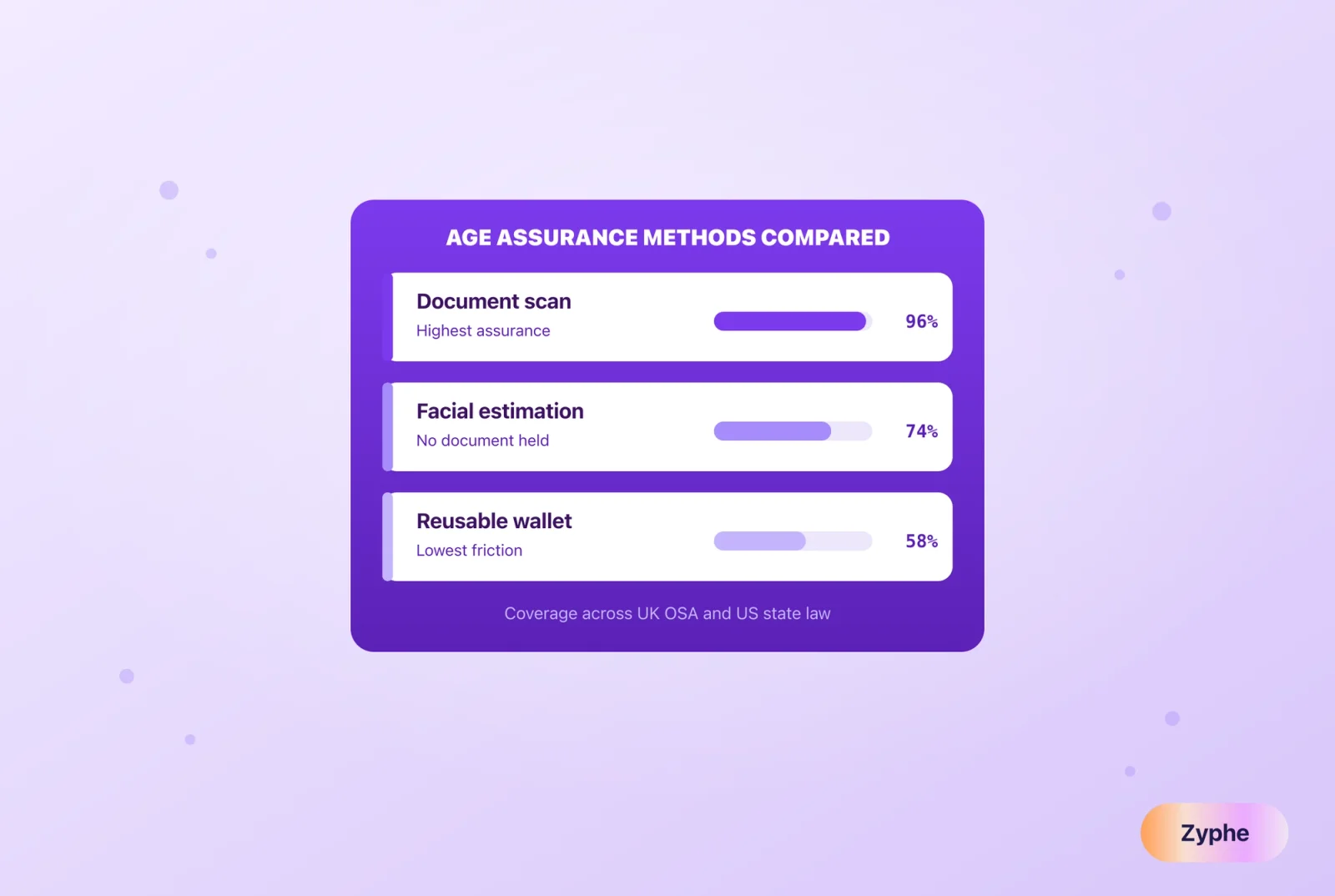
Age verification methods compared
Regulators increasingly care less about which vendor you use and more about which method you deploy. Ofcom's guidance names photo-ID matching, facial age estimation, mobile network operator checks, credit card checks, digital identity services, email-based estimation, and open banking as capable of being highly effective, while self-declaration is explicitly not.
| Method | How it works | Friction | Assurance level | Privacy exposure | Typical providers |
|---|---|---|---|---|---|
| Facial age estimation | AI estimates age from a selfie; no documents | Low | Probabilistic (MAE \~1 to 2 yrs) | Face image processed; retention varies, and some run on the device | Incode, Jumio, Ondato, Persona, Privately, Veriff, VerifyMy, Yoti |
| ID document \+ biometric | Government ID scanned, matched to live selfie | Medium | High: date of birth read from the document; the face match itself is probabilistic | Full identity collected; storage varies | Jumio, Ondato, Persona, Veratad, Veriff, Yoti, Zyphe |
| Database / telco / credit card | Checks age against records (credit files, MNO data) | Low | Depends on record coverage | Name/number shared with data brokers | AgeChecked, Persona, Veratad, VerifyMy, Yoti |
| Reusable digital credential | User verifies once, presents a signed "over-18" proof thereafter | Very low (after first check) | Deterministic | Minimal: attribute shared, not identity | Ondato (OnAge), Persona (Persona Wallet), Veratad (IDMax), Yoti (Digital ID, Yoti Keys), Zyphe (KYC Passport) |
The direction of travel is toward the last row. The EU is building this into law: its age verification trusted list and eIDAS dashboard lay the groundwork for wallet-based, minimal-disclosure age proofs across the bloc.
Compliance mapping: UK OSA and US state laws
UK Online Safety Act
Services that allow pornography or other primary priority content must use highly effective age assurance; the duty has been enforceable since 25 July 2025. Enforcement is real: Ofcom issued further age-assurance fines against pornographic platforms in early 2026, and its 2026 statutory report found the share of children encountering highly effective age checks when challenged rose from 25% to 43% between July 2025 and January 2026. Progress, but with tougher action promised.
US state laws
The Supreme Court's 6-3 decision in Free Speech Coalition v. Paxton (27 June 2025) upheld Texas's age verification law for adult content, clearing the constitutional path for the rest. The AVPA's state tracker now counts 26+ states with adult-content age verification laws in force, and the wave is spreading beyond adult content. Texas's app-store age verification law reached the Supreme Court in July 2026. States are also adding costs: Utah's SB 73 has, since 1 October 2026, taxed 2% of the sales price of covered transactions by sites that must verify age under its adult-content law, while keeping its ban on retaining identifying data.
One compliance detail buyers miss: several state laws restrict retention of identifying data collected during the age check. A vendor architecture that never centrally stores the ID, like Zyphe's decentralized PII storage, turns that retention clause from a legal risk into a non-issue. Centralized alternatives keep appearing in our KYC/IDV breach tracker for a reason.
Best age verification service by use case
Each row lists providers to shortlist alphabetically, not in order of preference.
| Use case | Providers to shortlist | Why |
|---|---|---|
| Adult platforms | Privately, VerifyMy, Zyphe | Users will not upload IDs into a central database tied to adult browsing; on-device estimation and checks that keep no central ID store protect conversion and fit state retention limits |
| Gaming / iGaming | Jumio, Ondato, Zyphe | Age check doubles as KYC for iGaming licensing; re-verification guards against account sharing |
| Social platforms | Incode, Privately, Yoti | Massive volume, minors present, low friction essential; estimation with document fallback |
| Ecommerce (alcohol, vapes, knives) | AgeChecked, Persona, Veratad | Database-first checks keep checkout friction low; step up to documents only on failure |
Verify age without building a database of your users
If your age check creates a central store of IDs and faces, you have traded a compliance problem for a breach and trust problem. Zyphe verifies age in under a minute with no PII held in any central vendor database: book a demo to see how it works for your platform.
Where Zyphe fits
Zyphe's own entry, identical on every comparison we publish.
- Best for
- Regulated teams that keep their KYC, KYB and AML tools but want an AI investigation layer that prepares decision-ready, evidence-backed case files.
- How it works
- Agents prepare KYC, KYB, AML and sanctions reviews with the evidence and a written rationale attached. By default your team approves each one, and your MLRO keeps final sign-off.
- Decision boundary
- The decisions AMLR Article 18(3) reserves for the obliged entity, such as the customer risk profile and whether to onboard, stay with your team. How the review desks work
- How to buy
- Agent review desks, priced per completed task with no monthly minimum, or a Growth or Enterprise plan; or the verification platform and API, priced per verification. Desk pricing · Platform pricing
- Integration
- A no-code link, a hosted flow, or the REST API with signed webhooks; SDKs for Node.js, browser JavaScript and React Native. Integration docs
- Limitations
- SOC 2 and ISO/IEC 27001 audits are in progress, with completion targeted Q4 2026. KYB register coverage depends on what each government exposes, and director data is often missing from official sources.
- Evidence
- Customer stories · Sample KYB report
 Michelangelo Frigo (Co-Founder at Zyphe) Michelangelo Frigo is a privacy and identity infrastructure expert and co-founder of Zyphe.