Age Verification
Age verification that proves the age without keeping the ID
Regulators now require platforms to know a user is old enough, and users now know what happens to the ID they upload. Zyphe verifies age from a government document with liveness, enforces the minimum age you configure, checks that the user is where they say they are, and lets a verified user prove they are over 18 again elsewhere without handing over a birth date. The document goes to the user's encrypted vault, not to a database of IDs.

What is age verification software?
Age verification software confirms that a user meets a minimum age before they can access a product, service or content, using a verified identity document, a trusted third-party record, or a reusable credential issued after such a check. It replaces self-declared date-of-birth fields, which regulators no longer accept for age-restricted services.
Trusted by those who trust no one.









What the check runs on
Identity document versions from 213 countries and territories, so the age on the document can be verified wherever the user is.
The minimum age is configured per flow: 18, 21, or a market-specific limit, enforced at verification.
The document is processed transiently and stored in the user's own vault. Zyphe retains the result, the log and the proof.
How Zyphe verifies age
Three methods, all of them anchored to a verified document rather than an estimate, and a geolocation check that catches the user who is not where the rule assumes.
Document-based age verification
The date of birth is read from a verified government document, with document fraud detection and active liveness so the document is genuine and the holder is present. The configured minimum age is enforced at the point of verification.
Reusable over-18 proof
A user who has verified once holds a KYC Passport and can prove they are over the limit to another service as a yes or no, with a zero-knowledge proof that discloses no date of birth and no document.
Geolocation and VPN checks
The geolocation step compares GPS with IP country and flags VPN or proxy use and blacklisted IPs, so a market-specific age limit is applied to users who are actually in that market.
Liveness and injection-attack detection
Active liveness with anti-spoof checks and injection-attack detection stop a borrowed document, a screen or a deepfake from passing the age check.
Selective disclosure
A service that only needs to know a user is over 18 receives exactly that. Name, address and the document itself stay with the user unless the service is entitled to them.
Audit trail
Every check records what was verified, against which document class, the threshold applied and the outcome, which is the evidence age-assurance regimes ask operators to keep.
Age verification in your onboarding
The same flow whether the rule is 18 for a marketplace, 21 for a US casino, or a national limit for a social platform.
Configure the minimum age, the markets it applies to, and whether a returning user can present a KYC Passport proof instead of a new document.
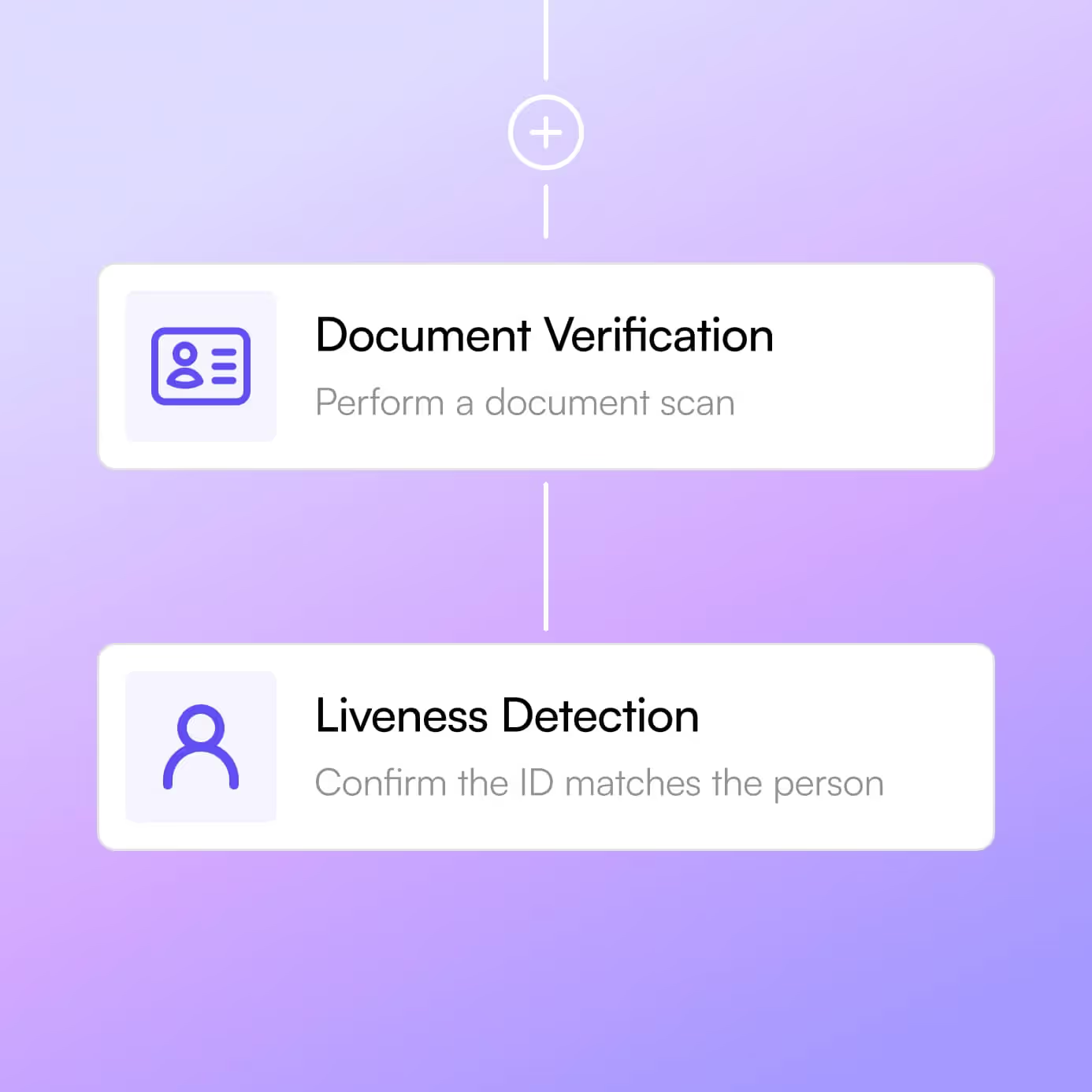
First-time users complete document verification with liveness; the age is read from the document and checked against the rule. Returning users present a reusable over-18 proof in a click.
Your case file records the outcome and the check performed. The document and the face go to the user's encrypted vault, so you meet the age-assurance duty without building a store of children's and adults' IDs.

Age assurance without an ID database
Age verification collects the most sensitive document a user owns from the largest possible audience. Zyphe processes it transiently, stores it encrypted in the user's own vault, and retains the verification result, the audit log and the cryptographic proof. A platform can show a regulator it verified age without ever holding a database of identity documents.
Where data is stored, what is retained, and the audit status: the security and trust pageThe regulations driving age verification
- United Kingdom: Online Safety Act
- Since 25 July 2025, services that allow pornography or other harmful content must use highly effective age assurance, enforced by Ofcom with fines of up to 10 percent of qualifying worldwide revenue. Self-declaration does not qualify; document verification, verified digital identity and reusable credentials do.
- European Union: Digital Services Act
- Article 28 requires platforms accessible to minors to put appropriate measures in place for their privacy, safety and security, and the Commission's 2025 guidelines name age verification among them. The eIDAS 2.0 wallet is designed to carry an over-18 attribute for exactly this use.
- United States: state laws
- A growing set of state laws require age verification for adult content and, in some states, for social media and app stores. In June 2025 the Supreme Court upheld Texas's age-verification law in Free Speech Coalition v. Paxton, which removed the main constitutional objection to document-based checks.
- Platform policies
- Marketplaces, gaming platforms and communities are adopting age checks under their own terms, often after an incident. The Persona and Discord episode showed what happens when the check stores the ID; the design question is now how to verify without keeping it.
Methods compared, including the one Zyphe does not offer
- Document verification with liveness
- The date of birth comes from a verified government document and a live person is confirmed to be presenting it. Highest assurance, and the method every age-assurance regime accepts. This is Zyphe's primary method.
- Reusable credential
- A user verified once proves the age predicate elsewhere without a new document, as a zero-knowledge proof. Same assurance as the original check, near-zero friction, and no birth date disclosed. Zyphe's KYC Passport.
- Facial age estimation
- A model estimates age from a selfie without a document. Fast and document-free, but an estimate with an error margin that regulators treat as acceptable only with a buffer above the limit. Zyphe does not offer it: age on this platform comes from a verified document or a credential derived from one, never from a guess.
- Self-declaration, email or payment-card signals
- Low friction and low assurance. Not accepted as highly effective age assurance in the UK and not a defence when a regulator asks how a minor got through.
Gambling, marketplaces and social platforms
Licensed gambling operators use Zyphe today for age enforcement alongside KYC, with the geolocation step checking that the user is in a licensed jurisdiction. Marketplaces and social platforms use the same flow with a different minimum age and, for returning users, the reusable proof.
KYC and age verification for iGaming →Better compliance in 190+ Countries
Banking Secrecy Act
Enforces strict record-keeping and reporting requirements for financial institutions to prevent money laundering and financial crimes in the United States.
Anti-money Laundering Act
Establishes measures and responsibilities for financial intermediaries in Switzerland to prevent money laundering and terrorist financing.
Proceeds of Crime
Canadian regulation requiring financial institutions to detect, prevent, and report suspicious transactions related to criminal proceeds.
Terrorist Financing Act
Legislation enforcing measures in Canada to detect, prevent, and report financial activities linked to terrorist financing.
Anti-money Laundering
Australian regulation mandating financial entities implement robust compliance measures to detect, prevent, and report money laundering activities.
Counter-Terrorism Financing Act
Australian law ensuring financial institutions identify, monitor, and report activities related to financing of terrorism to maintain national and global security.
Integrate in as little as 15 minutes
curl -X POST https://verify.zyphe.com/v1/login_sessions \
-H 'Authorization: Bearer <API_KEY>' \
-H 'Content-Type: application/json' \
-d '{"auth_type": "email"}'
Frequent Questions
Software that confirms a user meets a minimum age before they can access an age-restricted product, service or content, using a verified identity document, a trusted record or a reusable credential issued after such a check. It replaces self-declared date-of-birth fields, which regulators no longer accept.
No. Zyphe verifies age from a government document with liveness, or from a KYC Passport credential issued after such a check. Facial age estimation produces an estimate with an error margin; Zyphe's age comes from a verified date of birth.
No. The document is processed transiently and stored encrypted in the user's own vault. The platform keeps the verification result, the audit log and the cryptographic proof, which is the evidence age-assurance regimes ask for, without a database of identity documents. Security and data handling
With a KYC Passport: a credential the user holds after verifying once. The service asks for a proof that the user is over the limit and receives a cryptographically verifiable yes, with no date of birth and no document disclosed. KYC Passport
Document verification with liveness and verified reusable credentials are among the methods Ofcom names as capable of being highly effective age assurance; self-declaration is not. Whether a given deployment meets the duty depends on the service's risk assessment and configuration, which is why the minimum age and the accepted methods are set per flow. The operator playbook for the UK Online Safety Act
Yes. The minimum age is configured per flow and the geolocation step checks GPS against IP country and flags VPN or proxy use, so a 21 rule for a US casino and an 18 rule for an EU marketplace can run on the same integration.
Explore more Zyphe products
Know Your Customer
Verify people without keeping their documents
Document and liveness verification against 4,000+ identity document versions from 213 countries and territories, with injection detection and sanctions, PEP and adverse media screening.
Learn more →KYC Passport
Onboard once, reuse everywhere
A verification the person carries with them, so a customer who has already been checked can be recognised by the next platform without uploading their documents again.
Learn more →Liveness detection
that confirms a person, not a picture of one
Liveness detection that confirms a real, present person: active liveness with anti-spoof checks, a configurable face match, and injection-attack detection, with models updated monthly and run in-house.
Learn more →