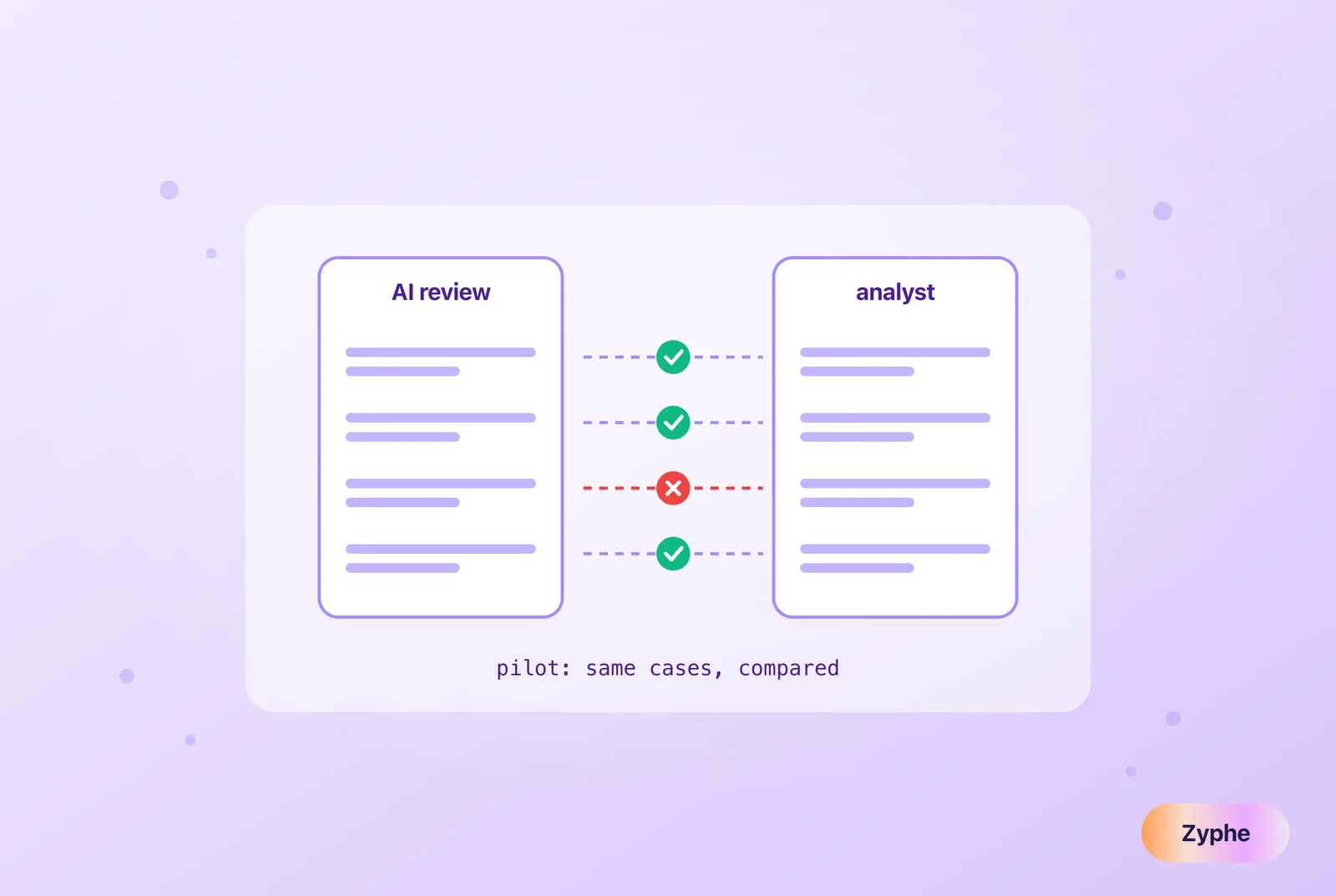
Run an AI compliance review pilot on your own case files: representative cohorts, independent reference reviews, stop conditions, and full cost measures.
Table of contents
An AI compliance review pilot tests a defined review workflow on representative case files against an acceptance standard agreed in advance. It measures evidence quality, unsupported conclusions, missed escalations, reviewer effort and total cost, keeps configuration cases separate from evaluation cases, and ends with a decision to proceed, narrow the scope or stop.
A demonstration tells you whether a supplier can produce one impressive file. A pilot tells you whether the proposed operating model can handle your queue, including the cases with missing evidence, conflicting declarations and ambiguous screening hits that make up most of the real work.
The question is no longer whether firms will use AI in compliance operations. In the Bank of England and FCA's 2024 survey of 118 UK financial firms, 75% were already using AI, up from 58% in 2022, and a third of all AI use cases were third-party implementations (Bank of England and FCA, November 2024). The same survey found that 46% of firms using or planning to use AI reported only a "partial understanding" of the AI technologies they use. A well designed pilot is how a compliance team closes that gap for the specific workflow it is about to buy.
Why do US regulators encourage pilots?
US banking agencies have said explicitly that testing new approaches alongside existing controls is legitimate. In their December 2018 joint statement on innovation, the Federal Reserve, FDIC, FinCEN, NCUA and OCC wrote that "Pilot programs undertaken by banks, in conjunction with existing BSA/AML processes, are an important means of testing" new approaches, and that pilots which expose gaps in a BSA/AML program "will not necessarily result in supervisory action with respect to that program" (joint statement). So run the pilot alongside your existing process, not instead of it, and treat findings about your own controls as useful output.
The model risk side has also moved. SR 26-2, issued in April 2026 jointly by the Federal Reserve, OCC and FDIC, replaced SR 11-7 and SR 21-8 (the 2021 statement on model risk for BSA/AML systems) and places generative and agentic AI outside its scope (Federal Reserve). That is a scope boundary, not an exemption; the model validation guide covers the evidence your governance still needs.
What decision should the pilot support?
Write the decision down before choosing a single case. The options are usually four: proceed for the tested case type with specified controls, narrow the scope, repeat after the supplier makes changes, or stop. A trial without a decision attached generates activity and no answer.
Name the decision owner and the evidence they need. A head of operations moving a periodic review backlog needs different evidence from a model risk lead approving a new component; if both sign off, agree each one's measures in advance.
What should the pilot protocol contain?
A short protocol that both the delivery owner and the customer reviewer can read prevents most later disputes. Agree these fields before any case is processed:
| Protocol field | Decision to record before testing |
|---|---|
| Scope | Queue, legal entities, jurisdictions and excluded case types |
| Output | Required evidence, memo, status labels and handoff format |
| Cohort | Case selection method and the complexity groups it must include |
| Reference | Who builds the independent assessment and how disagreement is resolved |
| Roles | Configuration owner, case preparer, reviewer and decision sponsor |
| Measures | Definitions, denominators, observation period and cost categories |
| Stop conditions | Errors or unauthorized actions that pause the pilot |
| Acceptance | Thresholds by error severity and by case type |
| Data handling | Permitted access, retention, redaction and deletion |
The sample EDD review, built from invented records, is a useful way to agree what the output should look like.
How should you select the cases?
Sample the workload you actually intend to hand over, including the hard parts. A balanced cohort for corporate review usually includes:
- simple single-layer companies with consistent records;
- multi-layer ownership across more than one registry;
- files with a missing document or an unavailable source;
- declarations that conflict with registry data;
- ambiguous name-only screening results;
- the languages and jurisdictions that drive your real volume.
Record the population the cases were drawn from and how they were selected. Keep supplier-proposed examples and configuration cases out of the evaluation set. If the workflow is tuned after the supplier has seen reference answers, disclose it and run a fresh held-out set, or you are measuring adaptation to known answers.
Size the cohort around the decision, the failure types that matter most and your reviewers' capacity; no universal sample size proves a workflow is safe.
How do you build a credible reference assessment?
Qualified reviewers should assess the evidence and the expected next action independently of the candidate output. The reference answer is often "request further evidence" rather than a final customer decision, and that is fine as long as it is recorded consistently.
Freeze the evidence available to both sides; if one side saw a document the other did not, explain it or rerun the case. When qualified reviewers disagree, record it and adjudicate material differences rather than forcing a clean pass or fail.
Apply your normal access and data handling rules throughout. Calling something a test does not by itself authorize sending customer records to a new supplier.
Which measures show whether the work is useful?
Separate quality, escalation and effort, and report each with its denominator. The review pilot scorecard is built to keep these apart:
- First-pass acceptance: files accepted without correction divided by files submitted.
- Final acceptance: files accepted after correction, reported separately.
- Missed escalations: cases the reference says needed escalation that the workflow did not escalate.
- Unnecessary escalations: cases escalated that did not need it, reported as their own rate.
- Unsupported statements: findings not backed by the cited source, checked by reading the source.
- Retained reviewer effort: minutes your team spent on each file, recorded at the time.
A synthetic illustration of why the escalation measures stay separate: if 20 reference cases require escalation and the workflow escalates 18, it misses 2 of 20. If it also escalates 6 of the 80 cases that did not need it, that is a separate 6-of-80 measure. Neither number on its own says the workflow is safe to deploy.
How should cost and time be measured?
Count every cost of producing an accepted file: supplier charges, data, setup, internal preparation, review, correction and repeated review, with allocation assumptions visible. The cost per accepted case guide explains why accepted files, not checks, belong in the denominator.
Public per-task rates make the supplier side easy to budget. Zyphe's pricing page lists, for example, $3.00 per periodic file refresh, $3.00 per company and UBO investigation, $0.25 per AML false-positive alert resolved, and $1.00 per EDD review round with a spending cap agreed first. Human review and separately purchased data sit outside those automated-work rates, so add them, along with your own reviewers' time.
Distinguish elapsed time from active labor: a case waiting three days for a customer document may involve ten minutes of analyst work. Show the distribution, not only averages, because a few difficult files often drive most of the operational pain.
What should stop or narrow the pilot?
Agree severity-based stop conditions before the first run. Typical examples are an unauthorized write to a customer record, disclosure to an unapproved destination, or a material clearance the evidence did not support.
If a serious failure occurs, preserve the evidence, identify every affected case, and only then resume. A supplier fix should be retested, and it should not erase the original failure from the report.
Narrowing the scope can be the right result. A workflow may handle straightforward periodic reviews well while complex ownership cases still need another process. That is a useful finding, not a failed pilot.
How do you run the pilot from kickoff to decision?
A typical sequence for a single queue:
- Agree the decision and the protocol with the delivery owner, reviewer and sponsor.
- Set up access and data handling under your normal approval process.
- Draw the cohort from a recorded population, with complexity groups fixed in advance.
- Build the reference assessments independently of the supplier.
- Run configuration cases, then freeze the workflow version.
- Run the evaluation set and record reviewer minutes as you go.
- Inject controlled failures: a missing source, a conflicting declaration and a duplicate submission.
- Score the results by severity, case type and cost.
- Write the decision report with every submitted, accepted, reworked, escalated and unresolved file accounted for.
- Make the bounded decision: proceed, narrow, repeat or stop. "Proceed for corporate periodic reviews in these three jurisdictions, with these controls" is a decision; "the AI works" is not.
If you are a US bank, run the supplier side of this through your third-party process at the same time. The AML vendor due diligence checklist lists the evidence to request before the pilot starts.
How does a pilot with Zyphe work?
Zyphe starts on one agreed queue or slice, such as a corporate periodic review backlog through the KYC periodic review desk or complex ownership files through the UBO and EDD desk. Scope, volume and service level are agreed before work begins, and the desk applies your policy: your thresholds, your risk taxonomy, your lookback periods.
Every case starts in Suggestion mode. The desk returns each file with the evidence gathered and a proposed disposition, and nothing closes without one of your reviewers. If a category of case holds up on a sample you set, you can later let that category run on Autopilot, where an agent's action goes through only if a rule-based check also passes, and switch it back at any time. The decisions AMLR Article 18(3) reserves to your firm, including the customer risk profile and the decision to enter the relationship, never move.
For a sense of what a production deployment produces, Azimut's agent deployment reports 1,000 L1/L2 analyst hours saved over six months, 50,000 false positives closed by agents and 850+ complex alerts discounted. Use your own pilot to find out what your queue produces.
General information, not legal advice.
Sources and method
Statistics come from the Bank of England and FCA report "Artificial intelligence in UK financial services 2024" (published 21 November 2024). Regulatory quotations come from the 2018 joint statement on innovative efforts to combat money laundering, and the SR 26-2 references from the Federal Reserve's letter, all checked on 25 October 2026. The escalation figures are a synthetic illustration. NIST's AI Risk Management Framework is a voluntary reference for organizing wider AI risk discussions; it does not certify this protocol.
 Michelangelo Frigo (Co-Founder at Zyphe) Michelangelo Frigo is a privacy and identity infrastructure expert and co-founder of Zyphe.