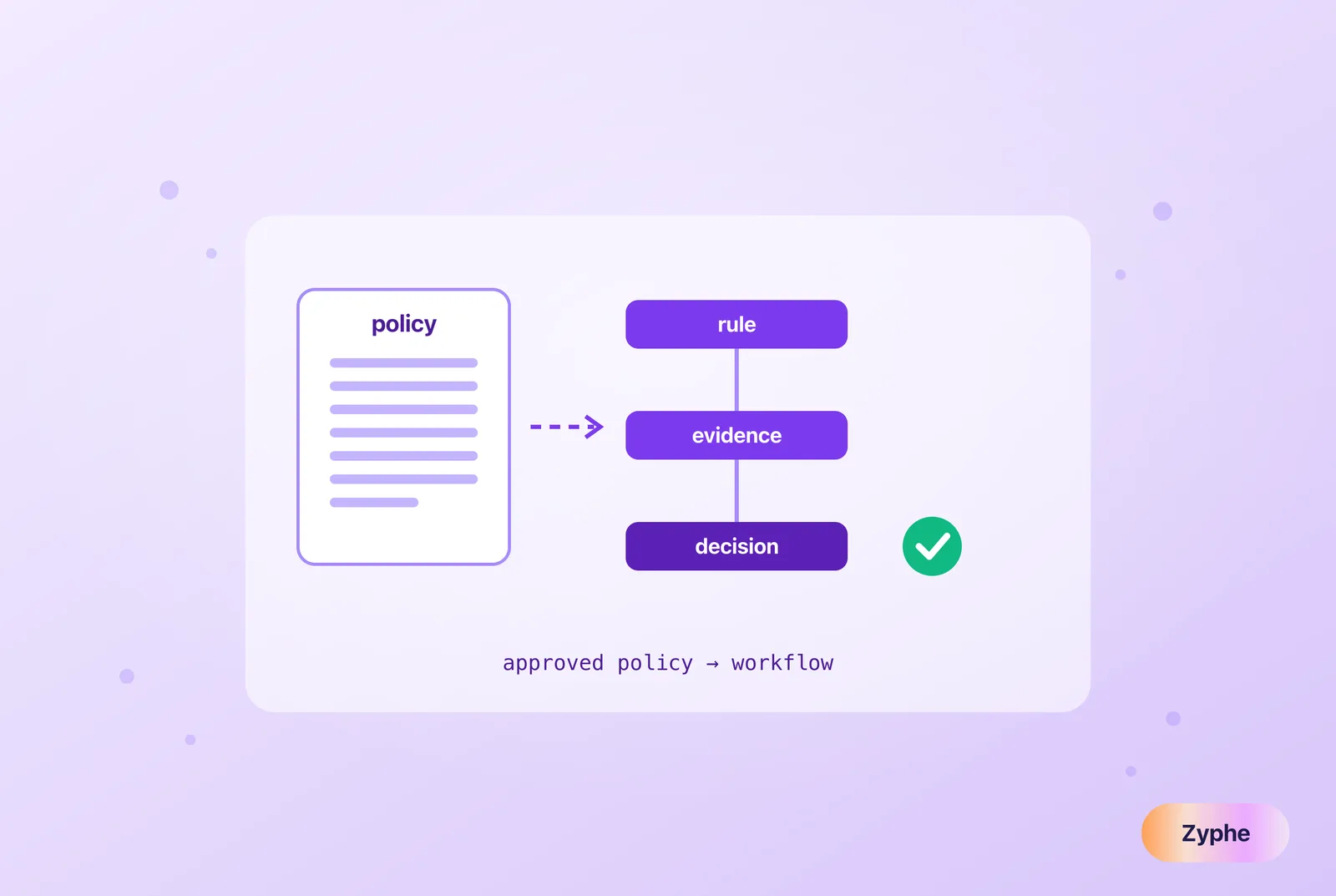
Compliance workflow automation turns policy into tasks, evidence rules, stop conditions and decision owners. A worked example, test cases and maintenance.
Table of contents
Compliance workflow automation translates an approved policy into executable tasks, evidence requirements and decision boundaries. A usable specification states what enters the workflow, which rules apply, where judgment is needed, when work must stop and who owns each exception. The policy owner approves that interpretation before anything runs.
"Review corporate customers using a risk-based approach" is a policy direction. It is not an instruction anyone, human or software, can execute. Before a case can move, someone has to decide which documents to obtain, how to treat two registers that disagree, what counts as a finished file and who signs it off.
Left implicit, those choices get filled differently by each analyst, and by an AI agent with whatever seems plausible. Written down and tested, they make the workflow predictable and auditable.
Why do compliance policies fail at the point of execution?
A policy can be sound on paper and still fail if it never reaches the systems doing the work. The TD Bank case is a recent example. According to the U.S. Department of Justice, TD Bank "added no new transaction monitoring scenarios and made no material changes to existing transaction monitoring scenarios from at least 2014 through late 2022," and did not automatically monitor domestic ACH transactions, most check activity and other transaction types, "resulting in 92% of total transaction volume going unmonitored from Jan. 1, 2018, to April 12, 2024" (DOJ, October 2024). The bank's resolution with DOJ alone came to more than $1.88 billion, and FinCEN's Director said the bank "allowed its AML program to languish" (FinCEN).
A UK case shows the same gap in onboarding. The FCA found that Starling Bank opened over 54,000 accounts for 49,000 high-risk customers between September 2021 and November 2023, despite a restriction it had agreed not to open such accounts (FCA, October 2024). The rule existed. The onboarding workflow did not enforce it.
Both cases point to the same discipline: a policy change is not finished until the workflow, its tests and its monitoring have changed too. For a deeper look at the US case, see the TD Bank lesson.
Where should a compliance workflow automation project start?
Start with one case type and one approved policy version, not with the whole function. For that case type, write down five things:
- Trigger. What starts a case: a review falling due, a new corporate onboarding, a registry change.
- Required inputs. The customer identifier, the existing file, the policy version and any declarations.
- Permitted sources. Which registries, data providers and internal systems the workflow may use, and which it may not.
- Expected output. A source-linked review memo, an escalation for missing evidence, or both, each with its own status label.
- Decision owner. The person or role who accepts the output and makes any decision it supports.
Record exclusions as well, so the workflow can recognize a case that falls outside its scope and hand it back instead of forcing it through. If you are recovering an overdue queue rather than designing a steady-state process, the KYC remediation plan covers segmentation and reporting first.
How do you turn a policy sentence into an executable rule?
Turn a policy sentence into a rule by separating what must always happen from what requires judgment, and naming the stop condition between them. Take this fictional instruction for a corporate review cohort: "Compare the current ownership declaration with permitted company records. Escalate a material discrepancy before the file can be treated as ownership-resolved."
| Specification element | Interpretation for this cohort |
|---|---|
| Input | Customer identifier, ownership declaration, company extract and policy version |
| Evidence requirement | Record the source and effective date of every ownership statement |
| Deterministic operation | Match identifiers and calculate economic interests from the share data supplied |
| Judgment task | Explain whether conflicting statements concern different dates, rights or entities |
| Stop condition | Required evidence unavailable, entity identity unresolved, or a material discrepancy |
| Exception output | The conflict, the missing evidence and the proposed next request |
| Decision owner | Designated reviewer on the customer's compliance team |
| Completion rule | Reviewer accepts the prepared output under the agreed category |
The specification does not say the newer document always wins. It asks the workflow to establish what each document represents and to keep any unresolved disagreement visible. The sample EDD review shows what that looks like in a finished file, with a sole-owner declaration that conflicts with two registers.
Which steps should be rules and which can be agents?
Use explicit rules for anything that must never vary, and use agents for gathering, reading and explaining within those rules. A practical split:
- Rules: required identifiers, permitted sources and destinations, ownership arithmetic, thresholds, mandatory fields, who may approve what.
- Agents: extracting facts from documents, choosing the next permitted collection step, comparing sources, drafting the explanation of a discrepancy, assembling the file.
- People: approving the policy, resolving genuine ambiguity, deciding the customer's risk profile and the relationship.
Treat "unknown" as a real state throughout. If a shareholder field is missing, the ownership is unknown, not zero. If a registry lookup fails, the check failed, not a negative finding. That distinction has to survive from the first step to the final file, or a reviewer will read silence as reassurance.
How should exceptions be designed?
Design each exception around the decision it needs, not around the fact that something went wrong. "Needs review" is too broad when one case needs a technical retry and another needs a specialist ownership assessment.
Give every exception type four properties: a reason code, an owner, the evidence bundle the owner will see, and the permitted next actions. A reviewer should be able to request information, reject an inference or return the file for correction without destroying the earlier version. Set an escalation path for when the intended owner is unavailable, because work should not continue simply because nobody was there to stop it.
Who must approve the policy behind an automated workflow?
The firm's own policy owner must approve the policy and the criteria a workflow applies, and in the EU that is a legal requirement rather than good practice. Article 18(3) of the EU AML Regulation lists tasks that "shall not be outsourced under any circumstances," including "the approval of the obliged entity's internal policies, procedures and controls" and "the approval of the criteria for the detection of suspicious or unusual transactions and activities" (Regulation (EU) 2024/1624, applying from 10 July 2027).
A vendor or an agent can draft the interpretation and implement it, but the sign-off stays with the firm. Keep that approval, with the policy version it refers to, attached to the workflow configuration so anyone reviewing a case later can see which approved interpretation governed it.
How do you stop documents from rewriting the workflow?
Keep permissions and destinations outside the control of anything the workflow reads. A retrieved document can contain text that tries to redirect an AI agent, a risk OWASP describes as indirect prompt injection. The workflow should treat that text as material to assess, never as authority to change what it may do or where it may send data.
Asking the model to "ignore suspicious instructions" is not a control. A real boundary is enforced where the action executes: the tool refuses an unauthorized destination regardless of what the model asked for. Include a test document containing a malicious instruction in your test set, and inspect the actions the system attempted, not just the wording of the memo.
How do you test the policy translation before go-live?
Write the test cases before implementation, and ask the policy owner to agree the expected outcome for each. A starting set for a corporate review queue:
- A consistent ownership file that should pass cleanly.
- A date mismatch with a legitimate explanation in the evidence.
- An unresolved discrepancy that must escalate.
- A required source that is unavailable.
- An out-of-scope entity type that must be handed back.
- A document containing an instruction to change the workflow's behavior.
If two experienced reviewers disagree on the expected outcome, resolve the policy question or write an escalation rule before you treat the workflow's behavior as an error. Test actions as well as prose: a correct recommendation does not excuse an unauthorized write to a customer record. When the queue goes live, the review pilot scorecard keeps acceptance, missed escalations and reviewer effort separate.
How do you keep the workflow current when policy changes?
Version the policy interpretation, the workflow and the test set separately, and re-run the affected tests whenever any of them changes. TD Bank's monitoring stayed static for years while its business changed; a versioned specification with an owner and a review date makes that drift visible.
When a policy changes, identify the affected steps and in-flight cases, decide whether open cases finish under the old version or restart under the new one, and record who authorized the change.
How does Zyphe run a desk on your policy?
Zyphe's operated review desks run on the policy your firm approved: your matching thresholds, your risk taxonomy and your lookback periods. The desk applies that policy rather than bringing its own, works each case to an agreed service level and returns a file with the evidence and written reasoning attached for your reviewer to approve or send back (how the desks work).
On the platform side, Zyphe's Model Context Protocol server lets an AI assistant configure verification flows, add or change flow steps and manage forms, and every tool call is recorded as an audit row (developer docs). The write actions that matter most are guarded on the server: a KYB result cannot be approved while a clarification is open or a document-backed field does not match, whatever the calling model decides. That is the kind of boundary this article recommends building into any automated workflow.
A short checklist before you automate a policy
Before you automate a compliance policy, check that you can answer each of these in writing:
- Which case type and policy version does this workflow implement?
- Which steps are rules, which are agent tasks and which are human decisions?
- What are the stop conditions, and who owns each exception type?
- Who approved the interpretation, and when is it next reviewed?
- Which test cases must pass, including a missing source and a malicious document?
If any answer is "the vendor knows," the specification is not finished.
General information, not legal advice.
 Michelangelo Frigo (Co-Founder at Zyphe) Michelangelo Frigo is a privacy and identity infrastructure expert and co-founder of Zyphe.