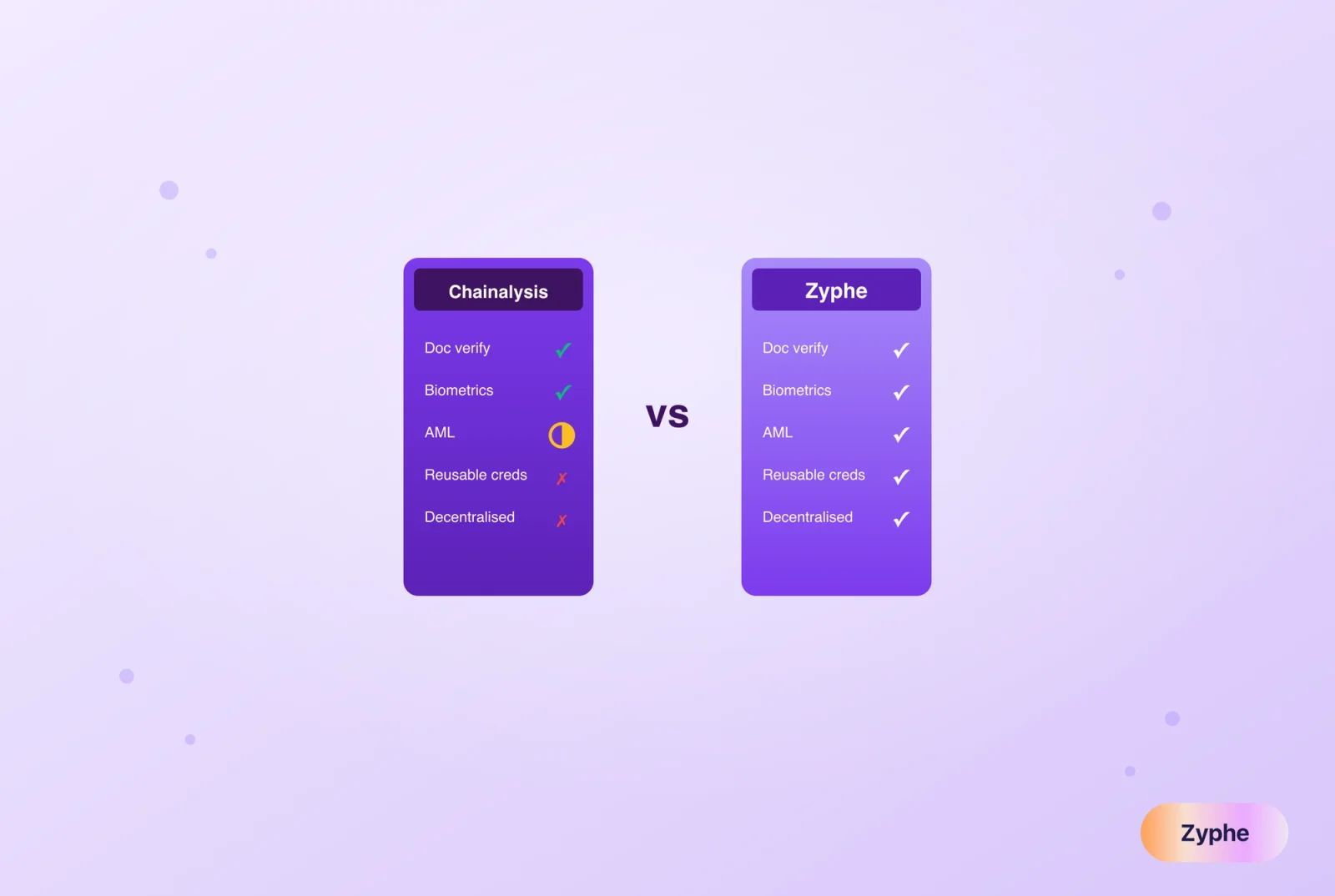
Comparing crypto compliance software? See how on-chain analytics (Chainalysis, Elliptic, TRM Labs) and KYC layers (Sumsub, Zyphe) fit a 2026 compliance stack.
Table of contents
- Crypto compliance software is not one category but two layers: on-chain analytics that screen wallets and trace transactions, and identity and KYC that verify customers and meet the Travel Rule.
- The leading on-chain analytics platforms are Chainalysis, Elliptic, and TRM Labs, and they are complementary to KYC, not substitutes for it.
- Chainalysis leads on investigation and court-defensibility, Elliptic on broad cross-chain coverage, and TRM Labs on real-time, AI-driven screening.
- For the KYC and onboarding layer, Sumsub is the established crypto leader, and Zyphe is the privacy-first option with decentralised storage and reusable credentials.
- Most crypto firms need both layers plus Travel Rule support under FATF Recommendation 16 and, in the EU, MiCA obligations for CASPs.
- The biggest buyer mistake is buying on-chain analytics while leaving a weak KYC layer, so the wallet screening runs on identities you cannot trust.
Crypto compliance software helps virtual asset businesses meet AML and sanctions obligations across two layers: on-chain analytics that screen wallets and trace transactions, and KYC that verifies customers and meets the Travel Rule. Leading on-chain platforms include Chainalysis, Elliptic, and TRM Labs, while KYC and onboarding is handled by providers like Sumsub and the privacy-first option, Zyphe.
TL;DR
The label hides a trap: it is two different categories, and confusing them leads firms to buy the wrong thing. The first layer is on-chain analytics, software that screens crypto wallets, scores risk, and traces transactions across blockchains, led by Chainalysis, Elliptic, and TRM Labs. The second is identity and KYC, software that verifies who the customer is, screens them against sanctions and PEP lists, and meets the Travel Rule, where Sumsub is the established crypto leader and Zyphe is the privacy-first option.
These layers are complementary, not interchangeable. On-chain analytics tells you a wallet is risky; KYC tells you who controls it. Most regulated crypto firms need both, plus Travel Rule support under FATF Recommendation 16 and, in the EU, MiCA obligations for crypto-asset service providers. This guide compares the tools by layer, explains how the analytics platforms differ, shows where Zyphe fits, and is honest about when not to over-buy.
12 min read. Last updated 13 July 2026.
What is crypto compliance software?
Crypto compliance software is the set of tools a virtual asset business uses to meet AML, sanctions, and identity obligations. It spans two distinct layers that are easy to conflate. On-chain analytics screens wallet addresses and transactions against risk signals, sanctioned addresses, exposure to mixers, illicit-source funds, and traces flows across blockchains. Identity and KYC verifies the human or business behind an account, screens them against sanctions and politically exposed person lists, and supports the Travel Rule that requires originator and beneficiary information to travel with transfers.
The distinction matters because a tool that is excellent at one layer does nothing for the other. Chainalysis will not onboard your customers, and a KYC provider will not trace a transaction across chains. Understanding crypto compliance software as two complementary layers is the first step to buying the right stack, which our KYC for crypto exchanges guide expands on.
What must a crypto compliance stack do in 2026?
Across both layers, regulated crypto firms have a defined set of obligations in 2026.
On the identity side: verify customers at onboarding, screen them against sanctions and PEP lists, and keep risk scoring current. On the transaction side: screen wallets and transactions in real time, detect exposure to illicit sources, and monitor for suspicious patterns. Across both: comply with the FATF Travel Rule, Recommendation 16, which requires originator and beneficiary information to accompany transfers above thresholds, as covered in our FATF Travel Rule guide. In the EU, the Markets in Crypto-Assets regulation, MiCA, sets obligations for crypto-asset service providers, including documented AML procedures and verified customer identities.
Good crypto compliance software produces defensible records across all of this, because a regulator examining a VASP will ask not just whether you screened, but whether you can prove who the customer was and where the funds came from.
Which crypto compliance tools should you compare?
Compare by layer, because the leaders in each are different companies.
For on-chain analytics: Chainalysis, Elliptic, and TRM Labs are the three established blockchain analytics platforms used by exchanges, banks, and law enforcement. For identity and KYC in crypto: Sumsub is the established leader, working with many top exchanges, and Zyphe is the privacy-first option with decentralised storage and reusable credentials. Some all-in-one suites blur the line, but in practice most serious crypto firms pair a best-in-class analytics platform with a strong KYC provider rather than expecting one tool to do both well.
The right tool for you therefore depends on which layer is your gap. If you cannot trace on-chain risk, you need analytics. If your onboarding is weak or your data model is a liability, you need a better KYC layer.
How do the crypto compliance tools compare?
The table groups the tools by layer, because comparing an analytics platform against a KYC provider is a category error.
| Tool | Layer | Core strength | Notes |
|---|---|---|---|
| Chainalysis | On-chain analytics | Investigation, court-defensibility | Mature Reactor workflow, broad attribution |
| Elliptic | On-chain analytics | Broad cross-chain coverage | Pioneer since 2013, wide asset coverage |
| TRM Labs | On-chain analytics | Real-time, AI-driven screening | Fast, automation-focused |
| Sumsub | Identity and KYC | All-in-one crypto onboarding | Centralised cloud, reusable KYC at Enterprise |
| Zyphe | Identity and KYC | Privacy-first, decentralised storage | Customer-held key, reusable credentials, Travel Rule support |
The point is the columns, not a winner: analytics and KYC are different jobs, and a complete crypto compliance stack usually contains one of each.
How do Chainalysis, Elliptic and TRM Labs differ?
The three on-chain analytics leaders optimise for different things, and the right one depends on your use case.
Chainalysis is widely considered the gold standard for investigations, with a large client base, a mature investigation workflow in Reactor, extensive cross-chain tracing, and an attribution database built through law enforcement collaboration, which makes it strong where court-defensible evidence matters. Elliptic pioneered blockchain analytics in 2013 and offers very broad coverage across assets and chains, with a large data footprint, which suits compliance operations needing wide visibility. TRM Labs, founded in 2018 and now a large player, emphasises speed and automation with AI-driven, real-time cross-chain screening, appealing to firms prioritising high-volume, automated monitoring.
All three are credible. Choose on whether your priority is investigative depth and evidentiary quality, breadth of coverage, or real-time automated screening. None of them, however, performs the identity and KYC layer, which is where the next section comes in.
Where does Zyphe fit in crypto compliance?
Zyphe sits in the identity and KYC layer, and it is built for the part of crypto compliance that the analytics platforms do not touch: knowing, reliably and privately, who your customer is. It verifies identity with NFC chip reads and two-step liveness, screens against sanctions and PEP lists, traces ultimate beneficial owners recursively, and supports Travel Rule information exchange.
The differentiator is architecture. Instead of storing verified crypto-customer data in a central cloud, Zyphe shards it across more than 60,000 decentralised nodes with a 29-of-100 threshold scheme, and the customer holds the encryption key, so there is no central honeypot, which matters in a sector that is a constant target. Reusable credentials let a verified user re-present their identity across services, and data residency is enforced per region. This connects cleanly to the on-chain layer: analytics screens the wallet, Zyphe verifies the person, and the two together give a regulator a defensible picture. See decentralised KYC and our AML software for how the monitoring connects.
How do you build a crypto compliance stack?
A complete crypto compliance stack combines both layers and the Travel Rule, deliberately rather than by accident.
- Start with the KYC and identity layer, because wallet screening is only as good as knowing who controls the wallet. Choose a provider that fits your data-privacy and residency needs.
- Add on-chain analytics for wallet and transaction screening, picking Chainalysis, Elliptic, or TRM Labs by whether you prioritise investigation, coverage, or real-time automation.
- Implement Travel Rule information exchange under FATF Recommendation 16 for transfers above the threshold.
- Connect the layers so identity, wallet risk, and transaction monitoring inform one risk picture rather than three silos.
- Confirm MiCA and local obligations, and keep defensible records across the whole flow.
Built this way, your crypto compliance stack has no gap between who the customer is and what their wallet does.
When should you not over-buy these tools?
It is possible to over-buy, and an honest guide should say so. If you are an early-stage crypto firm with low volume, you may not need the most expensive enterprise analytics platform on day one; a strong KYC layer plus a proportionate analytics tool may cover your actual risk, and you can scale up as volume grows.
If your gap is clearly on one layer, do not buy the other to solve it: adding a second analytics platform will not fix weak onboarding, and a new KYC provider will not trace on-chain flows. And if you already run a capable analytics platform and your only weakness is identity data sitting in a breachable store, the fix is the KYC layer and its architecture, not more screening. Buy for your actual gap, connect the layers, and avoid paying for overlap you will not use. If your gap is the privacy-first KYC layer, book a demo or read how it works.
The bottom line
Crypto compliance software is two layers wearing one name. On-chain analytics, led by Chainalysis, Elliptic, and TRM Labs, tells you a wallet is risky. Identity and KYC, where Sumsub leads and Zyphe is the privacy-first option, tells you who controls it. Confuse them and you buy the wrong tool; connect them and you get a defensible picture a regulator will accept.
Buy for your actual gap, pair a strong analytics platform with a strong KYC layer, cover the Travel Rule, and keep the architecture of your identity data in mind, because in crypto the data you store is a target. If your gap is privacy-first KYC, that is exactly where Zyphe fits.
Book a demo, see how it works, or read about KYC for crypto.
Related resources
- KYC for crypto exchanges
- FATF Travel Rule compliance for VASPs in 2026
- AML compliance software in 2026
- AML transaction monitoring in 2026
- Decentralised KYC
- AML software
- KYC for crypto
Cited sources
- Chainalysis, blockchain analytics and crypto compliance: https://www.chainalysis.com/
- Elliptic, blockchain analytics: https://www.elliptic.co/
- TRM Labs, blockchain intelligence: https://www.trmlabs.com/
- FATF Recommendations (Recommendation 16, the Travel Rule): https://www.fatf-gafi.org/en/topics/fatf-recommendations.html
- ESMA, Markets in Crypto-Assets (MiCA): https://www.esma.europa.eu/
 Michelangelo Frigo (Co-Founder at Zyphe) Michelangelo Frigo is a privacy and identity infrastructure expert and co-founder of Zyphe.