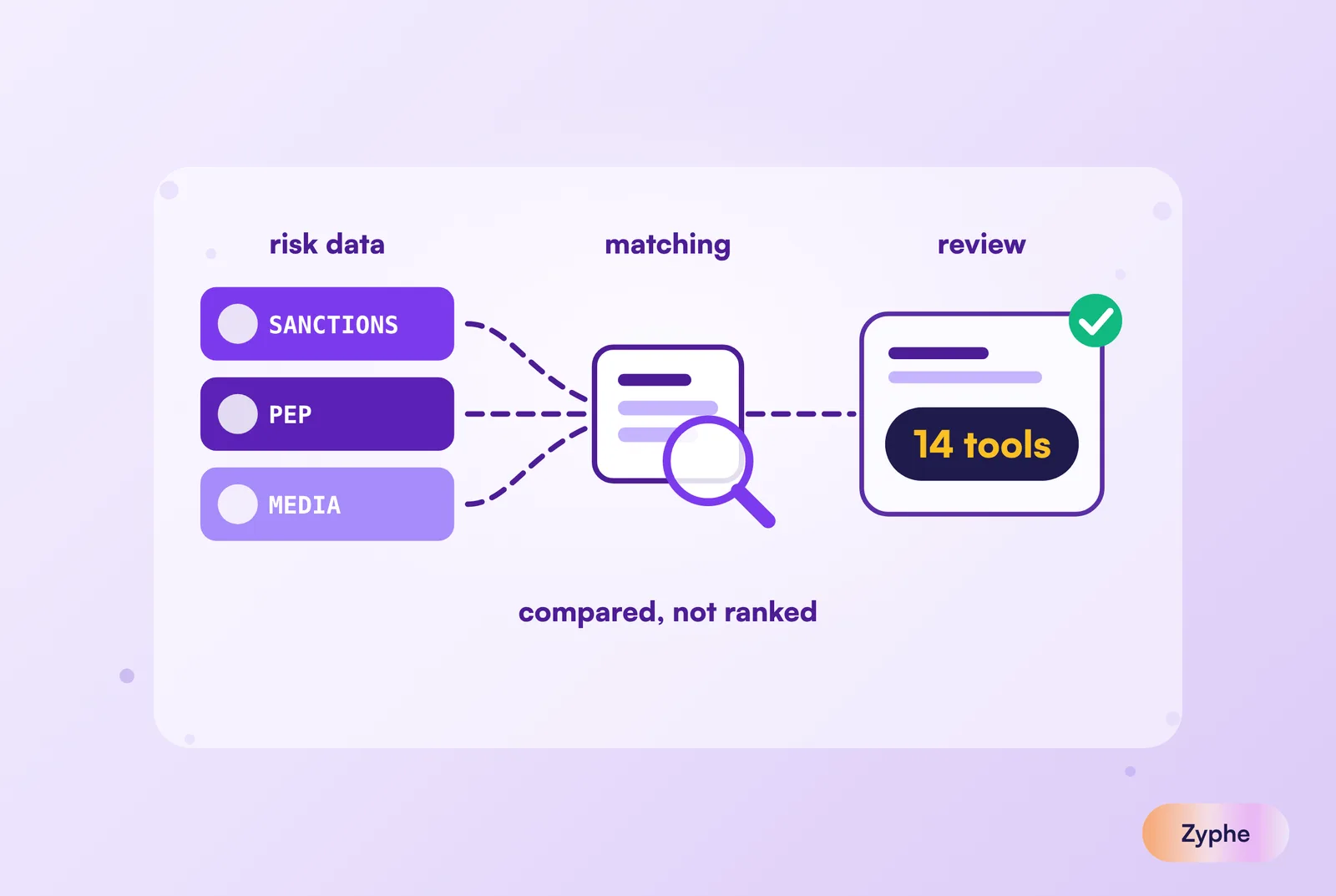
14 AML screening tools compared, not ranked: sanctions, PEP and adverse media data, monitoring, deployment and public prices, checked on each vendor's own site.
Zyphe wrote this comparison and is one of the vendors in it. Facts about other vendors come from their own public pages or the sources cited, as of this page's last update on . No vendor pays to appear here (editorial policy). Out of date? Tell us. Our own entry, limitations included: Where Zyphe fits.
Table of contents
- Fourteen AML screening tools are compared below, listed alphabetically, not ranked, each with its own data claim, screening scope, monitoring, deployment, public pricing and a best-for line, checked on its own site on 11 November 2026.
- An AML screening tool is three things that are often sold separately: the risk data (lists, PEP profiles, news), the matching engine, and the review of the alerts it produces. Most buying mistakes come from comparing one vendor's data with another vendor's engine.
- We read six vendor-published rankings of AML screening and adverse media tools. Five put their own publisher first, and three of the six acknowledge on the page that the publisher is one of the vendors listed. This post is also written by a vendor, so the method and every source are at the end.
- Nine of the fourteen vendors publish a false positive reduction figure or a related automation rate. None of them states the baseline it was measured against in the same way, so the figures cannot be compared with each other. Zyphe's own figure has the same gap.
- Five vendors publish a price you can read without a sales call: ComplyAdvantage, dilisense, sanctions.io, Sumsub and Zyphe. LSEG sells small online packages.
- The EU AML Regulation, which applies from 10 July 2027, makes the screening scope explicit: Article 20(1)(d) requires checking the customer and beneficial owners against targeted financial sanctions, including who controls the entity or holds more than 50 percent of it, individually or collectively.
AML screening software checks customers, their beneficial owners and counterparties against sanctions lists, politically exposed person (PEP) data, watchlists and adverse media, then scores each potential match for an analyst to review. It runs at onboarding, again whenever the lists or the customer change, and keeps a record of every decision for audit.
TL;DR
There is no single best AML screening software, because the tools on a shortlist are not the same kind of product. Dow Jones, LSEG and Moody's are research databases with screening software around them. Ripjar, Napier AI and FinScan are screening engines that work with data from others. ComplyAdvantage, Castellum.AI, dilisense, Sanction Scanner and sanctions.io sell their own consolidated data through an API or platform. Sumsub and Zyphe run screening inside identity verification. Decide first which layer you are missing: the data, the matching, or the review. Then test every finalist on your own names, because coverage counts and false positive percentages published by vendors measure different things.
What does AML screening software actually do?
AML screening software takes a person or a company from your customer file and asks one question of several data sets: does this name, together with its identifiers, match anyone a regulator or a reasonable reviewer would care about? The data sets are the sanctions lists (OFAC, UN, EU, UK and national lists), PEP data with relatives and close associates, other watchlists such as law enforcement and regulatory actions, and adverse media, the news and court reporting that surfaces risk before any list does.
The work happens in three layers, and it helps to keep them apart when you compare vendors:
- Risk data. Who compiled the records, from which sources, how often they are refreshed, and how allegations are separated from convictions.
- Matching. How the engine handles transliteration, aliases, word order and secondary identifiers such as date of birth, nationality and registration number, and how it scores what it finds.
- Alert review. What happens to a potential match: an analyst queue, case management, an audit trail, and increasingly an AI layer that prepares or clears routine alerts.
Screening also runs at more than one moment. It runs at onboarding, on ongoing monitoring when lists change, on event triggers when the customer's data changes, and, for payment firms, on the transactions themselves. If you are new to the underlying control, our sanctions screening guide, the PEP screening guide and the adverse media screening guide cover each one in depth.
Which AML screening software is on the 2026 shortlist?
Fourteen tools, in alphabetical order. Every cell comes from the vendor's own website on 11 November 2026, in the vendor's own terms, and the sources are listed at the end. A blank claim means the vendor does not state it on the page we checked, not that the capability is missing.
| Vendor | Screening product | Data claim (vendor's own words) | Monitoring | Deployment | Public pricing | Best for |
|---|---|---|---|---|---|---|
| Castellum.AI | Sanctions and PEPs Screening, AI-Powered Adverse Media Screening | 1,700+ global watchlists, updated every 5 minutes from issuers; matching across 100+ languages | Yes | API; hosting not stated | No | Sanctions-heavy programmes that want issuer-fresh lists and AI agents for routine alerts |
| ComplyAdvantage | Mesh Customer Screening | Proprietary data from thousands of sources; adverse media from 11,000+ verified media sources in 200+ countries | Yes; sanctions changes within minutes, daily PEP monitoring | Real-time API, batch or SFTP | Yes, Starter plan from $99 a month | Fintechs that want a vendor's own risk data and a self-serve entry plan |
| dilisense | Screening API, monitoring and downloadable database | 12,000+ official sources, 2.3M+ records, 190+ jurisdictions, refreshed several times a day | Yes | REST API, Excel batch, on-premise database | Yes, API from EUR 0.10 per call with 100 free calls; free web search | Small teams that want to test free, or screen on-premise |
| Dow Jones | RiskCenter Advanced Screening and Monitoring | Licensed Factiva news sources; 54,000+ companies owned or controlled by sanctioned parties | Yes, always on | Platform, APIs and data feeds | No | Adverse media depth and sanctions ownership research |
| FinScan | AML and sanctions screening suite | Automatic global list updates; data quality tools for fragmented records | Yes | Real-time API and batch | No | Firms whose customer data needs cleaning before screening works |
| LexisNexis Risk Solutions | Bridger Insight XG with WorldCompliance data | 8m+ curated risk profiles; news in 59 languages; bring your own data provider | Yes | Public or private cloud, or on-premise | No | Banks that need single-tenant or on-premise deployment |
| LSEG | World-Check One | 4m+ records covering sanctions, PEPs, adverse media and enforcement, updated daily | Yes | Online platform, API, embedded screening | Online packages by screen volume; price not on the page | Firms that want a curated research database from a small package upwards |
| Moody's | Grid risk database | 200+ countries and jurisdictions; 50+ risk categories with source attribution | Yes | Not stated on the Grid page | No | Adverse-media-heavy programmes that want curated, categorised profiles |
| Napier AI | Client Screening | Data from partner providers; AI fuzzy matching in 20+ languages | Yes, real time and batch | Managed SaaS, private cloud or on-premise | No | Institutions that need separate configurations per customer segment |
| Ripjar | Ripjar Screening | 6bn+ articles in 22+ languages resolved into up to 14m entity profiles; no lock-in to one data provider | Yes, on material changes | Not stated on the screening page | No | Large books where prior decisions must carry forward |
| Sanction Scanner | AML Screening and Ongoing Monitoring | 3,000+ sanctions, PEP, wanted and watched lists from 220+ countries | Yes | REST API with webhooks | No; a free single-name check | Fintechs that want screening and transaction monitoring from one API |
| sanctions.io | Screening API and Monitoring API | Lists updated every 60 minutes; around 350 ms per call; batches of up to 10,000 records | Yes, on every list change | REST API, Salesforce, HubSpot, SAP | Yes, a pricing calculator | Developers and CRM-centred teams that want a visible price |
| Sumsub | AML Screening in its verification platform | 50,000+ independent sources across 240+ countries and territories | Yes | Hosted platform and API | Yes, Compliance plan includes AML screening | One contract for identity verification and screening |
| Zyphe | AML screening in KYC and KYB flows, plus on-demand screening | 100,000+ lists and sources; a 0 to 100 score with a count of contributing sources | Yes, every 24 hours and on events | Hosted flow, no-code link or REST API | Yes, per screening and per monitored subject | Teams that screen inside onboarding and want agent review without a central PII store |
Two things to read before you use the table. First, the data claims do not measure the same thing. Castellum.AI counts watchlists, LSEG counts records, Ripjar counts articles and entity profiles, and Zyphe counts lists and sources. A larger number is not a better screen, and a curated record is a different unit from a raw article. Second, "monitoring" covers anything from a scheduled re-screen to an alert within minutes of a designation. Ask each finalist how long a new designation takes to reach your queue.
What is each AML screening tool best for?
Listed alphabetically. Each entry is drawn from the vendor's own pages on 11 November 2026.
Castellum.AI: best for issuer-fresh sanctions data with alert agents
Castellum.AI screens against 1,700+ global watchlists covering sanctions, PEPs, export controls, forced labour and law enforcement lists, and says it updates them every 5 minutes with data sourced directly from issuers. Its Jgram matching works across 100+ languages, and its policy-trained agents auto-adjudicate routine alerts with documentation. Adverse media is a separate product. Pricing is by tier, with no figures on the page. Choose it when list freshness and sanctions depth matter more than a bundled onboarding flow.
ComplyAdvantage: best for proprietary risk data with a self-serve entry plan
Mesh Customer Screening uses ComplyAdvantage's own data across sanctions, PEPs, relatives and close associates, watchlists, adverse media and enforcement. Sanctions changes are available within minutes, its adverse media covers 11,000+ verified sources in 200+ countries, and it classifies news into 34 risk subcategories. It connects by real-time API, batch or SFTP, and says agentic AI resolves up to 85 percent of routine alerts. A Starter plan starts at $99 a month, priced by the number of monitored entities up to 2,000.
dilisense: best for a free start or on-premise screening
dilisense consolidates 12,000+ official sources and 2.3M+ records across 190+ jurisdictions, refreshed several times a day, covering sanctions, PEPs, criminal lists and adverse media. It offers a free web search and a free API quota, an Excel batch tool, and a downloadable database for on-premise checks that keep customer names in-house. Its API is priced publicly, from EUR 0.10 per call with 100 free calls, or EUR 300 a month with 10,000 calls included, and ongoing monitoring starts at EUR 150 a month for 1,000 names. It suits small teams and developers who want to prove coverage before any spend.
Dow Jones: best for adverse media depth and sanctions ownership
RiskCenter Advanced Screening and Monitoring combines Dow Jones' structured Risk and Compliance data with thousands of licensed Factiva news sources for adverse media. Its research team compiles the sanctions lists, and its Sanctions Control and Ownership data identifies 54,000+ companies owned or controlled by sanctioned parties. Other official lists cover 400+ regulatory and enforcement bodies. It is delivered as a platform, APIs and data feeds, with no public price.
FinScan: best for screening on messy customer data
FinScan, from Innovative Systems, positions data quality as part of screening: its tools clean and de-duplicate fragmented records before they are matched. It offers real-time API and batch screening across sanctions, watchlists, PEPs and adverse media, plus payment screening. It publishes an 80 percent false positive reduction figure and customer cases such as 375M records across 14 sources screened overnight. Pricing is not published.
LexisNexis Risk Solutions: best for single-tenant or on-premise deployment
Bridger Insight XG is screening software that integrates with the WorldCompliance dataset of 8m+ curated risk profiles, or with a data provider you already use. News coverage spans 59 languages. It runs in public or private cloud, single-tenant or multi-tenant, or on-premise, with batch and API screening. Its optional modules, Firco Entity Resolution Filter and Intelligent Match Decision, are where its 50 to 80 percent false positive reduction claim comes from.
LSEG: best for a curated research database from a small package upwards
World-Check One gives access to more than 4m records covering sanctions, PEPs, adverse media, law enforcement and regulatory enforcement, updated daily by research teams on five continents. LSEG keeps allegations, investigations, charges and convictions distinct, and states that inclusion does not mean a person poses a risk. It is sold as an online platform, an API, World-Check On Demand data and World-Check Verify, an embedded screen that runs without storing customer PII. New customers can buy online packages, for example up to 3,000 screens over 12 months for up to three users.
Moody's: best for curated, categorised adverse media profiles
Moody's Grid consolidates adverse media, sanctions, watchlists and PEP data into structured risk profiles, with coverage across 200+ countries and jurisdictions and 50+ risk categories referenced in AML frameworks. Each event carries source attribution, and PEP profiles include related sanctions and media references, with AI-powered filtering to prioritise results. The Grid page does not state a deployment model or a price.
Napier AI: best for per-segment screening configurations
Napier AI Client Screening runs real-time and batch screening across sanctions, PEPs and adverse media, with data from partner providers and AI fuzzy matching across 20+ languages. Its distinctive feature is multi-configuration screening: separate thresholds and rules per customer type, risk level or list, tuned in a no-code sandbox on real data before release. Agents can clear known patterns, with the autonomy level set by your team. It deploys as managed SaaS, in a private cloud or on-premise.
Ripjar: best for entity-level screening where decisions carry forward
Ripjar Screening resolves every customer into one dynamic risk profile across sanctions, PEPs, watchlists and adverse media, so a rejected link stays rejected and only material changes trigger review. Its adverse media engine reads 6bn+ articles in 22+ languages into up to 14m entity profiles, updated twice daily, and its name matching covers 400+ languages and 20+ scripts. It works with your choice of sanctions, PEP and adverse media providers and your own internal lists, with no lock-in to one data provider. Pricing is not published.
Sanction Scanner: best for screening and monitoring from one API vendor
Sanction Scanner screens names against 3,000+ sanctions, PEP, wanted and watched lists from 220+ countries, with adverse media, transaction monitoring and customer risk scoring in the same product. Integration is a REST API with webhooks. The site offers a free single-name sanctions check; we found no published prices.
sanctions.io: best for developers who want to see the price
sanctions.io offers a REST Screening API at around 350 ms per call, batches of up to 10,000 records, and a Monitoring API that re-screens every registered entity when the lists change, which it says happens every 60 minutes. It covers sanctions, PEPs, criminal watchlists and adverse media, with native Salesforce, HubSpot and SAP integrations. Its public calculator estimates $1,999 a year for 10,000 screenings at the default settings.
Sumsub: best for one contract covering verification and screening
Sumsub screens individuals and companies against sanctions, PEP, watchlist and adverse media data from 50,000+ independent sources across 240+ countries and territories, inside the same platform as its identity and business verification. An LLM reviews each match and attaches a review note, and its default setup pairs an AML data vendor's matching with that AI review layer. Its Compliance plan, at $1.85 per verification with a $299 monthly minimum, includes AML screening.
Zyphe: best for screening inside onboarding without a central PII store
Zyphe screens people and companies against sanctions, PEP, watchlist and adverse media data drawn from more than 100,000 lists and sources, inside its KYC and KYB flows or on demand from the dashboard. Every match gets a 0 to 100 score, banded Low, Medium, High or Critical, plus the number of independent sources behind it. Relatives and close associates of a PEP score as PEPs. Monitored subjects are re-checked every 24 hours and on event triggers. Its AML agent can be off, suggest only, or clear routine false positives once a deterministic guard also passes. Verified identity data is not held in one Zyphe database. Pricing is public, from $0.20 per screening; the full picture, including its limits, is in the Zyphe section below.
Do you need a data vendor, a screening platform or both?
Most shortlists mix vendors that sell different layers, which is why demos are hard to compare. This map shows which layer each vendor supplies, as each describes itself.
| Vendor | Risk data | Matching and workflow | AI alert review |
|---|---|---|---|
| Castellum.AI | Own, enriched from issuers | Yes | Yes, adjudication agents |
| ComplyAdvantage | Own | Yes | Yes, agentic remediation |
| dilisense | Own consolidation of official sources | API and batch | Not stated |
| Dow Jones | Own research plus Factiva | Yes | AI risk profiles |
| FinScan | Not stated on the pages checked | Yes, with data quality tools | Not stated |
| LexisNexis Risk Solutions | Own (WorldCompliance) or yours | Yes | Model-based decisioning module |
| LSEG | Own research (World-Check) | Yes | Intelligent match resolution |
| Moody's | Own (Grid) | Not stated on the Grid page | AI-powered filtering |
| Napier AI | Partner providers | Yes | Yes, configurable agents |
| Ripjar | Your choice of providers plus its own news processing | Yes | Yes, Screening Assistant |
| Sanction Scanner | Own consolidation of lists | Yes | AI risk scoring |
| sanctions.io | Own consolidation of lists | API | Not stated |
| Sumsub | Data vendor matching plus its own sources | Yes | Yes, LLM review notes |
| Zyphe | Third-party data providers | Yes, inside KYC and KYB flows | Yes, AML agent with a deterministic guard |
How to use it. If your problem is coverage, for example adverse media in a region your current vendor misses, you are buying data, and the comparison is between Dow Jones, LSEG, Moody's, ComplyAdvantage and the list consolidators. If your problem is alert volume on data you already trust, you are buying matching and review, and the comparison is between engines that accept your provider, such as LexisNexis, Napier AI and Ripjar, or review layers. If you are building onboarding from scratch, a platform that bundles all three, such as ComplyAdvantage, Sumsub or Zyphe, removes integration work, at the price of accepting its data choice.
What happens when a vendor ranks its own category?
Search "best AML screening software" and most of the first page is written by vendors. On 11 November 2026 we read six vendor-published rankings of AML screening, sanctions or adverse media tools that surface for these queries in search or among the sources AI assistants cite for them.
| Publisher | Topic | Vendors listed | Publisher's own position |
|---|---|---|---|
| AML Watcher | AML software | 7 | 1 |
| ComplyAdvantage | Adverse media screening | 7 | 1 |
| Hypersign | AML screening software | 8 | 8, disclosed on the page |
| sanctions.io | AML and sanctions screening | 10 | 1 |
| Shufti | Adverse media screening | 9 | 1, disclosed on the page |
| Sigma360 | Adverse media screening | 7 | 1, acknowledged in its own table |
Five of the six put their publisher in first place. Shufti says it lists itself first for transparency and orders the rest alphabetically. Hypersign states that it works on one of the eight platforms and places itself last. Sigma360's own comparison table marks its entry as the article's top pick and notes that its claims are vendor-favourable. None of these approaches makes the content wrong, and several of these posts contain useful detail. It does mean that a rank on a vendor's blog is a sales position, not an evaluation.
This post is written by Zyphe, a vendor in the list. We sort alphabetically, which puts Zyphe last for reasons of spelling rather than merit, we quote every competitor in its own words with the date checked, and we state our own limits in the same place as our strengths. If a fact about your company is wrong or out of date, write to us and we will correct it and log the change on our corrections page.
Can you compare published false positive figures?
No, and the reason is worth knowing before a vendor quotes one in a pitch. Here is every figure of this kind we found on the pages checked.
| Vendor | Published figure | What it measures | Baseline stated on the page |
|---|---|---|---|
| Castellum.AI | 94% fewer false positives | Its matching algorithm | No |
| ComplyAdvantage | Up to 85% of routine alerts resolved autonomously | Automation of alert handling | No |
| FinScan | 80% false positive reduction; 74% and 67% in named cases | Matching plus data quality | Partly, in case studies |
| LexisNexis Risk Solutions | 50 to 80% reduction with add-on modules | Internal proof of value test | Partly, footnoted |
| Napier AI | Alert volume cut from 12% to 2% of screened records | One customer case | In the case itself |
| Ripjar | Up to 91% reduction in live deployments; 94% stronger matching than Levenshtein | Entity resolution and matching | Partly, for the matching figure |
| Sanction Scanner | A neobank cut false positives by 70% | One customer case | In the case study |
| Sumsub | 95% of matches triaged by AI before your team reviews them | AI triage of matches | No |
| Zyphe | Over 90% reduction | Screening | No |
The figures measure different things: a matching algorithm, an automation rate, a single customer, or a vendor's own test. A reduction is also only meaningful against a starting point, and the starting point is usually a customer's previous tool at its previous thresholds. A firm moving from untuned exact-name matching will see a large drop with almost any modern engine. Our own figure sits in the same category: Zyphe records it as founder-attested in its internal claims register, and the baseline behind it is not yet published. The only number that settles the question is the one you measure on your own customer file, which is what the test plan below is for.
What does AML screening software cost?
Most vendors in this category quote on request. These are the prices visible on the vendors' own pages on 11 November 2026.
| Vendor | What is public |
|---|---|
| ComplyAdvantage | Starter plan from $99 a month, priced by monitored entities up to 2,000; Enterprise on request |
| dilisense | Free web search; API from EUR 0.10 per call with 100 free calls, or EUR 300 a month with 10,000 calls included; monitoring from EUR 150 a month for 1,000 names |
| LSEG | Online packages for new customers by screen volume, such as up to 3,000 screens over 12 months; price not shown on the product page |
| sanctions.io | Public calculator; about $1,999 a year for 10,000 screenings at the default settings |
| Sumsub | Compliance plan at $1.85 per verification with a $299 monthly minimum, AML screening included |
| Zyphe | $0.20 per AML screening, $0.05 per monitored subject per year, $0.25 per false positive alert resolved by the agent; no subscription or monthly minimum |
The unit matters more than the headline. Per-screening pricing suits onboarding volumes; per-monitored-entity pricing suits a stable book that is re-screened for years; packaged screens suit low-volume teams. Ask every vendor three questions: is ongoing monitoring priced separately, is adverse media included or an add-on, and what happens to the price when a single screening produces several alerts. Current Zyphe rates are on the pricing page.
What do regulators expect from a screening system?
None of the regulators below names a vendor or a technology. They describe outcomes, and each one maps to something you can test.
The EU rulebook names the scope. Regulation (EU) 2024/1624, the AML Regulation that applies from 10 July 2027, lists customer due diligence measures in Article 20(1). Point (d) requires verifying whether the customer or the beneficial owners are subject to targeted financial sanctions, and, for a legal entity, whether sanctioned persons control it or hold more than 50 percent of it, individually or collectively. Point (g) requires determining whether the customer, the beneficial owner and, where relevant, the person on whose behalf a transaction is carried out is a PEP, a family member or a close associate. A screen that checks only the customer's own name, and not its owners, would not cover point (d) on its own. Our UBO screening software page explains how ownership is resolved before screening.
The global standard sets the obligations. The Financial Action Task Force (FATF) Recommendations 6 and 7 cover targeted financial sanctions for terrorism and proliferation, and Recommendation 12 covers PEPs, with enhanced due diligence always required for foreign PEPs.
OFAC lists the failure modes. The US Treasury's Office of Foreign Assets Control (OFAC) published A Framework for OFAC Compliance Commitments in May 2019. Among the root causes of past violations it lists "sanctions screening software or filter faults": software not updated for changes to the SDN or SSI lists, missing identifiers such as SWIFT Business Identifier Codes, and failure to account for alternative spellings, with examples such as Habana for Havana and Kuba for Cuba.
The UK shows what a scope gap costs. On 2 October 2024 the Financial Conduct Authority (FCA) fined Starling Bank £28,959,426. Starling had found in January 2023 that its automated system had, since 2017, screened customers against only a fraction of the full list of those subject to financial sanctions.
Industry guidance stresses your own data. The Wolfsberg Group's guidance on sanctions screening, published in January 2019, says the accuracy and completeness of a firm's own data is central to effective screening, and that screening is one control within a wider programme. That is why data quality features, such as FinScan's, belong on the evaluation list.
This article is general information, not legal advice. Confirm your obligations with your own compliance counsel.
How should you test AML screening software before you buy?
Run every finalist on the same test file. This ten-point plan takes about a week per vendor in a sandbox and answers the questions that demos skip. Use synthetic or de-identified records where your data protection rules require it. Some sandboxes do not re-screen after a list update (Zyphe's, for one, screens sandbox results once), so run test 8 in a production trial or ask the vendor to demonstrate it.
- List completeness. Take 20 designations from the last 30 days across OFAC, the UK, the EU and the UN, and confirm each one hits. Record how long each took to appear after the official announcement.
- Alternative spellings. Screen OFAC's own examples (Habana, Kuba, Soudan) plus names in Arabic, Cyrillic and Chinese script with two or three romanisations each.
- Secondary identifiers. Screen a common name with a different date of birth and nationality from the listed person. A good engine scores it low or suppresses it; a weak one raises a full alert.
- Ownership. Screen a company that is more than 50 percent owned by a designated person but is not listed itself, and a second company held 30 percent each by two designated persons. Both are Article 20(1)(d) cases.
- Payment identifiers. If you screen transactions, include a sanctioned bank's SWIFT Business Identifier Code and a sanctioned vessel name.
- PEP network. Screen a known PEP's spouse and a business partner. Check whether they are flagged and labelled as relatives or close associates.
- Adverse media quality. Screen a person with an old, dismissed allegation and one with a recent conviction. The two should not look the same in the alert.
- Re-screening speed. Add a test record, then check how long the tool takes to alert after a list update that affects it.
- Audit reconstruction. Ask the vendor to show which list version a customer was screened against on a given date, and who cleared the alert and why.
- Your real alert rate. Screen a de-identified sample of about 1,000 historic customers and count alerts per 100 customers and the share that were true matches. Compare that number across vendors, not the brochure figure.
Score each test pass or fail, and weight tests 1, 4 and 9 most heavily: they are the ones a supervisor will ask about.
Where does Zyphe fit, and where does it not?
Zyphe fits teams that screen as part of onboarding and want the screen, the identity behind it and the review of its alerts in one flow. A KYC flow can screen the people it verifies and keep them under monitoring, set per flow; a KYB flow screens the company and the people behind it, its officers and the beneficial owners it discovers from official registers or the applicant declares, as part of every case, so the ownership check in Article 20(1)(d) runs on resolved owners rather than on a name typed into a search box. Scores are configurable per organisation through risk tag weights, and every match shows how many sources stand behind it.
Its AML agent is set per flow step to Disabled, Suggest or Auto-pilot. In Suggest, escalations go to your team and clears are only suggestions. In Auto-pilot, a clear is enacted only if a deterministic guard also passes, and high-confidence sanctions hits, Critical risk and thin identity data stay with your operators. Zyphe does not file suspicious activity reports on a customer's behalf: the screening record is the evidence your team files from. The architecture point is that verified identity data is encrypted and held in the customer's own vault, not in one Zyphe database.
Where it does not fit, stated plainly:
- Zyphe is not a research database. Its screening data comes from third-party sanctions, PEP and adverse media providers. If you need a research team's own adverse media archive or sanctions ownership research, Dow Jones, LSEG and Moody's are built for that, and Zyphe will not replace them.
- No on-premise deployment. If policy requires screening inside your own data centre, look at LexisNexis Risk Solutions, Napier AI or the dilisense database.
- Certifications are in progress. SOC 2 and ISO/IEC 27001 audits are under way, with completion targeted for Q4 2026. If your vendor policy requires a completed report today, that is a blocker for now.
- Very large legacy books. A bank re-screening tens of millions of records against several internal lists may be better served by an engine built for that scale, such as Ripjar or FinScan.
If that profile fits, the sanctions screening software, PEP and adverse media screening software and AML software pages show the product, and the sanctions and PEP alert review desk covers the operated review service.
The bottom line
The best AML screening software is the one that closes the gap you actually have. Work out whether that gap is data, matching or review, shortlist three vendors that solve it, and run the same ten tests on all of them with your own names. Ignore rankings published by vendors, including this one, and published false positive figures without a baseline. If you screen inside onboarding and want ownership-aware screening with an agent that prepares the review, book a demo and bring your hardest test file.
Related resources
- Sanctions screening software
- PEP and adverse media screening software
- AML software
- What is sanctions screening?
- Sanctions screening false positives
- PEP screening in 2026
- Adverse media screening guide
- AML compliance software in 2026
- Best KYB software in 2026
Cited sources
- EUR-Lex, Regulation (EU) 2024/1624, the Anti-Money Laundering Regulation
- FATF, The FATF Recommendations
- OFAC, A Framework for OFAC Compliance Commitments (May 2019)
- OFAC, FAQ 5: determining a valid sanctions match
- FCA, FCA fines Starling Bank £29m for failings in their financial crime systems and controls
- The Wolfsberg Group, Guidance on Sanctions Screening
- Castellum.AI, Sanctions and PEPs Screening
- ComplyAdvantage, Customer Screening
- ComplyAdvantage, Adverse Media Screening
- ComplyAdvantage, Agentic Workflows
- dilisense, Sanctions Screening and PEP Checks
- dilisense, AML Screening API pricing
- dilisense, Ongoing Monitoring pricing
- Dow Jones, RiskCenter Advanced Screening and Monitoring
- FinScan, Sanctions and Watchlist Screening
- FinScan, KYC and AML compliance solutions
- LexisNexis Risk Solutions, Bridger Insight XG
- LSEG, World-Check One
- LSEG, World-Check KYC screening
- LSEG, World-Check Verify
- Moody's, Grid risk database
- Napier AI, Client Screening
- Ripjar, Ripjar Screening
- Sanction Scanner
- sanctions.io, Screening API
- sanctions.io, Pricing calculator
- sanctions.io, Salesforce integration
- sanctions.io, HubSpot integration
- sanctions.io, SAP integration
- Sumsub, AML Screening
- Sumsub, Pricing
- Zyphe documentation, AML overview
- Zyphe documentation, Risk scoring
- Zyphe documentation, When screening runs
- Zyphe documentation, Ownership discovery
- AML Watcher, AML software vendors (vendor ranking, read 11 November 2026)
- ComplyAdvantage, Best adverse media screening software (vendor ranking, read 11 November 2026)
- Hypersign, Best AML screening software 2026 (vendor ranking, read 11 November 2026)
- sanctions.io, Top AML and sanctions software (vendor ranking, read 11 November 2026)
- Shufti, Best adverse media screening software (vendor ranking, read 11 November 2026)
- Sigma360, 7 best adverse media screening tools in 2026 (vendor ranking, read 11 November 2026)
Where Zyphe fits
Zyphe's own entry, identical on every comparison we publish.
- Best for
- Regulated teams that keep their KYC, KYB and AML tools but want an AI investigation layer that prepares decision-ready, evidence-backed case files.
- How it works
- Agents prepare KYC, KYB, AML and sanctions reviews with the evidence and a written rationale attached. By default your team approves each one, and your MLRO keeps final sign-off.
- Decision boundary
- The decisions AMLR Article 18(3) reserves for the obliged entity, such as the customer risk profile and whether to onboard, stay with your team. How the review desks work
- How to buy
- Agent review desks, priced per completed task with no monthly minimum, or a Growth or Enterprise plan; or the verification platform and API, priced per verification. Desk pricing · Platform pricing
- Integration
- A no-code link, a hosted flow, or the REST API with signed webhooks; SDKs for Node.js, browser JavaScript and React Native. Integration docs
- Limitations
- SOC 2 and ISO/IEC 27001 audits are in progress, with completion targeted Q4 2026. KYB register coverage depends on what each government exposes, and director data is often missing from official sources.
- Evidence
- Customer stories · Sample KYB report
 Michelangelo Frigo (Co-Founder at Zyphe) Michelangelo Frigo is a privacy and identity infrastructure expert and co-founder of Zyphe.