Fast KYB replies in a day; instant KYB decides while the client is still on the page. Why that gap turns into weeks, and what instant business onboarding takes.
Table of contents
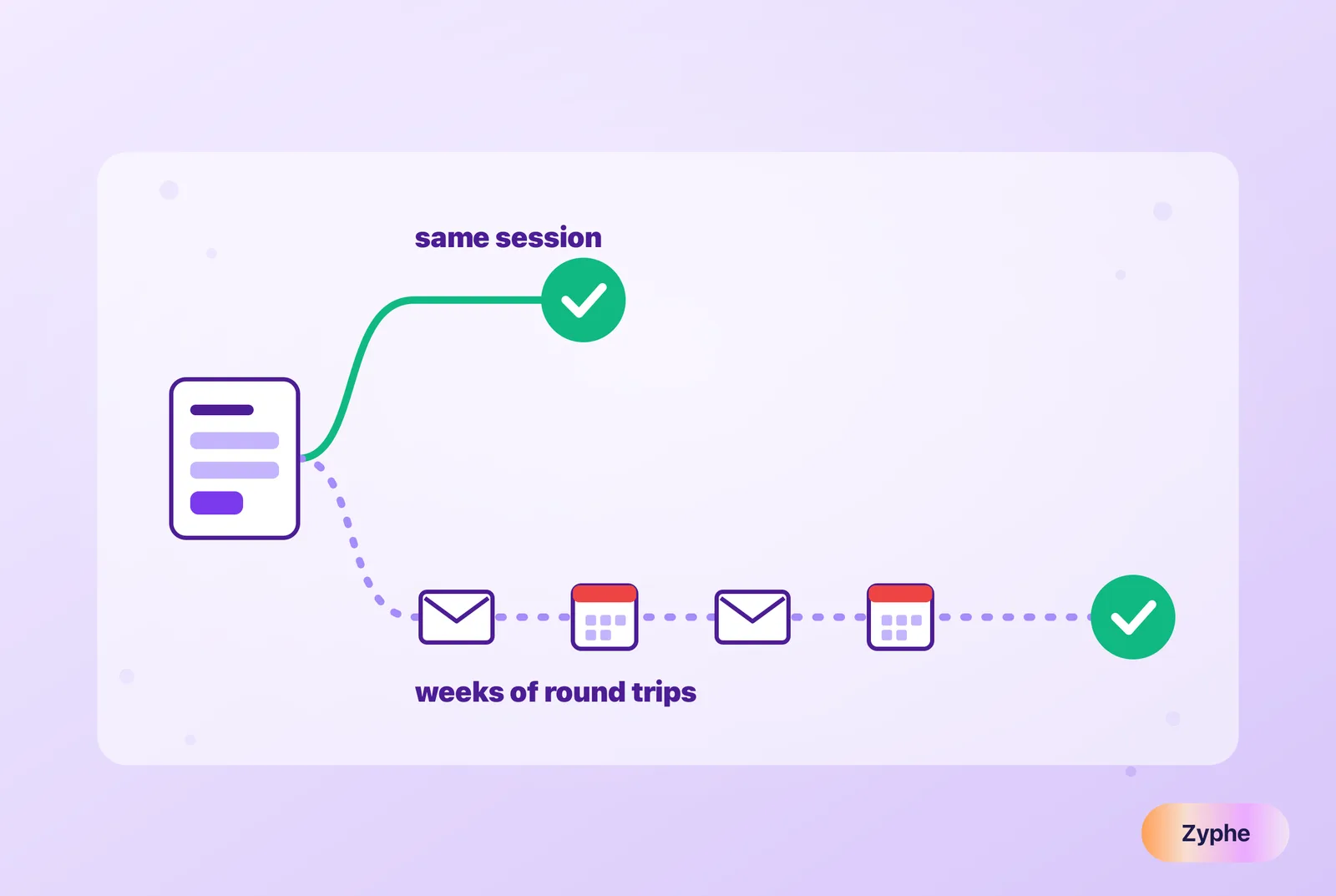
- When a business submits its company information, there are two kinds of answer: a fast one that arrives later, and an instant one that arrives while the applicant is still on the page.
- The gap between them is not a few hours. Once the applicant leaves the session, every missing item becomes an email, a wait and a re-review, and a typical case needs several of those loops.
- That is why a "24-hour review" so often ends up as two or three weeks to a decision, while instant KYB settles the same case in one sitting.
- Instant KYB needs five things to happen live: the registry pull, the ownership chain, owner verification, screening and the decision, with any gap asked for on the same screen.
- Complex or high-risk structures still go to a person. Even then, the instant part tells the applicant everything that is missing in one request, instead of one item at a time.
Instant KYB is Know Your Business verification that returns a decision, or one complete list of what is missing, while the applicant is still in the onboarding session: the company is matched to its registry, its ownership is traced to the beneficial owners, those people are verified and screened, and the result is shown on the same screen.
TL;DR
Fast KYB means your team reviews a submission and replies quickly. Instant KYB means the system decides while the applicant is still there. The difference matters because the applicant is the only person who can fill the gaps a review finds, and once they have left, each gap costs a round trip of days. Several round trips, plus owners who verify late, turn a fast reply into weeks. Instant KYB removes the round trips by doing the registry lookup, ownership tracing, owner verification and screening in the session, and by asking for anything missing right there. Keep human review for the cases that need it, but tell those applicants everything you need at once.
What is the difference between fast and instant KYB?
Picture the moment a business submits its company name and registration number on your form. From there, KYB can go one of two ways.
On the fast path, the submission goes into a queue. An analyst picks it up within a day, pulls the registry extract, works out the ownership, notices what is missing and emails the applicant. The reply is quick by the standards of KYB verification: hours, not weeks. But it is a reply, not a decision, and it reaches someone who has already closed the tab.
On the instant path, the checks run while the applicant waits. The registry record comes back in seconds, the ownership chain is traced to the ultimate beneficial owners, the person filling in the form verifies their own identity on the spot, the other owners receive their links in the same minute, and screening runs on everyone. If something is missing, the form asks for it there and then. The applicant leaves with a decision, or with a short, complete list of what is still needed.
Both paths run the same checks against the same KYB requirements. The difference is when the applicant hears about the gaps: while they are still there, or after they have gone.
Why does a fast reply turn into weeks?
Because almost every business case has gaps, and on the fast path each gap costs a full loop: the analyst writes, the applicant reads the email when they get to it, finds the document, uploads it, and the case goes back into the queue for the next review. Even with a quick team, one loop is rarely less than two or three working days.
Then the loops add up. A real case often needs three or four of them:
- The ownership is unclear, so the analyst asks for a shareholder register or an ownership chart.
- The chart shows a holding company, so the analyst asks about who owns that.
- A beneficial owner has to verify their identity, and the link goes to someone who was never part of the conversation.
- Screening flags a name match that needs a date of birth to clear.
Each loop starts only after the last one ends, because the analyst cannot see the next gap until the previous answer arrives. Four loops of three days is close to three weeks, and that is before anyone goes on holiday. This is how a team with a 24-hour reply target still takes weeks to onboard a business. We go through the full list of delay causes in our guide to KYB onboarding.
There is a second cost. The applicant's intent fades between loops. On day one they were signing up; by day ten they are answering an email from a provider they have not started using, while a competitor that answered instantly is already live. Some never reply at all, and those cases do not show up as rejections. They show up as silence.
What does the same case look like on both paths?
Take an illustrative case: a private company owned 60 percent by a holding company, which is owned by two people, plus one director who owns nothing directly. These are the steps on each path.
| Step | Fast path (24-hour review) | Instant KYB |
|---|---|---|
| Company details submitted | Queued for review | Registry record pulled in seconds |
| Company confirmed | Day 1, analyst pulls the extract | Same minute, shown on screen for the applicant to confirm |
| Ownership traced | Day 1, request sent for an ownership chart | Same minute, traced through the holding company automatically |
| Holding company owners identified | Day 4, after the chart arrives | Same minute |
| Owners and director verify | Links sent day 4, last one completes around day 9 | Applicant verifies in the session, other links sent in the same minute |
| Screening alert cleared | Day 10, date of birth requested by email | Cleared in the session using data from the verification |
| Decision | Around day 12 to 15 | Same session, or as soon as the last owner verifies |
The illustration assumes no holidays, no lost emails and an applicant who replies within a day each time. Each assumption that fails adds days to the fast path. It adds nothing to the instant path, because nothing on it waits for an email.
The one step that can still wait on instant KYB is an owner who is not present. Even there, the difference is that their link goes out at minute one rather than day four, and the case is otherwise complete.
What has to happen live for instant KYB to work?
Five things have to happen inside the session. If any one of them sits in a queue, the case falls back to the fast path.
- A live registry pull. The company record has to come from the official registry at the moment of the check, not from a document the applicant uploads later. Many registries offer programmatic access for this, such as the UK Companies House API, and the GLEIF API adds parent relationships for entities that hold a Legal Entity Identifier.
- Automatic ownership tracing. Ownership has to be resolved through each holding company to the natural persons behind it without asking the applicant for a chart. This is the step most flows leave to a person; see our guide to UBO mapping.
- In-session identity verification. The person filling in the form verifies on the spot, and every other owner and required control person is invited in the same minute, in parallel.
- Screening that clears its own noise. Sanctions, PEP and adverse-media checks have to use the verified date of birth and nationality to clear false matches automatically, so only real alerts wait for an analyst. See reducing sanctions screening false positives.
- A decision rule. Low-risk, fully verified cases need to be approved by policy, with an audit trail, instead of waiting for someone to click approve.
And one rule ties them together: anything missing is asked for on the same screen, all at once. A gap found in the session costs seconds. The same gap found the next morning costs days.
Which cases cannot be instant?
Some cases should get a person's attention, and instant KYB is not a reason to skip it. Nominee shareholders, trusts or foundations in the chain, bearer shares, holding companies in jurisdictions with little public data, real sanctions or adverse-media hits, and businesses in sectors your risk assessment rates as high risk all need enhanced due diligence and a decision by an analyst.
The rules expect this. FATF's standards ask firms to understand who ultimately owns and controls a business customer, to understand the purpose of the relationship, to keep monitoring it, and to apply measures in proportion to risk. Countries turn that into law for the firms they regulate, such as the US customer due diligence rule within a bank's wider anti-money laundering programme and, in the EU from July 2027, the Anti-Money Laundering Regulation. What applies to you depends on your jurisdiction, your licence and your risk assessment. None of these texts sets a processing speed, slow or fast; what they share is the expectation of more scrutiny where the risk is higher.
Even for these cases, the instant part still pays off. By the time the case reaches an analyst, the registry record, the ownership chain, the owner verifications and the screening results are already there, and the applicant has already been asked for everything the system could see was missing, in one request. The analyst starts from a complete file instead of a company name.
Is a 24-hour review not fast enough?
It is a fair objection. A 24-hour reply is better than most of the market, and some teams argue that business customers expect a review and do not mind a short wait.
The trouble is that the 24 hours measures the wrong thing. It measures how quickly your team replies, not how long the customer waits for a decision. Because each reply usually opens another loop, the decision time is the reply time multiplied by the number of loops, plus the time the applicant takes to answer each one. A team can hit its reply target on every case and still take weeks to onboard. Instant KYB changes the number that matters, the number of loops, by bringing it close to zero for routine cases.
There is also a practical point. A business that is told "approved" in the session can start using your product that day. A business told "we will review and get back to you" goes back to its day, and some of them go to the provider that answered instantly.
How do you measure whether your KYB is instant?
Two numbers tell you more than average onboarding time:
- The share of business applicants who get a decision, or a complete request, in the same session. This is your instant KYB rate.
- The number of out-of-session loops per case: every email or message that asks the applicant for something after they have left. On a good flow, routine cases have none and complex ones have one.
Add the time from submission to the last owner's verification, since that is the wait instant KYB cannot remove on its own, and the number of applicants who started and never finished. Our playbook for reducing KYC onboarding drop-off covers the same idea for individuals.
How does Zyphe deliver instant KYB?
Zyphe pulls the authoritative company record from 240+ corporate registries at the moment of the check, so the applicant confirms their company details instead of uploading them. Ownership is traced through each holding company to the natural persons behind it, in the same session, and the applicant verifies their own identity on the spot while every other owner and required control person gets their link at once.
Screening against sanctions, PEP and adverse-media data uses the verified details to clear false matches, low-risk cases are approved by your rules with an exportable audit trail, and complex or higher-risk structures go to your analysts with the file already assembled. The verified records sit in no central store of customer PII, and integration is a single API. See KYB software for the details, or book a demo to watch a company go from form to decision in one session.
The bottom line
The difference between fast and instant KYB is not speed in the usual sense. It is whether the applicant is still there when you find the gaps. Find them in the session and they cost seconds; find them the next day and each one costs a round trip, and the round trips add up to weeks. Move the registry pull, ownership tracing, owner verification and screening into the session, ask for anything missing all at once, and keep your analysts for the cases that deserve them. If your business onboarding still runs on review queues, book a demo to see a company verified in one sitting.
This article is general information, not legal advice.
Related resources
- KYB onboarding: why it stalls and how to speed it up
- KYB verification: how it works
- KYB requirements: the compliance checklist
- UBO mapping with AI
- What is KYB?
- KYB software
Cited sources
- FATF, The FATF Recommendations: https://www.fatf-gafi.org/en/publications/Fatfrecommendations/Fatf-recommendations.html
- eCFR, 31 CFR 1010.230, beneficial ownership requirements for legal entity customers: https://www.ecfr.gov/current/title-31/subtitle-B/chapter-X/part-1010/subpart-B/section-1010.230
- EUR-Lex, Regulation (EU) 2024/1624 (Anti-Money Laundering Regulation): https://eur-lex.europa.eu/eli/reg/2024/1624/oj
- Companies House, developer hub for the Companies House API: https://developer.company-information.service.gov.uk/
- GLEIF, the GLEIF API: https://www.gleif.org/en/lei-data/gleif-api
 Michelangelo Frigo (Co-Founder at Zyphe) Michelangelo Frigo is a privacy and identity infrastructure expert and co-founder of Zyphe.